The Suspension of Judgment: Crisis Management for Skeptics
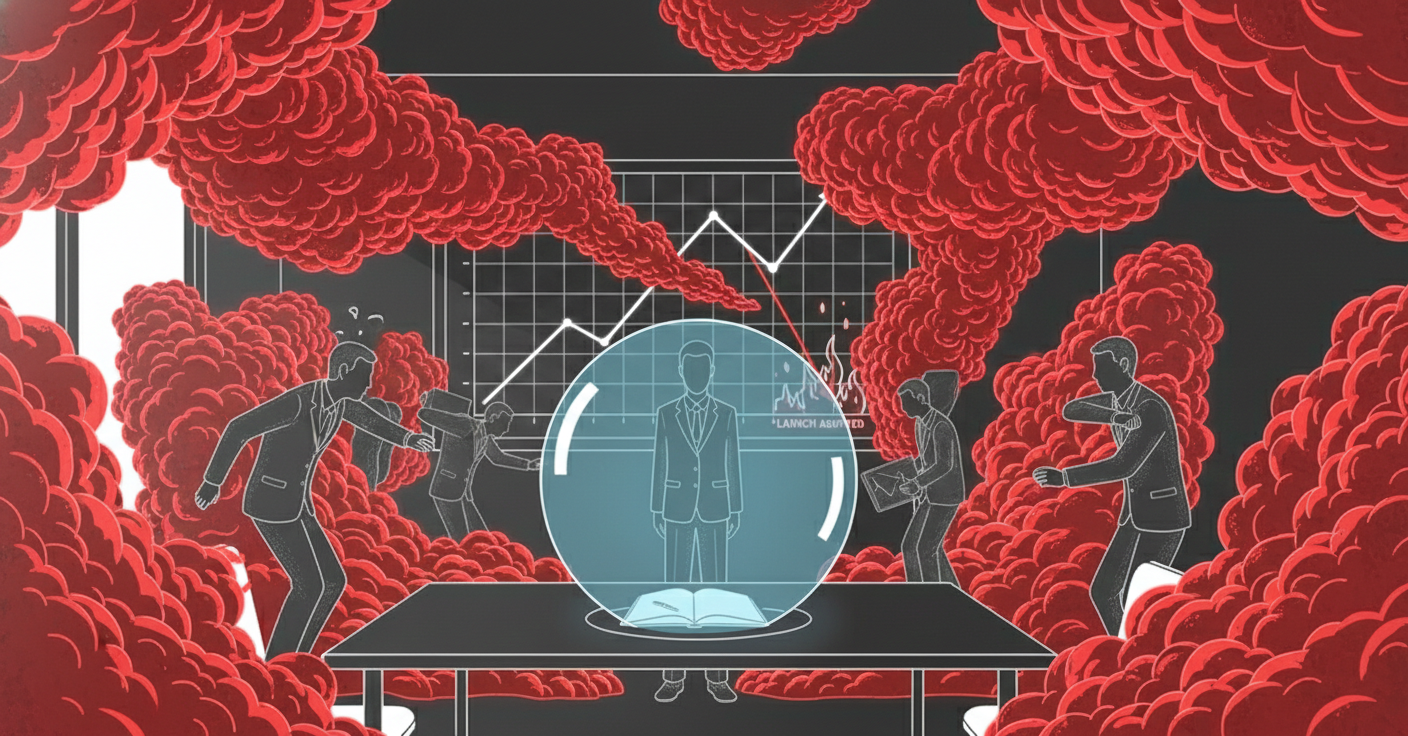
The Fog of War and the urge to "Do Something"
It is 2:00 AM on a Sunday. Your Chief Information Security Officer (CISO) calls you. "We have a problem. The servers are encrypting themselves. It looks like ransomware." Your pulse spikes. Cortisol floods your system. You log into Slack and see the panic unfolding in real-time. The General Counsel is asking about liability. The PR team is drafting a statement. The Engineers are shouting about shutting down the network. The pressure to act is overwhelming. Every instinct in your body, honed by millions of years of evolution, screams: “Don’t just stand there, do something!”
In corporate leadership, we are trained to value decisiveness above all else. We idolize the leader who, amidst chaos, points a finger and says, "Go that way." We equate speed with competence and hesitation with weakness. But history (and philosophy) teaches us that in the first hours of a crisis, the instinct to "do something" is often the most dangerous threat to the organization. The first casualty of war is truth; the second casualty is usually the career of the executive who guessed wrong.
This brings us to Sextus Empiricus, the Roman physician and philosopher who followed the Pyrrhonian legacy of Skepticism. Sextus was not a naysayer. He was a doctor who observed that his colleagues often killed their patients because they were "Dogmatists." They would see a fever (symptom), assume it was caused by "excess blood" (theory), and immediately start bleeding the patient (action). If the theory was wrong, the action was fatal. Sextus proposed a radical alternative: The Suspension of Judgment (Epoché). He argued that the wise practitioner must resist the urge to conclude. They must hold conflicting possibilities in their mind without choosing one, until the evidence makes the choice obvious.
In modern crisis management, this is not just philosophy; it is the difference between a minor incident and a catastrophe. The most effective leaders are not the ones who know the answer immediately. They are the ones who can tolerate the terror of not knowing the answer for long enough to find the truth.
The Neurology of Panic: Why We Rush to Judgment
To understand why the Suspension of Judgment is so difficult, we must look at the human brain. The brain is a prediction machine. It abhors ambiguity. Uncertainty registers in the brain similarly to physical pain. When we are faced with a gap in information, "Why is the server down?", our brain desperately wants to close that gap. This is called Cognitive Closure. Under stress, our need for closure skyrockets. We grasp at the first plausible narrative that floats by.
- Narrative A: "It’s a Russian cyberattack!" (High drama, fits the news cycle).
- Narrative B: "It’s a bad code deploy." (Boring, embarrassing).
If the CEO shouts, "We are under attack!" the entire organization pivots to defend against an external enemy. They shut down ports. They call the FBI. They leak to the press. If, four hours later, it turns out to be a junior developer who pushed a bad config file, the damage is already done. You have traumatized your customers, embarrassed your brand, and wasted critical hours fighting a phantom. You fell into the trap of Dogmatism: asserting a truth without sufficient proof.
The Strategy of Isostheneia (Equivalence)
Sextus Empiricus offers a specific tool to fight this biological urge. He calls it Isostheneia (Equivalence of Strength). The method is simple but excruciating to practice. When you are presented with a Dogmatic claim ("It is ransomware"), you must immediately construct an opposing argument of Equal Strength. You must force your mind to treat the opposing theories as equally valid until proven otherwise.
In a "War Room" scenario, Isostheneia looks like this: The Incident Commander says, "All signs point to an external hack." The Chief Wise Officer (playing the Skeptic) intervenes: "That is a strong possibility. However, we must place an argument of equal strength on the table: Internal Error. Until we find the specific payload, we will treat 'Hack' and 'Glitch' as Isosthenic, equal in weight."
This does two things:
- It preserves resources: It prevents the team from tunneling 100% of their effort into a single (possibly wrong) rabbit hole.
- It lowers emotional temperature: By treating the theories as "hypotheses" rather than "facts," you detach the team’s ego from the outcome.
The goal of Isostheneia is not to stay undecided forever. That would be paralysis. The goal is to stay undecided just long enough to avoid the fatal error. It is a strategic pause. It is the discipline of keeping the file open when every bone in your body wants to close it.
The "Anti-Huddle": Structuring Doubt
How do you operationalize this? Most crisis teams use a "Huddle" structure where everyone gets in a room and brainstorms until a consensus forms. The problem with consensus is that it is often just Groupthink disguised as agreement. If the loudest person in the room thinks it's X, everyone else drifts toward X.
To practice Skeptical Crisis Management, you must restructure the room. 1. Assign the "Red Team" (The Counter-Dogmatists) Do not wait for someone to disagree. Assign someone to disagree. "Sarah, for the next hour, your only job is to prove that this is not a cyberattack. You are the lawyer for the 'Glitch' theory. finding evidence that contradicts the 'Hack' theory." By assigning the role, you remove the social stigma of being the "naysayer." Sarah isn't being difficult; she is doing her job.
2. The Leader Speaks Last (The Hippocratic Rule) In medicine, the senior doctor speaks last so they don't bias the residents. In a crisis, if the CEO says, "I think we need to shut down the platform," the debate is over. No VP wants to argue with a terrified CEO. The Skeptical Leader stays silent. They collect the inputs. They watch the Isostheneia play out. They ask questions ("What evidence would disprove that?"), but they do not offer a hypothesis. This silence creates a vacuum that draws out the truth from the experts.
The Art of "Aphasia" (Non-Assertion)
Sextus Empiricus used another term: Aphasia. In modern medicine, aphasia is a condition where you cannot speak. In Ancient Skepticism, Aphasia was a virtue. It meant "Non-Assertion." It was the refusal to say "This is definitely true." Instead, the Skeptic says: "It appears to be X at this moment."
This is crucial for External Communication. The biggest mistake companies make in a crisis is issuing a definitive statement too early.
- Day 1 Statement: "We were not hacked. Customer data is safe." (Dogmatism).
- Day 3 Statement: "Actually, we were hacked, but only emails."
- Day 10 Statement: "Social Security Numbers were stolen. We are sorry."
This drip-feed of contradictions destroys trust. It proves that the leadership was guessing. The Skeptical approach is to embrace Aphasia.
- Skeptical Statement: "We are investigating an anomaly. We are holding multiple hypotheses. We will not confirm the cause until we have forensic certainty. Here is what we are doing to protect you now..."
This sounds less confident than "We are safe," but it is antifragile. If it turns out to be bad, you didn't lie. If it turns out to be nothing, you didn't panic. You maintained your credibility by refusing to pretend you had knowledge you didn't possess.
The Transition to Action: The "Jeff Bezos" Razor
Skeptics are often accused of being paralyzed. "If you suspend judgment forever, you die." This is a misunderstanding. Sextus was a doctor. He didn't just stare at sick patients; he treated them. But he treated the symptoms (which were visible) rather than the hidden causes (which were theoretical).
In a corporate crisis, you can act without judging. Jeff Bezos famously distinguished between Type 1 Decisions (Irreversible) and Type 2 Decisions (Reversible). The Skeptic applies Epoché (Suspension) differently to each.
- Type 2 (Reversible): "Should we reboot the server?"
- Skeptic: "We don't know the root cause, but rebooting is low risk and might fix the symptom. Do it." (Action based on utility, not truth).
- Type 1 (Irreversible): "Should we wipe the database and restore from backup?"
- Skeptic: "Stop. This destroys the forensic evidence. We cannot undo this. We apply Isostheneia here. We do not act until the opposing argument is dead."
The Wise Officer moves fast on the Reversible, and incredibly slow on the Irreversible. They treat the symptoms immediately (communicate with customers, put up a maintenance page) while suspending judgment on the cure until the diagnosis is certain.
Conclusion: Ataraxia (Tranquility)
Why did Sextus Empiricus do all this? He wasn't trying to save the Roman Empire. He was trying to achieve Ataraxia, mental tranquility. He noticed that the Dogmatists were miserable. They were constantly anxious because they had staked their reputation on theories they couldn't prove. When reality contradicted them, they suffered. The Skeptic, by promising nothing and investigating everything, remained calm.
In the boardroom, panic is contagious. But so is calm. When the leader refuses to rush to judgment, when they say, "I don't know yet, and that is okay, let's look at the evidence," it lowers the heart rate of the entire team. It changes the culture from one of Blame Avoidance (where everyone guesses to cover their ass) to one of Truth Seeking.
The next time the phone rings at 2:00 AM, remember the Doctor of Doubt. Do not rush to be the hero who knows the answer. Be the Skeptic who holds the space open for the answer to reveal itself. Suspend judgment. Weigh the arguments. And wait for the fog to lift.
No spam, no sharing to third party. Only you and me.

Member discussion