
The Monolith Defense: A C-Level Guide to Architectural Economics

In the boardroom, the transition from Monolith to Microservices is often sold as a "modernization" project. The narrative is seductive: "If we break our application into small pieces, we will move faster, scale infinitely, and hire easier."
This is rarely true.
For the CIO and CFO, the shift to Microservices is not just a technical refactor; it is a fundamental shift in the organization’s risk profile and cost structure.
We often look at the architecture of Netflix or Uber and attempt to mimic it. This is a survivor bias error. Those companies adopted microservices to solve organization-scale problems (thousands of engineers), not product-scale problems.
Here is the "Red Team" analysis of the Monolith, breaking down the decision across Financial, Organizational, and Technical dimensions.
1. The Financial Dimension: The "Microservice Tax"
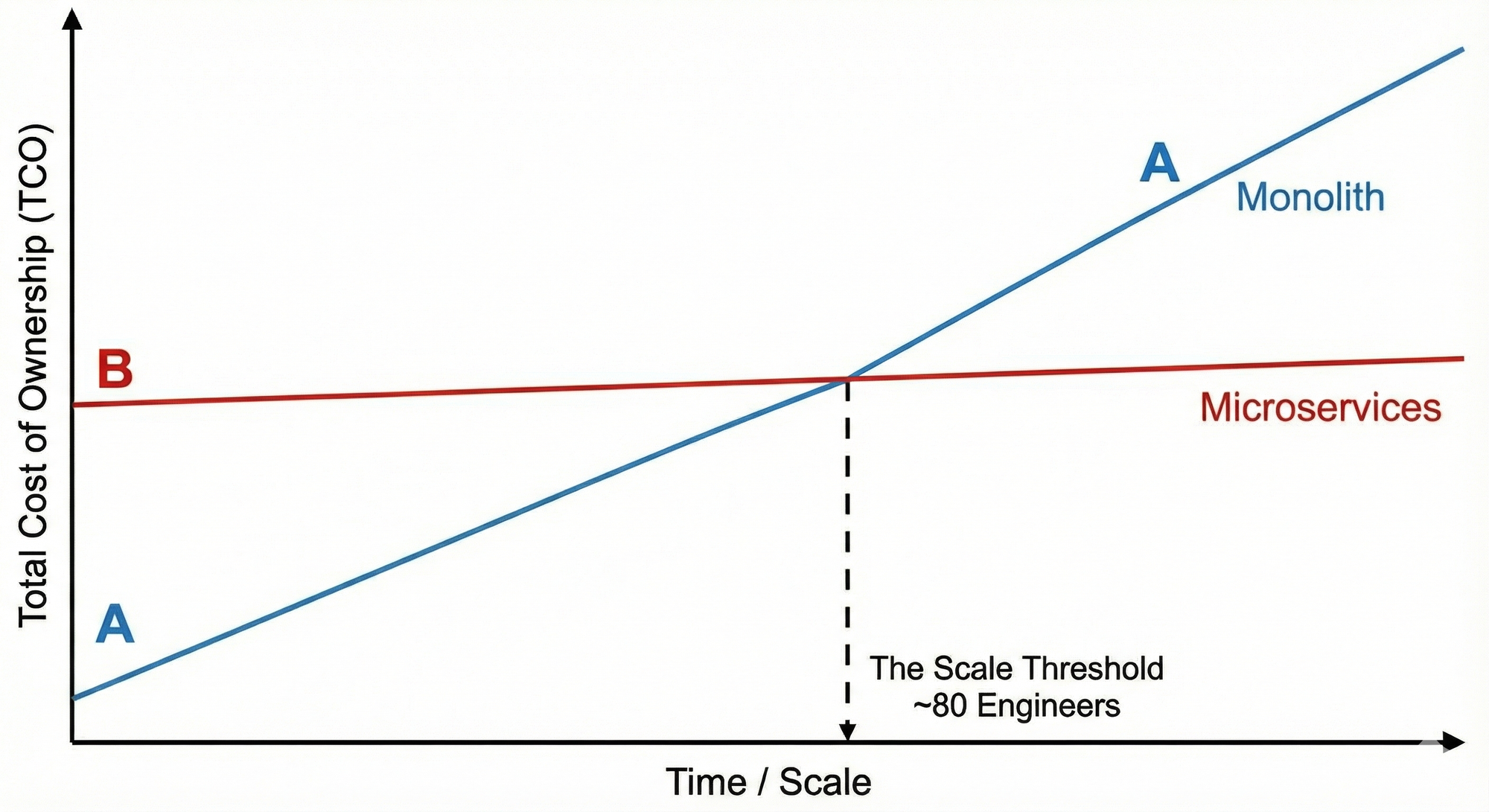
The most common misconception is that Microservices reduce cloud costs via granular scaling. While technically true (you only scale what you need), the Total Cost of Ownership (TCO) usually inverts due to hidden complexity.
The OPEX Shift: From Developers to DevOps
In a Monolithic architecture, the infrastructure is simple. You have a Load Balancer, an Application Server, and a Database.
In a Microservices architecture, you introduce a massive "Glial Layer" of infrastructure to connect the services: Service Meshes (Istio), Container Orchestration (Kubernetes), Distributed Tracing, and API Gateways.
The Financial Reality: You are trading potentially inefficient Compute Spend (cheap) for highly efficient Engineering Salaries (expensive).
Table 1: The Hidden P&L Impact
| Cost Center | Monolith Economics | Microservice Economics | The CFO Takeaway |
| Infrastructure | High Resource Waste (Over-provisioning) | High Granularity (Precise Scaling) | Microservices save ~20% on AWS bills. |
| Headcount | Full-Stack Developers | Needs dedicated Platform/DevOps Team | Microservices require hiring expensive specialists ($200k+). |
| Complexity | Low (Single Repo) | High (Distributed Systems) | Microservices increase "Onboarding Time" by ~40%. |
| Failures | Binary (Up or Down) | Partial (Degraded Performance) | Debugging distributed failures costs expensive senior hours. |
The Verdict: unless your cloud bill exceeds $50,000/month, the salary cost of the DevOps team required to run microservices will dwarf your infrastructure savings.
2. The Organizational Dimension: Conway’s Law is Non-Negotiable
For the VP of People or COO, architecture is actually an organizational design problem. This is defined by Conway’s Law:
"Organizations which design systems are constrained to produce designs which are copies of the communication structures of these organizations."
The Topology Mismatch
- The Monolith Organization: If you have a centralized QA team, a centralized Ops team, and functional hierarchies, you must build a Monolith. If you try to build microservices with a centralized structure, you will create a bureaucratic nightmare where every deployment requires approval from three different departments.
- The Microservice Organization: Microservices require "Two-Pizza Teams" (Amazon model). Each team must contain a Developer, a QA, and an Ops person. They must have total autonomy to deploy without asking permission.
The Risk: If you adopt Microservices but refuse to decentralize your management structure, you will simply build a "Distributed Monolith." This is the worst of both worlds: the complexity of distributed systems with the rigidity of centralized management.
3. The Technical Dimension: The Data Consistency Nightmare
For the CTO and CAIO, the hardest truth to swallow is the loss of ACID (Atomicity, Consistency, Isolation, Durability).
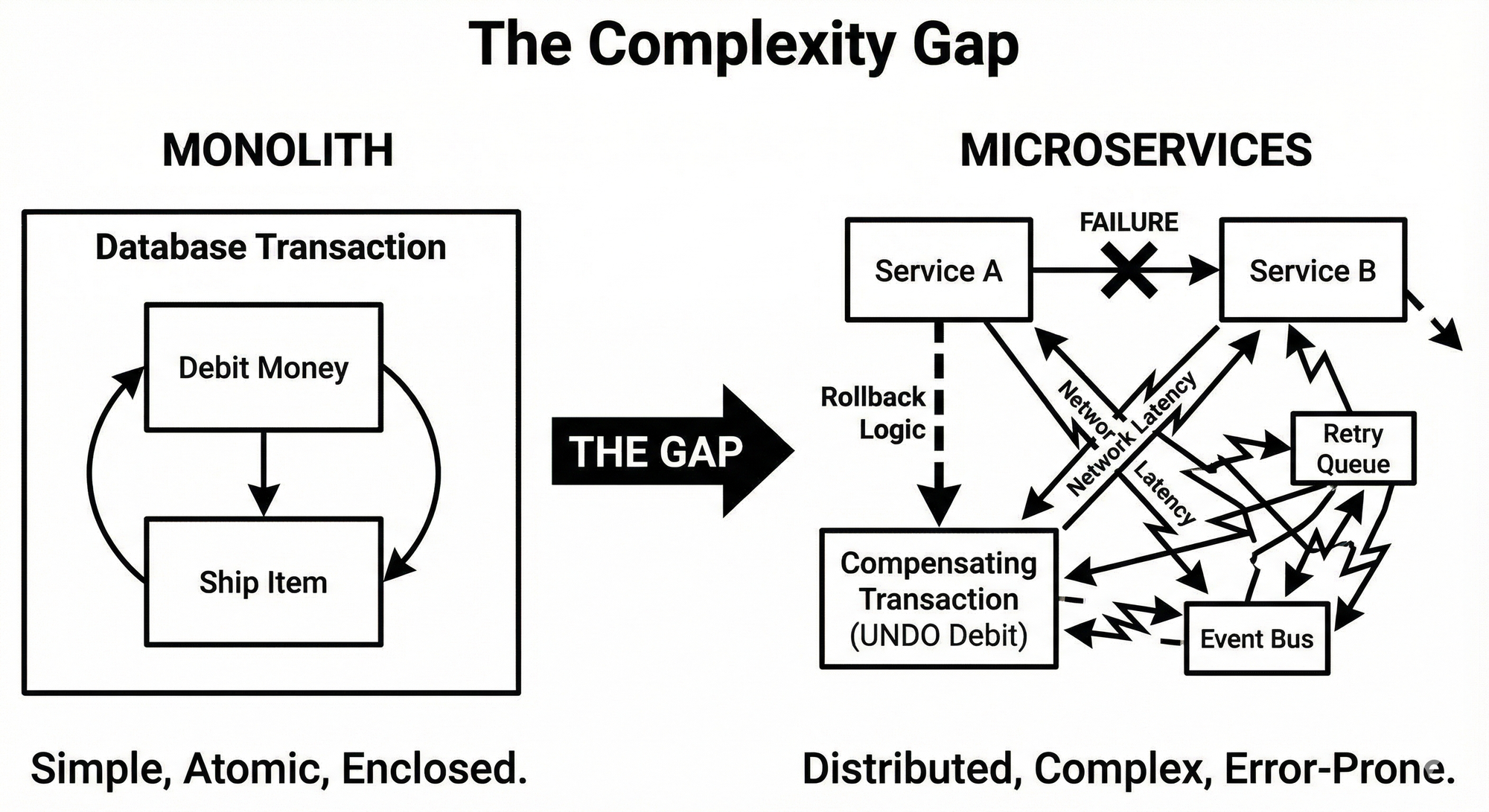
In a Monolith, data integrity is guaranteed by the database. If a user buys a product, the inventory is deducted and the payment is recorded in a single, atomic transaction. It either all happens, or none of it happens.
In Microservices, the "Order Service" and "Inventory Service" are different databases. You cannot use a single transaction. You enter the world of Eventual Consistency.
The "Base" Trade-off
- Monolith: ACID (Strong Consistency). The data is always correct.
- Microservices: BASE (Basically Available, Soft state, Eventual consistency). The data will be correct... eventually.
The Business Implication:
Are you comfortable with a scenario where a user places an order, gets a confirmation, but 2 seconds later the system realizes the item is out of stock because the "Inventory Service" lagged behind?
Handling these failures requires complex patterns like Sagas and Distributed Transactions, which increase code complexity by an order of magnitude.
4. The Strategic Solution: The "Citadel" Architecture
We do not have to choose between the "Big Ball of Mud" (Chaos) and "Microservice Complexity" (Overhead). The strategic middle ground is the Citadel Pattern (often called the Modular Monolith).
The Architecture Strategy
- The Citadel (Core Monolith): Keep 90% of your business logic (User Management, Billing, Core Product) in a single, unified codebase. This maximizes developer velocity and data consistency.
- The Outposts (Satellite Services): Extract only the components that have specific physical requirements.
- Do you have an AI module needing GPUs? Make it a microservice (Python).
- Do you have a high-frequency trading module? Make it a microservice (Rust).
- Do you have a legacy integration? Isolate it.
This approach gives you the velocity of a monolith with the scalability of microservices where it actually matters.
Visual Diagram: The Citadel Pattern
Diagram Description: A schematic diagram.
Center: A large fortress icon labeled "The Citadel (Monolith)". It contains "Core Business Logic", "Auth", and "Billing".
Perimeter: Connected to the Citadel by single bridges are distinct towers labeled "AI Service (GPU)", "Reporting Service (High Memory)", and "3rd Party Webhooks".
Takeaway: Complexity is isolated to the edges; the core remains simple.
Summary & The Decision Matrix
When should the Board approve a rewrite to Microservices? Use this decision matrix.
- Team Size: Do you have >80 engineers?
- No: Stick to Monolith.
- Yes: Consider Microservices to reduce merge conflicts.
- Scalability: Do you have a specific component taking down the whole system?
- No: Stick to Monolith.
- Yes: Extract only that component (Citadel Pattern).
- Organization: Are you ready to give teams full autonomy (Dev+Ops combined)?
- No: Stick to Monolith. Microservices require organizational decentralization.
The Executive Bottom Line:
Complexity is the enemy of execution. In the early to mid-stages of a company, the goal is Velocity (Time to Market), not Scalability (Time to 100M users). The Monolith optimizes for Velocity. Do not optimize for problems you do not yet have.
No spam, no sharing to third party. Only you and me.





Member discussion