The Digital Twin of the Org: Simulating the Re-org Before You Fire
Note: We test code before we deploy it. We test cars before we sell them. But when it comes to the most complex system of all, the Company Organization, we usually just "Guess and Deploy." The "Re-org" is often a traumatic event based on a PowerPoint slide. In 2026, the rise of Digital Twins of the Organization (DTO) allows us to act like true Homo Faber: We can simulate the chaos in a sandbox before we inflict it on real people.
The "Re-org" is the corporate equivalent of open-heart surgery performed with a dull spoon. A new VP arrives. They look at the Org Chart (which is just a drawing, not reality) and say: "Let's move Sales under Marketing and split Engineering into squads." On Monday, the email goes out. On Tuesday, chaos ensues. Dependencies break. Informal networks are severed. The Élan Vital (momentum) of the company creates a massive antibody response. The patient (the company) goes into shock.
Why do we do this? Because until now, we confused the Map (The Org Chart) with the Territory (The actual flow of work).
What is a Digital Twin of the Organization (DTO)?
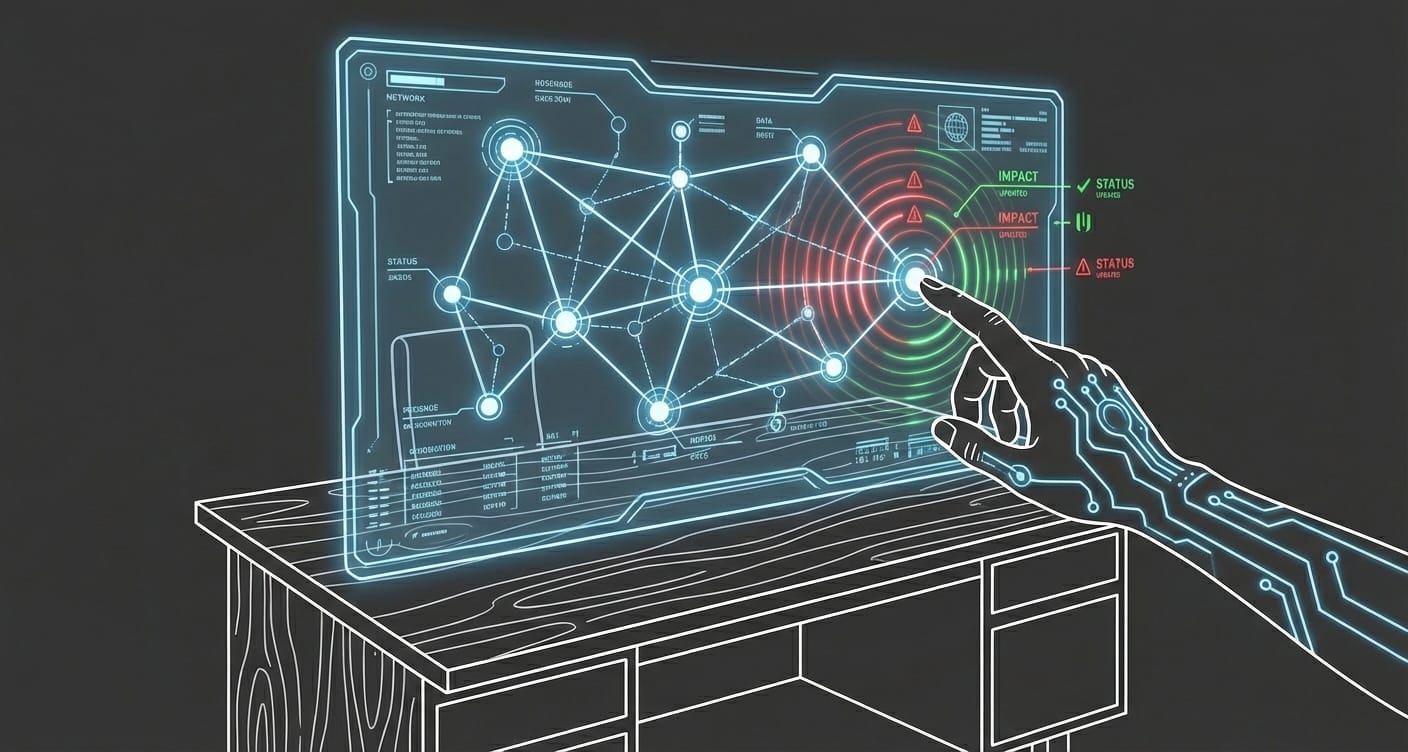
A Digital Twin is a dynamic, virtual replica of a physical system. NASA uses them to simulate spacecraft. GE uses them to simulate jet engines. A DTO applies this to the company. It doesn't just map "Who reports to whom" (The Org Chart). It maps "How the work actually flows." It ingests data from:
- ERP/HRIS: Roles and costs.
- Jira/GitHub: How tickets move and where they get stuck.
- Slack/Email (Metadata): Who is actually talking to whom (The "Informal Network").
- Process Mining: The digital footprints of every transaction.
The Philosophy: Homo Faber in the Sandbox
Henri Bergson taught us that the human intellect (Homo Faber) is designed to manipulate solids. We move boxes around. The problem is that a company is a Liquid (Duration/Flow). A DTO allows Homo Faber to treat the company as if it were a solid model, without hurting the liquid reality. It is a Safety Sandbox.
Instead of guessing, you can run a simulation:
- Input: "What if we reduce the QA team by 20% and automate the testing?"
- Simulation: The DTO runs the historical data through this new constraint.
- Output: "WARNING: This creates a bottleneck in Q3 that delays the flagship launch by 4 weeks. Revenue impact: -$2M."
Three Use Cases for the Chief Wise Officer
1. The "Blast Radius" Analysis
Before you announce a change, you simulate its Blast Radius. Often, we think a change is local ("I'm just merging these two teams"). But the DTO reveals the hidden dependencies.
- Revelation: "You didn't know this, but Team A actually answers 40% of Team B's support tickets via Slack. If you separate them, Support collapses."
- The Wise Move: You see the invisible Conatus (survival struggle) of the teams and plan accordingly.
2. Finding the "Ghost Constraints"
Theory of Constraints (Goldratt) says every system has one bottleneck. In complex orgs, the bottleneck is often invisible. It might be "Kevin in Finance." A DTO highlights where the flow stops. It shows a pile-up of digital debris around specific nodes.
- Revelation: The bottleneck isn't "Engineering Speed"; it's "Kevin's Approval Queue."
- The Wise Move: Don't hire more engineers. Buy Kevin a better contract management tool (or an assistant).
3. Stress-Testing Resilience (The Chaos Monkey)
You can run "What If" scenarios that no sane CEO would test in real life.
- Scenario: "What if our cloud costs double?"
- Scenario: "What if the entire Singapore office goes offline?"
- Scenario: "What if we grow 50% overnight?" The DTO reveals which parts of the org break first. It shows you where you are Fragile (Taleb).
The Warning: The Map is Not the Territory
A warning from the Chief Wise Officer: The DTO is not the Soul. It captures the Intellect (processes, data, logic). It cannot capture the Intuition (Trust, Morale, Élan Vital).
- The DTO might say: "Merging Team A and Team B is 20% more efficient."
- Reality might say: "Team A hates Team B. If you merge them, they will all quit."
Conclusion: Use the Digital Twin to test the Physics of your organization (Process/Logic). But use your Intuition to manage the Biology (Culture/Trust). The simulation prevents the surgical error, but only the leader can heal the patient.
No spam, no sharing to third party. Only you and me.
Member discussion