
Technical Debt is Financial Debt: Explaining Refactoring to the Board

Every engineering leader knows the pain of the "Refactoring" meeting.
You go to the CEO or the Board and say: "We need to pause feature development for two months to refactor the billing module. The code is messy."
The CEO hears: "We want to stop generating revenue so we can polish the doorknobs."
The CFO hears: "We want to increase OPEX with zero ROI."
The answer is almost always "No. Build the new feature first. Fix it later."
The problem isn't that the Board doesn't care about quality. The problem is a translation error. We talk about "Code Quality," "Linting," and "Patterns." They care about "Risk," "Asset Depreciation," and "Cash Flow."
To get the budget to fix your platform, you must stop calling it "Technical Debt." You must start treating it as an Off-Balance-Sheet Liability.
Here is the financial model for software entropy.
1. The Financial Model: Principal and Interest
In 1992, Ward Cunningham coined the metaphor "Technical Debt," but most people forget the second half of his definition. Debt isn't bad. Debt is a tool.
When you rush a feature to market to close a deal, you are taking out a Loan.
- The Principal: The time you saved by skipping tests, hard-coding values, or ignoring scalability. (e.g., You launched 2 weeks early).
- The Interest: The extra time it takes to build every future feature on top of that hack.
If you launch early (borrow Principal) and land a $1M client, that is Good Debt. It’s leverage.
The problem arises when you stop paying the Principal, but the Interest compounds. Eventually, the team spends 100% of their time servicing the interest (fixing bugs) and 0% of their time paying down principal (building value).
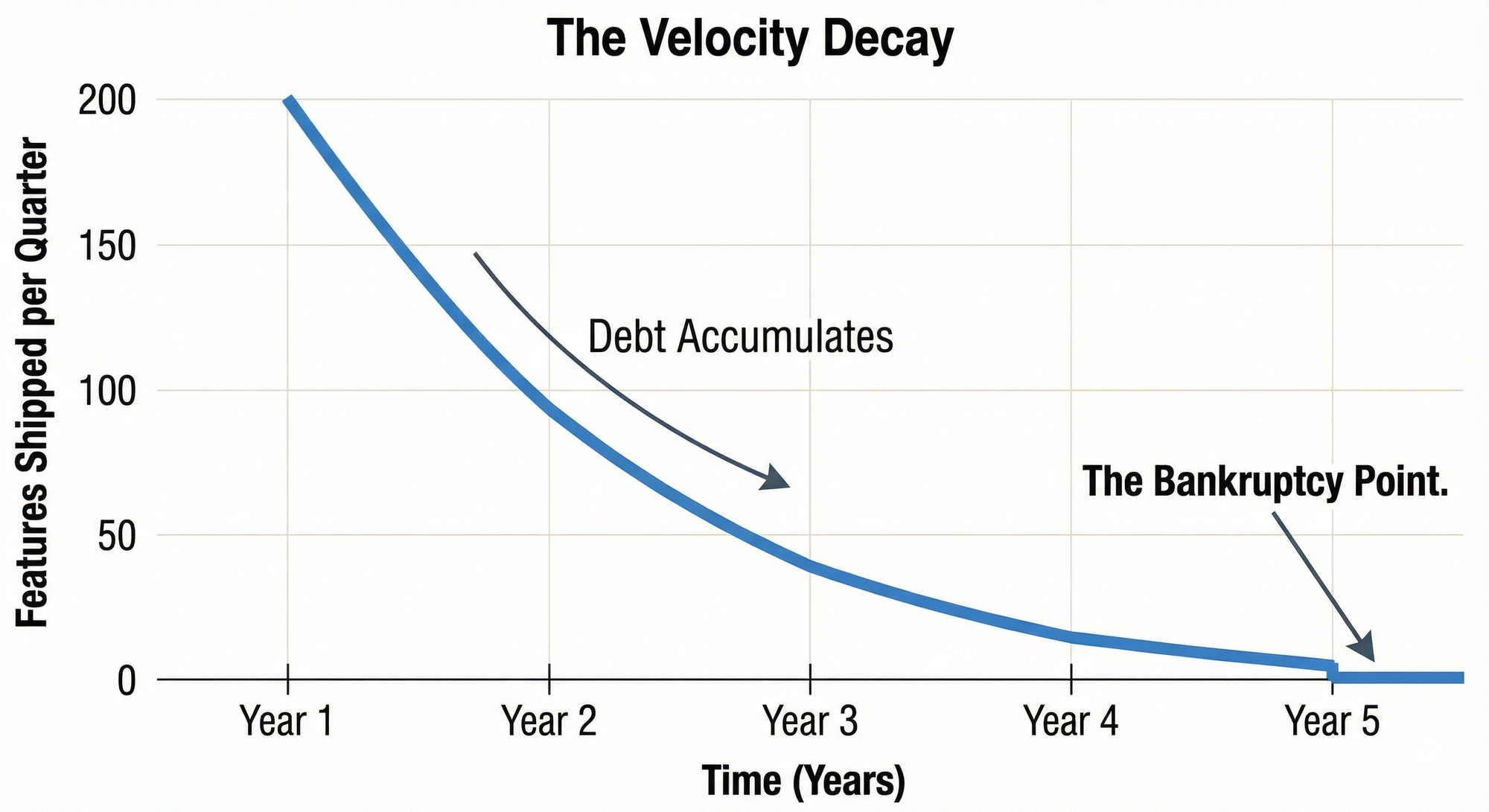
2. Technical Bankruptcy: The "Rewrite" Event
In finance, when you can no longer service your debt, you declare Chapter 11 bankruptcy.
In software, when you can no longer ship features because the code is too fragile, you declare The Rewrite.
The Rewrite is the most dangerous event in a tech company's life cycle.
- Revenue halts: You stop shipping new features to customers for 6–12 months.
- Competitors catch up: While you are rebuilding what you already had, competitors are building what you should have had.
- Morale collapses: Engineers hate rewrites (despite what they say). They are slogs with no visible progress.
The Executive Pitch: Refactoring is not "cleaning up." Refactoring is debt servicing to prevent bankruptcy.
3. The Four Types of Debt (Know Your Portfolio)
Not all debt is created equal. You need to explain to the Board which type of debt you are holding. We use Martin Fowler’s Quadrant to categorize our "Toxic Assets."
Table 1: The Debt Portfolio
| Type | Example | Financial Equivalent | Strategy |
| Prudent / Deliberate | "We hard-coded the admin panel to launch for Black Friday." | Bridge Loan. High interest, short term. Necessary for growth. | Pay it back immediately after the event. |
| Reckless / Deliberate | "We didn't write tests because we don't have time." | Predatory Payday Loan. Stupid, expensive, and avoidable. | Fire the manager who allowed this. |
| Prudent / Inadvertent | "We chose Monolith, but now we have 100 users and need Microservices." | Growth Pains. We outgrew our clothes. A sign of success. | Schedule a refactor as a "Scalability Project." |
| Reckless / Inadvertent | "The team didn't know how to use React correctly." | Competence Crisis. You hired the wrong people. | Train the team or replace them. |
4. The Solution: The "20% Tax" (The Hidden Line Item)
Don't ask for permission to refactor. A CFO will never approve a project titled "Code Cleanup."
Instead, you must embed debt repayment into your operational cost structure. This is the 20% Tax.
- The Rule: In every Sprint, 20% of the capacity is reserved for "Non-Functional Requirements" (Refactoring, Library Updates, Test Coverage).
- The Accounting: You do not itemize this. If a feature takes 4 days to build, you estimate 5 days. The 5th day is the tax.
Why hide it?
Because clean code is not a "feature." It is the definition of Professional Engineering.
When you hire a chef, they don't ask for permission to wash the dishes after dinner. They wash them because if they don't, the kitchen closes.
You are the Head Chef. Wash the dishes.
Summary: Changing the Vocabulary
If you want to survive as a technical leader in the boardroom, change your vocabulary today.
- Stop saying: "The code is messy."Start saying: "Our cost of change has increased by 40% due to legacy complexity."
- Stop saying: "We need to refactor."Start saying: "We need to pay down technical principal to reduce our time-to-market risks."
- Stop saying: "We need a rewrite."Start saying: "We are approaching technical bankruptcy; we need to restructure our assets."
The Board understands Money. Show them that Code = Money, and you will get your budget.
No spam, no sharing to third party. Only you and me.



Member discussion