
The Quantum Apocalypse (Y2Q)
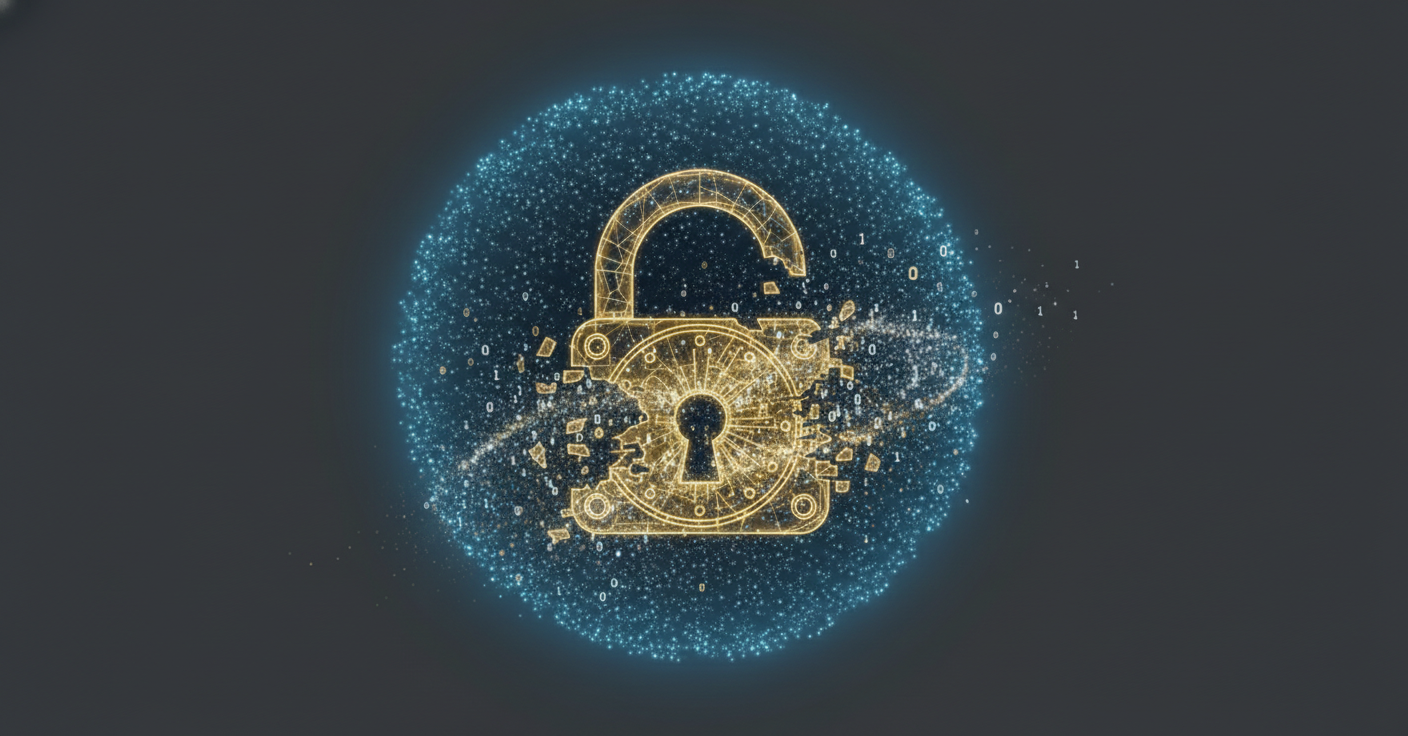
In the late 1990s, the world panic-spent $300 billion to fix the Y2K bug, a simple two-digit date formatting error that threatened to crash the global financial system. We are now staring down the barrel of Y2Q (Year 2 Quantum). But unlike Y2K, which had a fixed deadline (Jan 1, 2000), Y2Q has a floating deadline. It could be 2030. It could be 2035. It could be next Tuesday, if a state actor makes a classified breakthrough.
Y2Q is the moment a cryptographically relevant quantum computer (CRQC) comes online and breaks RSA-2048 encryption. That sounds technical. Here is what it means practically:
- Every password manager is unlocked.
- Every bank transaction is visible.
- Every encrypted state secret sent since the 1990s is readable.
- The padlock icon on your browser becomes decoration.
Most executives dismiss this as a "Future Problem." They say, "Quantum computers are unstable. We have 10 years." They are making a fatal strategic error. They are ignoring the HNDL Strategy: "Harvest Now, Decrypt Later."
The Invisible Threat: Harvest Now, Decrypt Later (HNDL)
You might think your data is safe today because quantum computers don't exist yet. But your adversaries (state actors, criminal syndicates) are not waiting. They are currently scraping encrypted traffic from the internet and storing it in massive data centers. They cannot read it today. They are simply holding it. They are waiting for "Q-Day." The moment they build or steal a quantum computer, they will feed this harvested data into it.
- The proprietary formula you emailed today? Compromised.
- The genomic data of your patients? Exposed.
- The long-term contract negotiations? Public.
If your data has a "shelf life" of more than 5 years (e.g., healthcare records, trade secrets, national security intel), it is already at risk. From a strategic perspective, the breach has effectively already happened; the realization of the loss is just delayed.
The Physics of the Collapse: Shor's Algorithm
Why does Quantum break encryption? Classical encryption (RSA) relies on the fact that factoring large prime numbers is incredibly hard. It would take a supercomputer millions of years to guess the factors of a 2048-bit key. In 1994, mathematician Peter Shor wrote an algorithm for a theoretical quantum computer. Shor's Algorithm turns the exponential difficulty of factoring into a polynomial triviality. A quantum computer doesn't check keys one by one. Using Superposition (the ability to be in multiple states at once), it can find the answer in hours, not millions of years. The wall that protects the digital economy isn't just getting lower; the laws of physics are removing the wall entirely.
The Migration Nightmare: Why You Must Start Now
If Y2Q happens in 2032, why worry in 2026? Because Crypto-Agility is a myth. Migrating an enterprise's cryptography stack takes massive amounts of time.
- Inventory: Do you even know where all your keys are? (Most CISOs don't).
- Hardcoded Secrets: How many IoT devices, legacy servers, and third-party APIs have RSA keys hardcoded into their firmware?
- Supply Chain: Even if you upgrade, is your cloud provider quantum-safe? Is your payroll vendor?
The migration to Post-Quantum Cryptography (PQC), new math algorithms like CRYSTALS-Kyber that are resistant to quantum attacks, will take the average Global 2000 company 5 to 7 years. If you start in 2030, you will be too late. You will be trying to patch the hull of the ship while it is already underwater.
The CWO Strategy: A "Quantum-Safe" Roadmap
The Chief Wise Officer does not panic; they prepare. We treat Y2Q not as a sci-fi curiosity, but as a Supply Chain Risk.
1. The Data Inventory (The Triage) You cannot encrypt everything with PQC immediately. It’s computationally heavy. You must triage your data based on Shelf Life.
- Marketing emails? Ignore. Who cares if they are read in 2030.
- Pharma IP / Customer SSNs? Critical. Start here. If the data's value > 5 years, it must be migrated to PQC protocols now to prevent HNDL attacks.
2. Demand "Crypto-Agility" from Vendors Stop buying legacy tech. Add a clause to every RFP (Request for Proposal) starting today: "Vendor must provide a roadmap for Post-Quantum Cryptography support by 2027." If a SaaS provider looks at you blankly, do not sign the contract. You are buying technical debt.
3. The "Hybrid" Approach The National Institute of Standards and Technology (NIST) has standardized new PQC algorithms. But they are new. They might have bugs. The wise strategy is Hybrid Encryption. Wrap your data in both the old reliable RSA (to protect against classical computers) and the new PQC algorithms (to protect against future quantum computers). You wear a belt and suspenders.
Conclusion: The End of "Static" Security
Y2Q teaches us that security is not a state; it is a moving target. For 40 years, we relied on the "Prime Number" assumption. We built the entire internet economy on it. That foundation is crumbling. The Quantum Apocalypse is not about the end of the world. It is about the end of Legacy Trust. The organizations that survive Y2Q will be the ones that realize that in the quantum era, the only safe data is the data you are actively re-encrypting.
No spam, no sharing to third party. Only you and me.


Member discussion