
Ataraxia — Tranquility as a Competitive Advantage

In the high-stakes environment of a modern boardroom, "calm" is often seen as a secondary trait, a nice-to-have personality quirk. We reward the "passionate" leader, the "intense" founder, the "relentless" executive. We equate a high resting heart rate with "hustle" and commitment.
But the Chief Wise Officer knows that intensity is often just a mask for Dogmatic Anxiety.
Sextus Empiricus identified a profound psychological trap that destroys leaders today just as it did in the second century. He observed that people who are convinced they know what is "good" or "bad" are in a constant state of torment. If they don't have the things they consider "good," they are miserable in their pursuit. If they do have them, they are even more miserable because they are terrified of losing them. They are never at rest because their peace is contingent on the accuracy of their judgments.
The Skeptic’s goal was something else entirely: Ataraxia.
Ataraxia is often translated as "tranquility," but its literal meaning is more precise: "unperturbedness." It is the state of a mind that is no longer being jerked around by the twin shadows of hope and fear. In a strategic context, Ataraxia is not just a mental health benefit; it is a brutal competitive advantage. The leader with the lowest heart rate in the room sees the board more clearly than anyone else.
The Myth of Apelles: Success through Surrender
To explain how tranquility is achieved, Sextus tells a story about Apelles, the most famous painter of the ancient world.
Apelles was trying to paint a horse. He wanted to capture the exact look of the foam around the horse’s mouth after a race. He tried every technique he knew. He layered colors, he used fine brushes, he blended and shaded. But he failed. No matter how hard he worked, the foam looked like paint, not foam.
Finally, in a fit of rage and frustration, Apelles gave up. He picked up the sponge he used to wipe his brushes, covered in a mess of grey and white paint, and hurled it at the canvas.
The sponge hit the horse's mouth. When it fell away, it left behind a perfectly irregular, textured splatter. It was the most realistic foam he had ever seen.
Sextus’s point is subtle but revolutionary: The peace (and the solution) came only when the effort to "force" the truth was abandoned. In the Skeptic’s view, Ataraxia follows the Suspension of Judgment (Epoché) the way a shadow follows a body. You don’t "work" to be tranquil. You become tranquil because you stop the exhausting labor of trying to be "certain" in an uncertain world.
The Performance Tax of Dogmatic Anxiety
In business, we pay a massive "Anxiety Tax" on our decision-making.
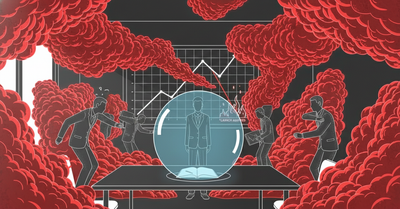
When a CEO is a Dogmatist, every data point is a threat or a validation. If a competitor launches a product, it isn't just a market event; it is an existential crisis. The Dogmatist feels they must know what it means. “Is this the end of our dominance? Is our strategy wrong?” Because they cannot tolerate the "Non-Evident" nature of the future, they rush to judgment. They pivot too early, they fire people too fast, or they double down on a losing hand just to prove they were right. This agitation creates Tunnel Vision. The brain’s prefrontal cortex (rational thought) shuts down as the amygdala (fear center) takes over.
The Skeptic, practicing Epoché, experiences a different reality. When the competitor launches, the Skeptic says, "I see the product. Whether it will succeed or fail is currently non-evident. I suspend judgment." This suspension acts as a thermal shield. While the Dogmatist is burning up in the atmosphere of panic, the Skeptic remains in the cool vacuum of observation. Because they are not defending an ego-driven "Truth," they can see the competitor's flaw that everyone else missed. They can wait for the perfect moment to strike. Tranquility is the source of timing.
Ataraxia in Negotiation: The "Nothing to Prove" Strategy
Nowhere is Ataraxia more powerful than in high-stakes negotiation.
Most negotiators enter a room with a "Dogmatic Burden." They have a target number, a rigid timeline, and a desperate need to be seen as "the winner." Their internal state is one of Taraxis (disturbance). Their counterpart can feel this tension; they can smell the "need" in the room, and they use it as leverage.
The Skeptical negotiator operates from a place of Aphasia (non-assertion). They don't assert that this deal is "the best" or "necessary." They treat the negotiation as an investigation (Skepsis).
- "It appears your price is X. It appears our budget is Y. Let us see if these can be reconciled." By suspending the judgment that "I MUST win this deal," the negotiator becomes invulnerable. If the deal happens, fine. If the deal fails, fine. Because their peace of mind is not tied to the "Truth" of the deal, they can walk away without blinking. Ironically, the person who is most willing to walk away is usually the one who gets the best terms.
Ataraxia is the ultimate "Fuck You" money for the mind.
Decision-Making: The "Lowest Heart Rate" Rule
If you look at the greatest strategic failures in tech history, the refusal to buy Netflix by Blockbuster, the Yahoo-Google miss, the Intel-iPhone chip rejection, they weren't failures of intelligence. They were failures of Judgment. The leaders in those rooms were Dogmatists. They were convinced they "knew" how the world worked. Their past success had hardened into a set of truths that they were anxious to protect.
A Skeptic in those boardrooms would have lowered the heart rate. They would have looked at the Netflix model and said: "This contradicts our current 'Truth' about retail. However, our 'Truth' is just an appearance. Let us weigh these two models as equal (Isostheneia) and see which one reality favors."
To cultivate Ataraxia in your leadership team:
- Kill the "Hero" Narrative: Stop rewarding the person who claims to have all the answers. Start rewarding the person who asks the best questions.
- Normalize "I Don't Know": Make "I am suspending judgment until X happens" a valid and respected status update.
- The 24-Hour Rule: In a crisis, unless the building is literally on fire, enforce a 24-hour period of Epoché. No conclusions are allowed. Only observations.
The Shadow Metaphor: Why You Can’t Force Peace
Sextus Empiricus's most profound insight is that you cannot "achieve" Ataraxia by seeking it directly. If you try to "be calm," you are just creating another Dogmatic goal to be anxious about. “Am I calm enough? Why am I still stressed?”
Ataraxia is a natural byproduct. When you stop trying to solve the unsolvable, when you stop pretending you can predict the unpredictable, and when you stop asserting that your opinion is the Absolute Truth, the agitation simply stops.
The shadow (peace) appears only when the body (the refusal to judge) is in place.
As a Chief Wise Officer, your job is to be the Apelles of your company. When the team is sweating over the "perfect" plan, when the engineers are grinding to find the "hidden cause" of a bug that isn't showing itself, and when the marketing team is terrified of a launch, throw the sponge.
Suspend the judgment. Embrace the uncertainty. Let the foam happen.
No spam, no sharing to third party. Only you and me.
Member discussion