The Ship of Theseus: The Metaphysics of Refactoring
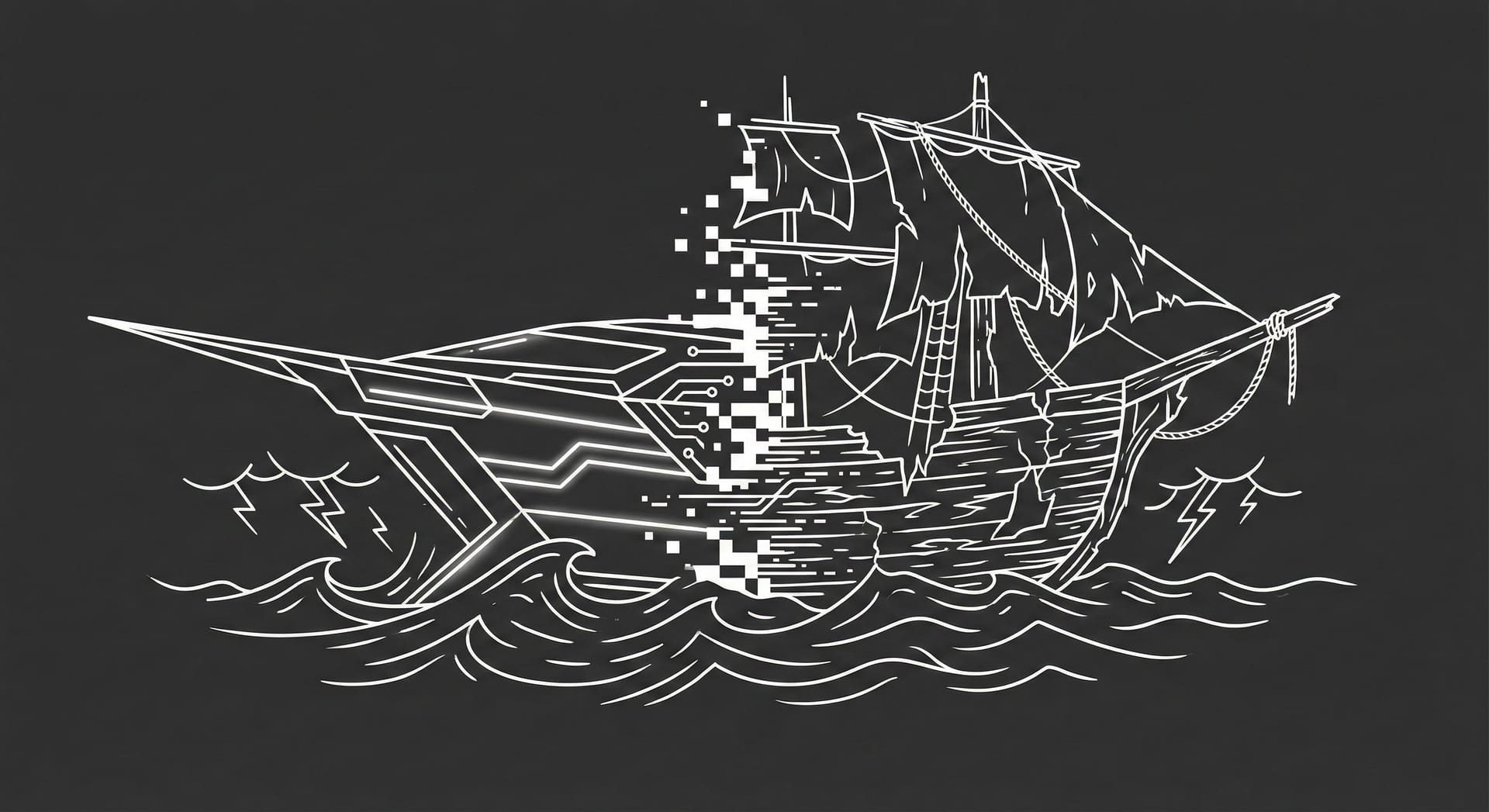
There is a thought experiment from Plutarch that haunts every long-term technology project: The Ship of Theseus.
The paradox is simple:
Theseus sails a ship. Over time, planks rot and are replaced by new timber. Eventually, after many years, every single part of the ship has been replaced.
- The Question: Is it still the same ship?
In Software Engineering, we face this paradox daily. We rarely build "Greenfield" projects anymore. We are almost always managing "Brownfield" systems—living organisms that we must repair while they are sailing at full speed.
Whether you are migrating a frontend framework, moving clouds, or decoupling a service, you are engaging in a metaphysical act. You are replacing the planks while trying to maintain the identity of the system.
Here is why most "Rewrites" fail, and why the Ship of Theseus is the only viable architectural strategy.
1. The Trap of "The Second Ship" (The Big Bang Rewrite)
Thomas Hobbes added a twist to Plutarch’s paradox:
Imagine a scavenger follows Theseus. Every time Theseus throws away an old plank, the scavenger picks it up. Eventually, the scavenger builds a complete ship out of the old, rotten parts.
- The New Paradox: Which one is the real Ship of Theseus? The one with new parts (Continuous Refactor), or the one with the original parts (The Legacy Backup)?
In tech, this manifests as the "Big Bang Rewrite."
A CTO says: "The current system is too messy. We cannot fix it. We will build a Version 2.0 from scratch (The Second Ship) and then switch over."
This almost always fails.
Why? Because while you are building the "Perfect V2," the "Messy V1" is still sailing. It is getting bug fixes, new features, and data patches. By the time V2 is ready, it is already obsolete because V1 has moved on. You end up with two ships, neither of which works perfectly.
2. The Solution: The Strangler Fig Pattern
The only way to win is to accept the paradox: The ship must become new while remaining the same.
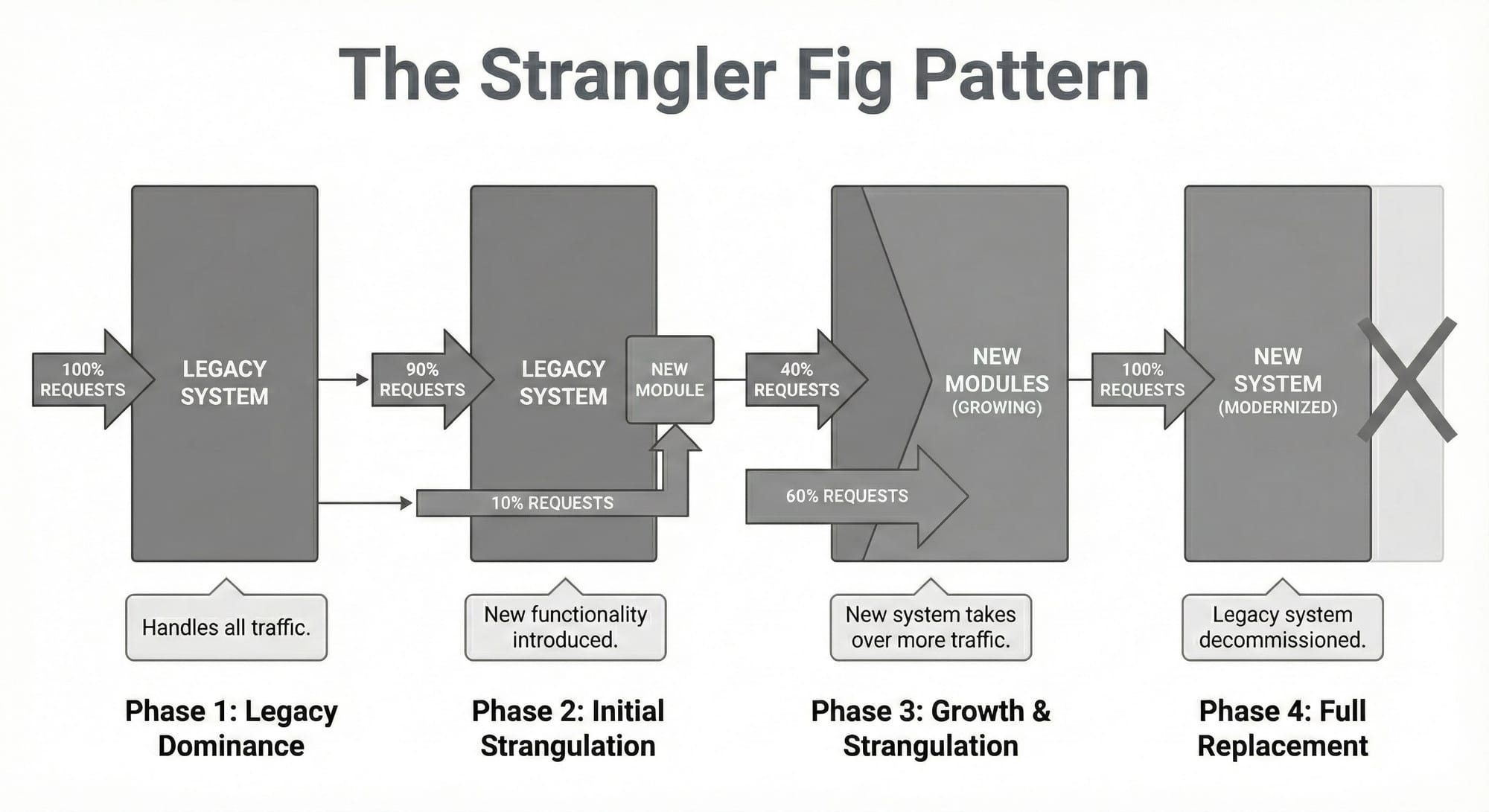
In architecture, we call this the Strangler Fig Pattern (coined by Martin Fowler).
Instead of a rewrite, you wrap the old system and replace it piece by piece.
- Step 1: You intercept the traffic (The API Gateway).
- Step 2: You route one specific function (e.g., "User Login") to a new service.
- Step 3: The rest of the traffic goes to the Legacy System.
- Step 4: Repeat until the Legacy System vanishes.
You are replacing the planks one by one. The users (the crew) never notice the ship changing. The identity of the system remains continuous, even though the code is 100% different.
3. Where does the "Soul" Live? (Code vs. Data)
If you replace all the code (React to Vue, Python to Go), is it the same application?
Yes. Because in software, the Identity is not the Code. The Identity is the Data.
The "Soul" of the Ship of Theseus is the database schema and the user records.
- You can throw away the entire backend.
- You can redesign the entire UI.
- But if you lose the Customer Data, the ship sinks.
The Strategic Lesson:
When planning a massive migration, obsess over the Data Migration, not the Code Migration. Code is ephemeral (the planks). Data is the history of the voyage. If you preserve the data integrity, you preserve the system's identity.
4. The Crew of Theseus (Conway’s Law)
There is a final, darker interpretation.
If you replace every engineer on the team over 5 years, is it the same team?
Often, we see a "Legacy Codebase" that is terrible. We fire the team, hire "A-Players," and tell them to fix it.
Two years later, the code is terrible again. Why?
Because Culture persists longer than People.
This is Conway’s Law in action. The communication structures, the "shadow processes," and the incentives (the ghost of the ship) influence the new crew.
You cannot fix the Ship just by changing the planks (Code) or the sailors (Team). You must change the Navigation Chart (Culture/Incentives). Otherwise, the new crew will just rebuild the old ship with new wood.
Summary
Stop looking for the "Perfect Architecture." It doesn't exist.
Software is not a building; it is a garden. It is constantly dying and growing.
- Avoid the Rewrite: Don't build a Second Ship on the shore.
- Embrace the Paradox: Replace the planks while sailing.
- Protect the Soul: Guard the Data above all else.
Your goal is not to build a ship that lasts forever. It is to build a ship that can be replaced forever.
No spam, no sharing to third party. Only you and me.
Member discussion