The Burden of Freedom: A Phenomenological Analysis of Jean-Paul Sartre
I. Introduction: The Terror of Total Agency
To confront the philosophical architecture of Jean-Paul Sartre is to stand at the edge of a metaphysical precipice, staring into a void that is not simply the absence of things, but an active, terrifying force of negation that resides at the very heart of human existence. It is a confrontation with the "terror of total agency", the realization that the human being is condemned to be free, stripped of the comforting determinisms of biology, psychology, or theology. In the draft of intellectual history, Sartre emerges not simply as a chronicler of post-war European malaise, but as the architect of a rigorous ontology that dismantled the self, leaving in its wake a consciousness that is purely transparent, purely active, and utterly responsible.
We seek to exhume the philosophical machinery beneath Sartre’s famous slogans, offering a comprehensive analysis of his phenomenological method and its existential consequences. While the popular imagination often reduces Existentialism to a mood of beret-wearing gloom or a license for libertinism, the reality of Sartre’s project, particularly in his magnum opus Being and Nothingness (1943) and his earlier essay The Transcendence of the Ego (1936), is a technical and exhaustive dismantling of the "inner life" as it was previously understood in the Western canon. By analyzing his critique of Edmund Husserl, his anatomy of Bad Faith, and the suffocating pressure of "The Look," we reveal a thinker who placed the human subject in a position of unbearable ontological tension: poised forever between a past that is fixed (facticity) and a future that is radically open (transcendence).
The "Burden of Freedom" is not just a poetic metaphor in this context; it is a structural necessity of consciousness. As we navigate Sartre’s thoughts, from the pre-reflective cogito to the hell of other people, we find that his insights are not artifacts of the 1940s, but acute diagnostics of the human condition that resonate with contemporary debates on agency, algorithmic determinism, and authentic leadership. We begin where Sartre began: with the purification of consciousness and the eviction of the Ego from the sanctuary of the mind.
II. The Ghost in the Machine: Critique of the Transcendental Ego
Before Sartre could construct the towering edifice of Being and Nothingness, he had to clear the ground of the philosophical debris left by his predecessors. The primary obstacle to a truly existential phenomenology was the concept of the "Ego" as a resident inhabitant of consciousness, a "ghost in the machine" that directed thoughts and actions. In his seminal 1936 essay, The Transcendence of the Ego, Sartre striked against the phenomenology of his mentor, Edmund Husserl, fundamentally altering our understanding of what it means to say "I".
The Husserlian Heritage and the Parting of Ways
Sartre’s philosophical awakening occurred famously in a Parisian bar in the early 1930s, upon discovering phenomenology’s promise to describe "the things themselves." His friend Raymond Aron pointed to an apricot cocktail and declared that with phenomenology, one could make philosophy out of the drink. Sartre was captivated by the prospect of a philosophy that engaged directly with the texture of reality rather than abstract concepts. However, his fascination with Husserl quickly turned to critical revisionism.
Husserl had posited the existence of a "Transcendental Ego", a unifying principle behind all conscious experience. For Husserl, beneath the stream of perceptions, memories, and anticipations, there stood an "I" that owned these experiences, a pole of identity that ensured the unity of the mind across time. This Ego was the guarantor that the consciousness perceiving the cocktail today was the same consciousness that perceived it yesterday.
Sartre rejected this formulation. He argued that Husserl had failed to apply his own phenomenological reduction (epoché) consistently. If phenomenology is the rigorous description of experience as it presents itself, then we must ask the crucial question: do we actually encounter an "I" when we are immersed in an activity? When one is running after a streetcar, or absorbed in reading a novel, is there an "I" present in that experience? Sartre’s answer is a definitive no. In the unreflective moment, there is consciousness of the streetcar, consciousness of the hero in the book, but there is no consciousness of an "I". The "I" is absent.
The Non-Egological Conception of Consciousness
Sartre’s audacious claim is that the "I" is not a structure within consciousness but an object for consciousness. It is a product of reflection, not a producer of experience. The Ego only appears when I adopt a reflective stance, when I look back at my experience and say, "I was reading". This distinction creates a "non-egological" view of the mind, where consciousness is defined by its emptiness and its directedness toward the world.
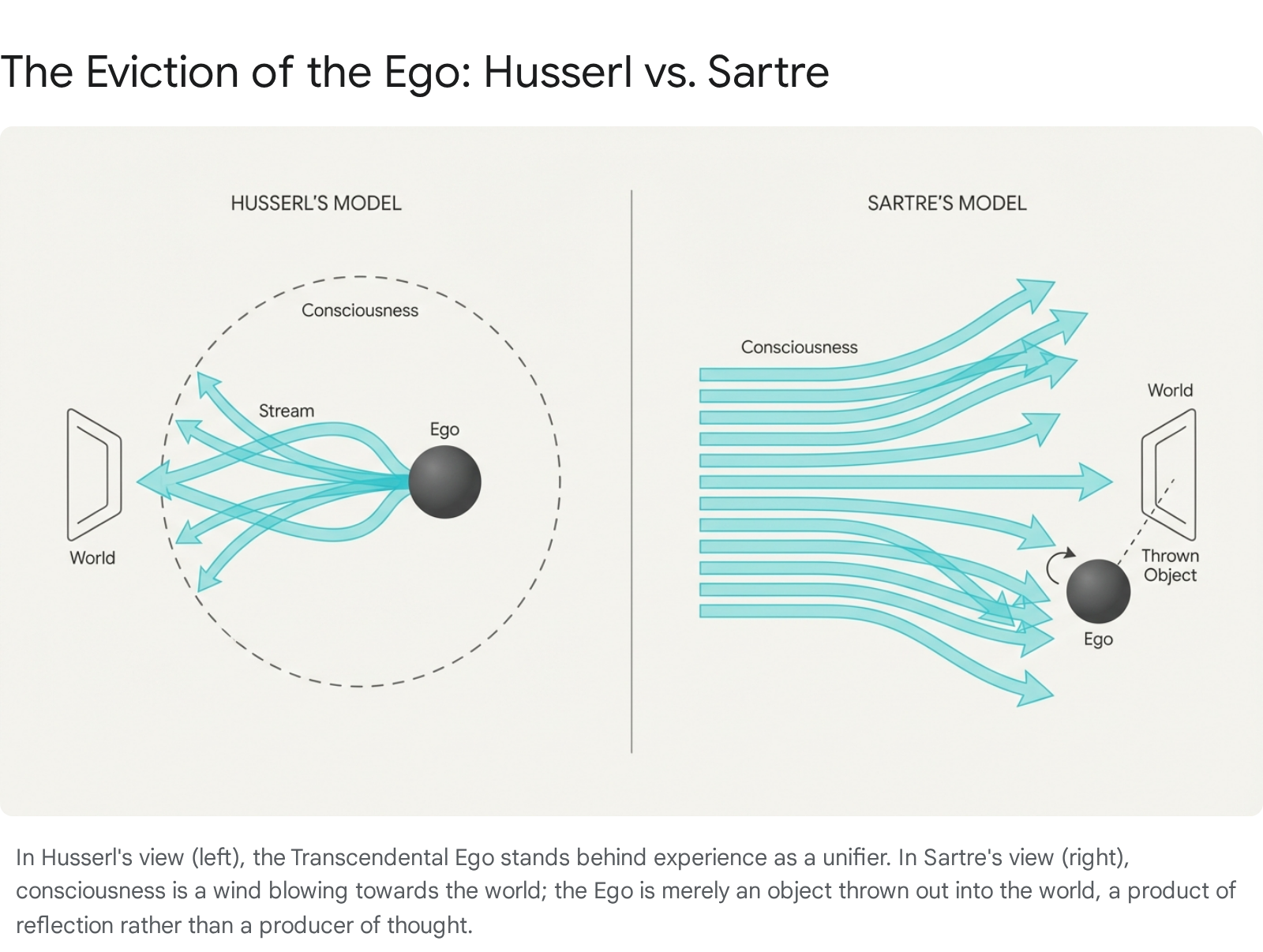
This shift has profound ontological implications. If the Ego is not the source of consciousness, then consciousness itself is an absolute emptiness, a "wind blowing towards objects". It is pure intentionality, it is nothing but the revelation of things. As Sartre writes, "Consciousness is a being such that in its being, its being is in question in so far as this being implies a being other than itself".
The unity of the mind, therefore, does not come from a stable "self" inside; it is a synthetic unity imposed by the objects we attend to. The "Me" is a construction, a fiction we create to give consistency to our behaviors. This foreshadows the terrifying freedom of Being and Nothingness: if there is no pre-existing Ego to determine my actions, if the "Me" is just a story I tell myself, then my actions arise ex nihilo, out of nothing. I am not a character who acts; I am an action that creates a character.
The Illusion of Immanence and the Transparency of Mind
Sartre further critiques what he calls the "illusion of immanence", the common psychological belief that thoughts, feelings, or images are "things" contained inside the mind like furniture in a room. Drawing on both Husserl’s discovery of intentionality and Bergson’s work on duration, Sartre argues that we must purge the mind of these "little things". A thought is not a pebble in a box; it is an act. An image is not a picture stored in the brain; it is a way in which consciousness aims at an absent object.
This purification results in a consciousness that is "translucent" or transparent. There are no dark corners, no unconscious cupboards where motives can hide (a direct challenge to Freud). Everything in consciousness is conscious of itself. This transparency means we are entirely responsible for our psychic life. We cannot blame a "complex" or an "unconscious drive," because those are things, and consciousness is not a thing. By emptying consciousness of all content, including the Ego, Sartre leaves us with a terrifying purity: we are nothing but a monstrous spontaneity, free to constitute the world and ourselves in every instant. This absolute lightness is the first weight of our burden.
III. The Architecture of Nothingness: Being-in-Itself vs. Being-for-Itself
Having evicted the Ego and established consciousness as a transparent activity, Sartre constructs his ontology on the tension between two mutually exclusive modes of existence: the En-soi (Being-in-itself) and the Pour-soi (Being-for-itself). This dichotomy is the engine that drives the entire Sartrean system of anguish, freedom, and bad faith.
The Great Divide: Plenitude and Decompression
The first category, Being-in-itself (L'être-en-soi), refers to the being of non-conscious objects, the stone, the table, the ash tray. Its defining characteristic is that it is. It is opaque, solid, and identical with itself. It lacks nothing; it desires nothing. It has no history (unless a consciousness gives it one) and no future. It is "pure plenitude," a density of existence that simply coincides with itself. It is the silent, indifferent backdrop of existence.
The second category, Being-for-itself (L'être-pour-soi), is human consciousness. It is defined precisely by its failure to coincide with itself. It is a "decompression" of being. Sartre defines it with the famous paradox: the For-itself is "a being which is what it is not and is not what it is".
- It is not what it is because it is always projecting itself toward a future it has not yet achieved (I am not yet the waiter I am training to be).
- It is what it is not because it is always separated from its past (I am no longer the child I was). Because consciousness is always consciousness of something else, it is never identical with itself. It is a separation, a distance, a hollow.
The Process of Nihilation (Néantisation)
How does the For-itself arise from the In-itself? How does this hollow open up in the solid block of being? Sartre introduces the concept of nihilation (néantisation). This is not a physical destruction, but an ontological act: the active generation of nothingness. To perceive an object is to distinguish it from the background; it is to introduce a "not" into the world. To say "This is a cup" is simultaneously to say "This is not the table" and "I am not the cup".
Sartre argues that this power of negation is the foundation of all inquiry and all truth. When we ask a question, we open the possibility of a negative answer ("No, it is not raining"). If being were purely positive plenitude, questions would be impossible; there would only be affirmation. The fact that we can ask questions proves that we can detach ourselves from the causal chain of being.
Sartre uses the famous phenomenological example of Pierre in the café to illustrate the reality of nothingness. He describes entering a café to meet Pierre. The café is full; there is the clatter of saucers, the haze of smoke, the hum of conversation. The entire scene organizes itself as a "plenitude of being." But when Sartre realizes "Pierre is not here," this absence is not an abstract judgment. It is a real event in the room. Pierre’s absence haunts the café; it is a "nothingness" that slips between the tables and the chairs. The café becomes a background for the figure of Pierre-who-is-not-there. This "nothingness" is introduced into the world by human consciousness.
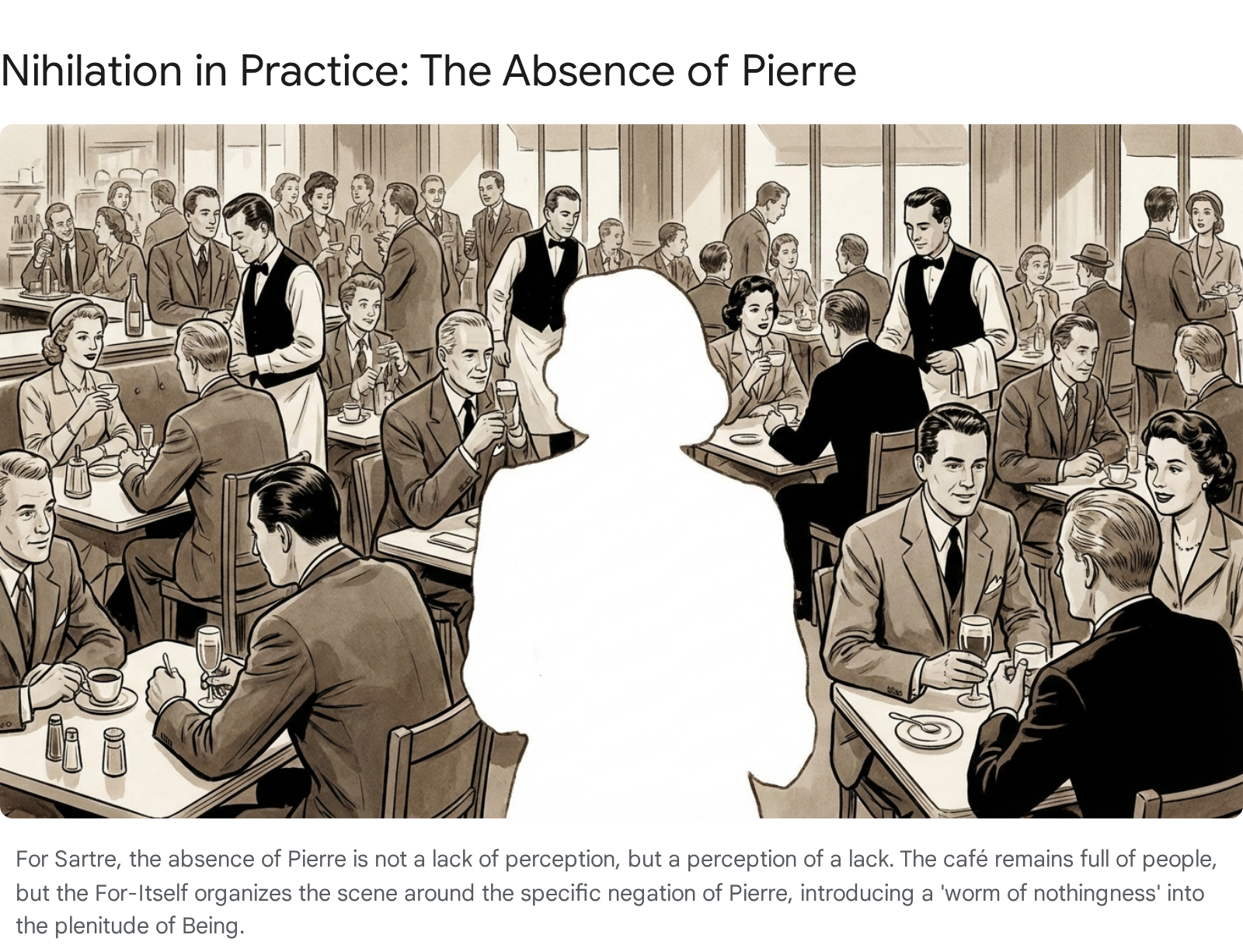
This capacity to "secrete" nothingness is the very definition of freedom. To be free is to be able to detach oneself from the given, to imagine what is not yet real. If I were fully determined by my past or my biology, I would be a solid block of Being-in-itself, incapable of seeing "what is not." But because I can introduce nothingness, because I can say "no," because I can imagine a future different from the present, I am free. As Sartre famously notes, quoting Heidegger, "Nothingness lies coiled in the heart of being, like a worm". This worm is human consciousness.
Fragility and Destruction
Sartre extends this analysis to the concepts of destruction and fragility. In the natural world of the In-itself, there is no destruction, only redistribution of matter. A storm that scatters a pile of stones does not "destroy" anything in physics; it simply moves atoms. Destruction only exists because a human consciousness projects a "meaning" onto the stones (e.g., "this was a wall"). When the wall is scattered, consciousness perceives a lack, the wall is no longer there. Thus, "man is the being by whom nothingness comes into the world". The fragility of a vase or a civilization is not an inherent property of the object, but a quality imposed by a consciousness that can imagine its non-being.
IV. The Vertigo of Freedom: Anguish and the Future
This freedom, however, is not a joyful liberation; it is experienced fundamentally as Anguish (Angoisse). Sartre meticulously distinguishes Anguish from Fear, a distinction that clarifies the internal nature of the existential burden.
Fear vs. Anguish
Fear is always directed at an external object or situation. I fear the bomb, the precipice, the bankruptcy. Fear is the apprehension of a threat from the world to my being. It treats the self as an object that can be destroyed.
Anguish, by contrast, is the apprehension of myself. It is the realization that I am the one who must choose how to act, and that nothing, absolutely nothing, compels me to act one way or another. Anguish is the reflective realization of my own unpredictability.
Sartre illustrates this with the phenomenology of vertigo on a cliff edge.
- Fear: I look down at the abyss and feel fear because I might slip. The danger comes from the "coefficient of adversity" of the world (the loose rocks, the wind). I see myself as a thing that might fall.
- Anguish: I realize that I could throw myself off. The guardrail prevents me from falling accidentally, but nothing prevents me from jumping intentionally. My past self (who wanted to live) does not determine my future self (who might jump). I am separated from my future action by a nothingness. I must constantly re-choose to survive. The vertigo is not the fear of falling; it is the dizziness of my own freedom.
The Gambler and the Rupture of Time
Sartre applies a similar analysis to the gambler who resolves to stop gambling. The gambler says, "I will not play anymore." But the next day, when he approaches the gaming table, he realizes that his resolution is part of the past. It has no causal power over him now. The resolution must be remade ex nihilo. The past resolution is strictly a fact about a past self; the present self is free to ignore it. This is the source of anguish: we cannot rely on our past to determine our future. We are condemned to create ourselves anew in every instant.
Anguish is the vertigo of knowing that "I am the one who sustains values in being," and that "nothing justifies me in adopting this or that value". There are no signs in the world that tell us what to do. Even if we consult a sign (e.g., a religious text), we are the ones who choose to interpret it as a sign and choose to obey it. We are the "unjustifiable foundation" of our own lives. To flee this unbearable responsibility, we turn to Bad Faith.
V. The Hell of the Other: Intersubjectivity and "The Look"
If the relation to oneself is defined by nothingness and anguish, the relation to the Other is defined by conflict. Sartre’s analysis of intersubjectivity in Being and Nothingness is a radical departure from the optimistic empathy of other phenomenologists like Husserl or Scheler. For Sartre, the existence of the Other is not proven by intellectual argument, but by the visceral "shudder" of being looked at.
The Solipsistic Trap and the Look (Le Regard)
Traditional philosophy struggled to prove the existence of other minds, often falling into solipsism (the idea that only my mind is certain). Sartre bypasses the intellectual proof in favor of an ontological encounter: "The Look" (Le Regard).
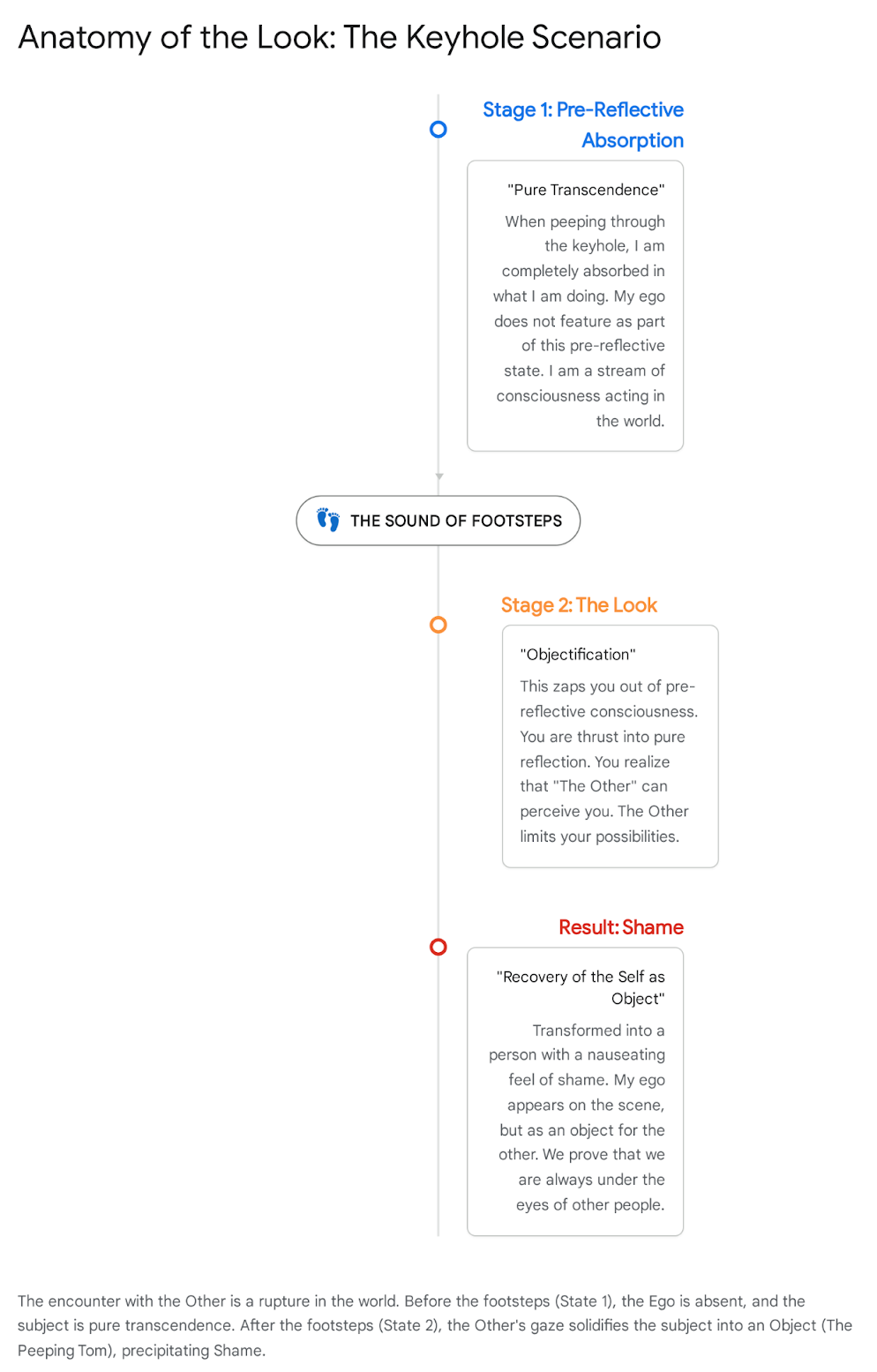
He describes a voyeuristic scenario: Imagine I am peeping through a keyhole, watching a scene in a room. I am jealous, curious, or perhaps purely an observer.
- The Pre-Reflective State: In this moment, I am pure consciousness; I am a subject, a transcendence. I am not aware of myself; I am only aware of the scene I am watching. The door, the keyhole, and the people in the room are objects in my world, organized by my gaze. I am the center of this universe.
Suddenly, I hear footsteps in the hall. A floorboard creaks.
In an instant, everything changes. I am seen. I realize that I am being watched by another. This is the cataclysm of "The Look."
The Three Consequences of the Look
- Objectification (I become an Object): Under the gaze of the Other, I am no longer a free subject; I become an object. The Other sees "a peeping tom." I have a nature, a fixed identity, a character. But this nature is possessed by the Other, not by me. The Other holds the secret of who I am. I fall from being a transcendence to being a "facticity".
- The Drain of the World: My world, which was organized around my gaze, now "bleeds" away toward the Other. The objects in the room (the door, the keyhole) are no longer just tools for me; they are now objects for him. The Other acts as a "drain" or "sinkhole" in the middle of my world, through which my universe escapes. The distances and meanings of my world are stolen from me and reorganized around the Other’s freedom.
- Shame: The primary emotional reaction to the Look is shame. Shame is not just a feeling of embarrassment; it is an ontological recognition. It is the recognition that "I am indeed that object which the Other sees and judges". Shame is the confession that I am fallen into the world, that I am vulnerable, that I need the Other to define me.
Conflict as Essence
This dynamic implies that human relationships are fundamentally conflictual. We are locked in a struggle to recover our transcendence. The presence of the Other reveals that I am not the only subject in the universe. To regain my freedom, I must try to transcend the Other's transcendence.
- Sadism: I can try to make the Other an object (by looking back, by dominating, by sexualizing), thereby regaining my status as a subject.
- Masochism: Or I can submit and try to become purely an object for the Other, attempting to escape the burden of my own freedom by letting the Other determine my being.
But a stable, mutual recognition is impossible in this ontology (unlike Hegel’s dialectic where recognition is the goal). For Sartre, "Hell is other people" because the Other is the one who steals my world and freezes my possibilities into a fixed nature. The Look is a permanent threat to my freedom.
VI. The Labyrinth of Bad Faith: Lying to the Self
If Anguish is the recognition of our freedom, and the Look is the threat from the Other, how do we survive the pressure of existence? We construct the elaborate psychological fortress that Sartre calls Bad Faith (Mauvaise Foi).
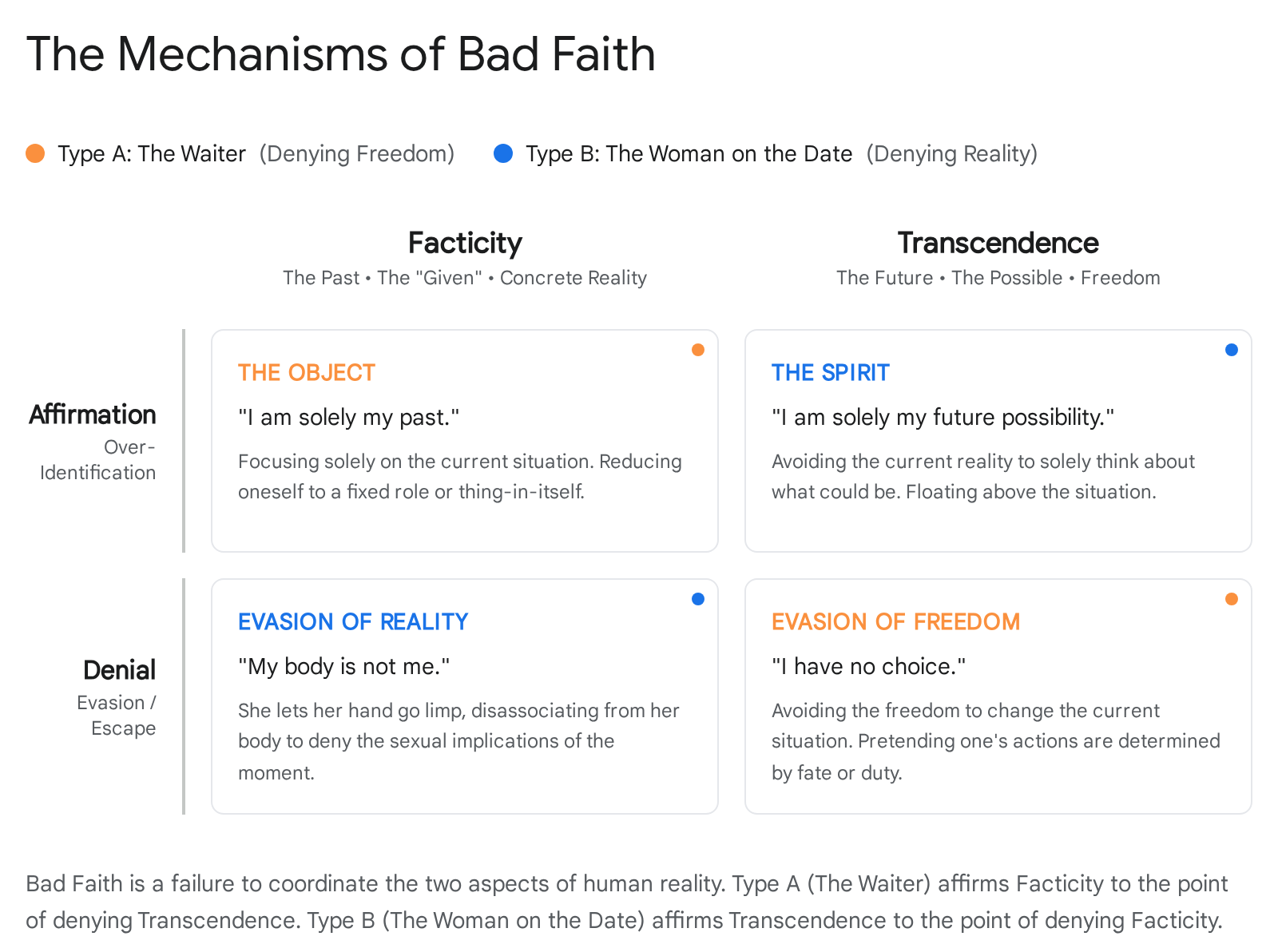
Bad Faith is a lie told to oneself. But this presents a logical problem: for a lie to be successful, the liar must know the truth and hide it from the deceived. But in Bad Faith, the deceiver and the deceived are the same person. How can I lie to myself if I know the truth I am hiding? Sartre resolves this by rejecting the Freudian unconscious (which splits the mind into "Id" and "Ego") and instead utilizing the "double property" of human reality: we are both Facticity and Transcendence.
Bad Faith operates by exploiting the ambiguity between these two aspects. We deny our freedom by claiming we are just things (Facticity), or we deny our situation by claiming we are pure spirit (Transcendence).
Case Study 1: The Unrecognized Genius
To illustrate the denial of facticity, we can present the example of a man who claims to be a writer but has never produced a significant work. This "Unrecognized Genius" argues that his circumstances, poverty, bad luck, or the demands of his job, have prevented him from writing. He maintains that his "true self" is that of a creative artist (Transcendence), despite the lack of any concrete books or plays (Facticity).
He separates his soul from his actions. He lives in the belief of his genius rather than the reality of his life. By claiming "I am a writer" while not writing, he denies his Facticity (his actual track record) to take refuge in a disembodied Transcendence. He wants to be judged by what he could be, not what he is. He engages in Bad Faith by pretending that his intentions are as real as his actions, refusing to accept that "man is nothing else but that which he makes of himself."
Case Study 2: The Waiter
Consider the café waiter. His movements are a little too precise, a little too eager. He bows with excessive solicitude; his voice is overly solicitous. He balances the tray with the recklessness of a tightrope walker. He is playing at being a waiter. Why? Because he cannot be a waiter in the same way an inkwell is an inkwell. An inkwell has no distance from itself; it coincides perfectly with its definition. But a human being is free; he implies a "nothingness" between himself and his role. He could choose to leave, to drop the tray, to scream, to become a communist. To escape the anxiety of this freedom, he attempts to merge completely with his role. He tries to become a "Waiter-in-itself," a social automaton. This is Bad Faith: the denial of the transcendence that separates us from our roles. He wants to have the permanence of a stone while retaining the consciousness of a man.
Critique of the Unconscious
Sartre’s analysis of Bad Faith is also a sustained attack on Freudian psychoanalysis. Freud explains self-deception by positing a "censor" that stands between the Unconscious and the Conscious. The censor "knows" the truth (in order to repress it) but hides it from the conscious mind. Sartre argues this merely pushes the problem back a step: the Censor itself must be in Bad Faith! If the Censor knows what to repress, it is conscious. If it hides it from the Ego, it is lying. Thus, the duality of the deceiver/deceived exists within the censor itself. Sartre insists on the unity of consciousness: we are fully aware of our bad faith. The genius writer knows he is not writing; the waiter knows he is playing a role. We are complicit in our own deception.
VII. The Paradox of Sincerity
Critically, Sartre argues that the pursuit of "Sincerity" is often just another form of Bad Faith. This seems counterintuitive, isn't sincerity the opposite of lying?
Sartre introduces the character of the "Champion of Sincerity" who demands that his friend admit, "I am a liar," because the friend has told lies in the past. The friend refuses, or equivocates. The Champion believes he is asking for the truth. But Sartre argues the Champion is in Bad Faith. Why? He wants the friend to constitute himself as a thing, a "Liar" with a capital L, a fixed nature like a stone or a table. He wants to pin the friend down. But the friend is a consciousness.
- He is a liar in the sense of Facticity (he has told lies in the past).
- But he is not a liar in the sense of Transcendence (he is free to tell the truth in the future; he is not defined by the lie forever). Thus, the demand for sincerity, "Admit what you are!", is a demand to deny one's freedom. It is an attempt to define a human being by their past, ignoring their potential for the future. The Champion of Sincerity uses the truth of the past to kill the freedom of the future.
For Sartre, we can never "be" anything in the mode of sincerity. I can never say "I am a waiter" or "I am a liar" in the same way I say "This is a cup." I can only say "I am playing at being a waiter." To claim otherwise is to seek the comfort of the In-itself.
VIII. Freedom in Chains: Situation and Adversity
Sartre is famously quoted as saying "We are condemned to be free." But this absolute freedom is often misunderstood. Does it mean I can fly by flapping my arms? Does it mean a prisoner is free to leave his cell? Sartre’s answer in Being and Nothingness is nuanced. He distinguishes between ontological freedom (the freedom of choice/attitude) and practical freedom (power/ability).
The Coefficient of Adversity
We always encounter the world as a resistance. The mountain is hard to climb; the boulder is heavy; the algorithm limits my visibility. Sartre calls this resistance the "Coefficient of Adversity". However, Sartre argues that the coefficient of adversity is determined by our projects. The boulder is not "an obstacle" in itself. It is just a rock. It only becomes an obstacle if I desire to move it or climb past it. If I just want to sit on it, it is a "seat." If I want to admire the view, it is "scenery." If I want to build a house, it is "material." Thus, the resistance of the world is a reflection of my own freedom. "It is I who decide the coefficient of adversity in things". The world only pushes back because I push against it.
The Situation and Responsibility
This leads to the concept of the Situation. My freedom is not abstract; it is always "in situation." I am thrown into a world with a specific body, a specific past, a specific class, and a specific language.
- Facticity: These are the brute facts (I am short, I am French, I am working class, I am in prison). Sartre was imprisoned by German forces in a prisoner-of-war camp (Stalag XII-D) near Trier, Germany, for approximately nine months between 1940 and 1941.
- Freedom: This is how I interpret and surpass these facts. Sartre argues that I am responsible for my situation. If I am mobilized in a war, it is my war. I cannot say "I am a victim of history." Why? Because I could always get out of it. I could desert; I could commit suicide. These are terrible choices, but they are choices. By remaining a soldier, I choose the war and make it mine. This view has been criticized as harsh (does the victim choose their oppression?), but for Sartre, it is the ultimate dignity. To claim one has "no choice" is to reduce oneself to a thing. To accept that one is choosing, even in the worst torture chamber, is to affirm one's humanity.
Modern Context: The Algorithmic Adversity
In the contemporary world, we might extend Sartre’s concept to the "algorithmic coefficient of adversity". Algorithms introduce a new layer of friction and "facticity." They treat us as "pure facticity" (our past data, our clicks). But even here, Sartre would argue, we retain the freedom to choose our attitude toward the algorithm, to resist its nudges, or to integrate it into our projects. The algorithm is an obstacle only because we project a desire (e.g., for popularity or information) that it mediates.
IX. Toward Authenticity: Escaping the Spirit of Seriousness
If Bad Faith is the disease, is there a cure? Being and Nothingness ends on a pessimistic note, implying that "man is a useless passion" because he desires to be God (to be a For-itself that has the solidity of an In-itself). However, hints of an ethical deliverance appear in the concept of Authenticity.
The Spirit of Seriousness (L'esprit de sérieux)
The enemy of authenticity is the "Spirit of Seriousness." This is the belief that values are objective entities existing in the world, independent of human subjectivity. The "serious" man believes he is a father, a boss, or a patriot in the same way a rock is a rock. He subordinates himself to these values, claiming "I had no choice, duty called." He hides his freedom behind the "world of things." He transfers the quality of "desirable" from his own choice to the object itself (e.g., "I pursue money because money is valuable," rather than "Money is valuable because I choose to pursue it"). Sartre sees this as a fundamental abdication. Values are not discovered; they are created. By obeying a moral rule, I am choosing to sustain that rule in existence.
Authenticity
Authenticity, then, is the "radical acceptance of freedom". It is the lucid consciousness that I am the baseless foundation of my own values.
- It is not about being "true to one's inner self" (since there is no inner self).
- It is about being true to one's situation. It requires "assuming the responsibilities and risks" of the situation, recognizing that "I am the one by whom it happens". Authenticity is a "self-recovery of being which was previously corrupted". It is the moment the For-itself stops fleeing its anguish and accepts the weight of its total agency.
In a business or leadership context, this means rejecting the excuse of "market forces" or "bureaucracy." An authentic leader acknowledges that every corporate structure, every profit target, and every layoff is the result of human choices for which they are responsible. They do not hide behind the "Spirit of Seriousness" that treats the market as a god.
X. Conclusion: The Chief Wise Officer in the Void
Jean-Paul Sartre’s philosophy is often accused of being a philosophy of despair, a dark rumination on the absurdity of life. Yet, a close reading reveals it to be a philosophy of extreme empowerment. He strips us of every excuse. He denies us the comfort of a god, a nature, or an unconscious mind that drives us. He leaves us naked in the wind of nothingness.
But in this void, he installs a sovereign dignity. If we are nothing, we are also everything. We are the creators of meaning in a meaningless universe. The "Burden of Freedom" is heavy, yes, it carries the weight of the entire world, for which we are responsible. But it is a burden that only a god, or a human being, can bear.
Sartre, the "Chief Wise Officer" of this existential void, does not offer us a map. He offers us a mirror, one that does not reflect our face, but the empty space where our face should be. He demands that we stop pretending to be statues and start the terrifying, exhilarating work of existing. We are condemned to be free, and in that condemnation lies our only glory.
XI. Selected Primary Bibliography
- The Transcendence of the Ego (La Transcendance de l'Ego), 1937.
- Nausea (La Nausée), 1938.
- Sketch for a Theory of the Emotions (Esquisse d'une théorie des émotions), 1939.
- The Imaginary (L'Imaginaire), 1940.
- Being and Nothingness (L'Être et le Néant), 1943.
- No Exit (Huis Clos), 1944.
- The Roads to Freedom (Les Chemins de la liberté), 1945–1949.
- Existentialism Is a Humanism (L'Existentialisme est un humanisme), 1946.
- Critique of Dialectical Reason (Critique de la raison dialectique), 1960.
- The Words (Les Mots), 1964.
No spam, no sharing to third party. Only you and me.
Member discussion