
"Hell is Other People" (The Sociology of Meetings)
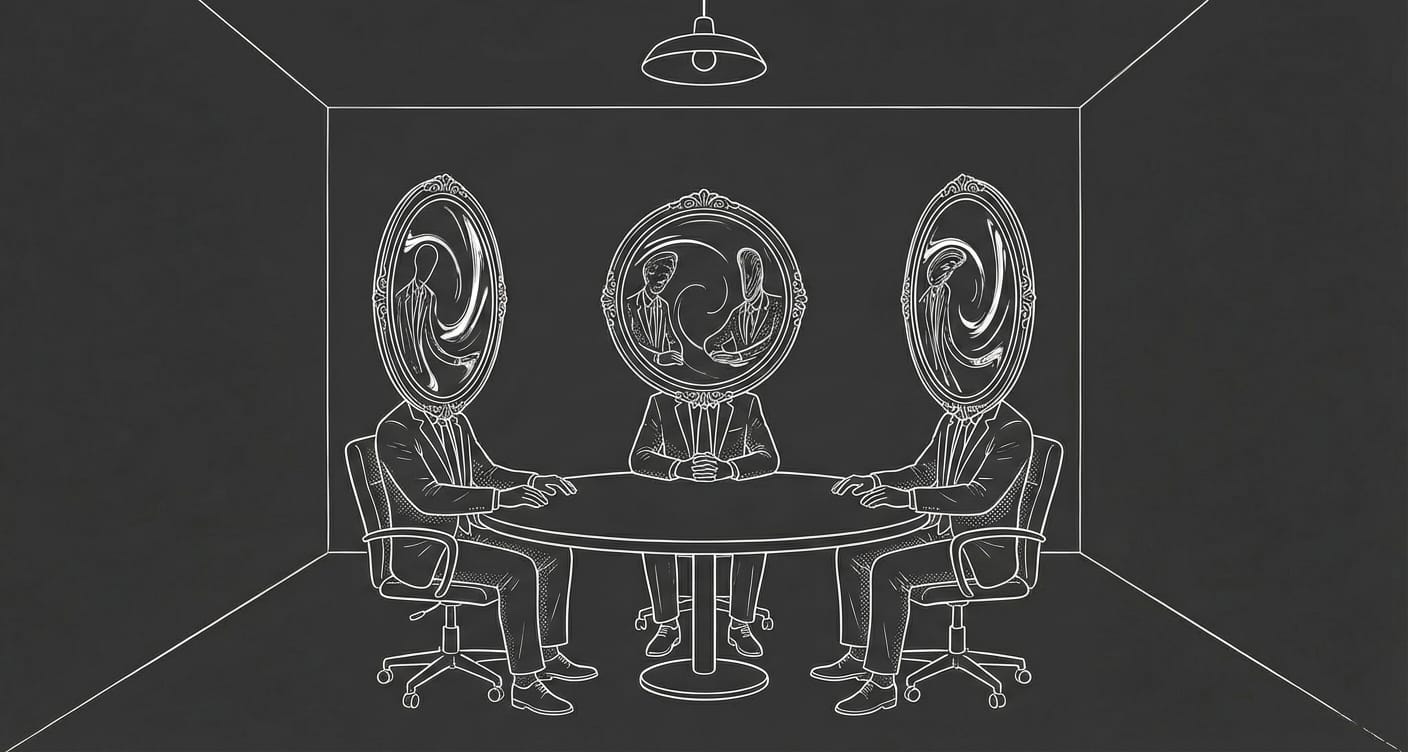
Note: "Hell is other people" is not about annoying colleagues. It is about Dependency. In Sartre’s play No Exit, the characters are tortured because they have no mirrors. They cannot see themselves. They rely entirely on the other two people in the room to tell them who they are. This is the exact position of a Leader. You cannot "lead" in a vacuum. You need the reflection of your team to know if you exist. And that need makes you their hostage.
In 1944, Jean-Paul Sartre staged a play where three damned souls are locked in a room. Garcin, a deserter, desperately wants to believe he is a Hero. But he cannot verify it himself. He begs Estelle to tell him he is brave. Estelle refuses. She holds the power of his identity in her hands, and she withholds it to torture him. Garcin screams: "Hell is other people!"
He doesn't mean "I hate you." He means: "I am incomplete without you, and I hate that I need you."
The Corporate "No Exit"
In the corporate world, we are structurally locked in the same room. We think the Boss holds the power. Sartre argues the opposite: The "Object" holds the power over the "Subject."
1. The Leader’s Dependency
Imagine a CEO. In their head (Subjectivity), they are a "Visionary Savior." But they cannot enact this vision alone. They need the Engineers to build it and the Sales team to sell it. The moment the CEO walks into the room, they are at the mercy of the Team’s Gaze.
- If the Engineers roll their eyes, the "Visionary" instantly crumbles into a "Delusional Suit."
- If the Sales team ignores the strategy, the "Command" becomes a "Suggestion."
This is the Hell of Management: You are only a Leader if they consent to treat you like one. You are constantly auditioning for the role you supposedly own. You are begging them: "Please reflect my authority back to me so I can feel real."
2. The Withholding of Recognition
Just like in the play, the torture in the office comes from withholding validation. We are all fighting a silent "Battle for Recognition" (a concept Sartre borrowed from Hegel).
- The Boss's Weapon: Withholding praise. You work late to be seen as a "High Performer." The Boss says nothing. Your identity flickers.
- The Employee's Weapon: Withholding enthusiasm. The Boss gives a rousing speech to be seen as "Inspirational." The team stares blankly. The Boss feels like a fool.
We torture each other by refusing to give the other person the reflection they crave. We turn them into Objects (resources) to avoid acknowledging them as Subjects (humans).
The Escape: Breaking the Mirror
Garcin stays in Hell because he creates a dependency: "If Estelle says I am brave, then I am brave." He gives her the remote control to his self-worth.
Many leaders do the same. They lead by Consensus or People-Pleasing. They are terrified of the Gaze of the team, so they try to placate them. They want to be "The Cool Boss" or "The Loved Manager." This is a trap. You will never be loved enough to feel safe.
The Sartrean Solution: Authenticity (Self-Definition) To escape Hell, you must stop needing the mirror.
1. Accept Misunderstanding
Sartre argues that conflict is the essence of relationships. You will always be an Object in their eyes.
- To the CFO, you are a Cost Center.
- To the Team, you are "The Man."
- To the Board, you are a Risk. Stop trying to change their view. Hell is the exhaustion of trying to manage everyone's perception of you. The Wise Officer accepts: "I am the villain in their story right now. That is fine. I don't need their permission to do my job."
2. Lead Without the Applause
True freedom is acting without the need for the "Other" to validate the action. If you make a hard decision (e.g., a pivot, a layoff, a budget cut), do not look to the team for comfort. Do not ask them to tell you, "It's okay, you're still a good person." That is placing the burden of your conscience on them. Validate yourself. Know why you did it. Accept the guilt. Accept the solitude. When you stop needing their validation, their Gaze loses its power. You are no longer a hostage.
Conclusion
Sartre’s play ends with a terrifying realization: The door opens, but the characters refuse to leave. They stay in Hell because they are addicted to the struggle. They would rather be tortured by others than face the emptiness of being alone. In business, we stay in toxic cultures and endless meetings for the same reason: We are terrified of the solitude of true responsibility. Hell is other people. Freedom is being okay with that.
No spam, no sharing to third party. Only you and me.




Member discussion