
The Porcupine Dilemma: The Art of Corporate Distance
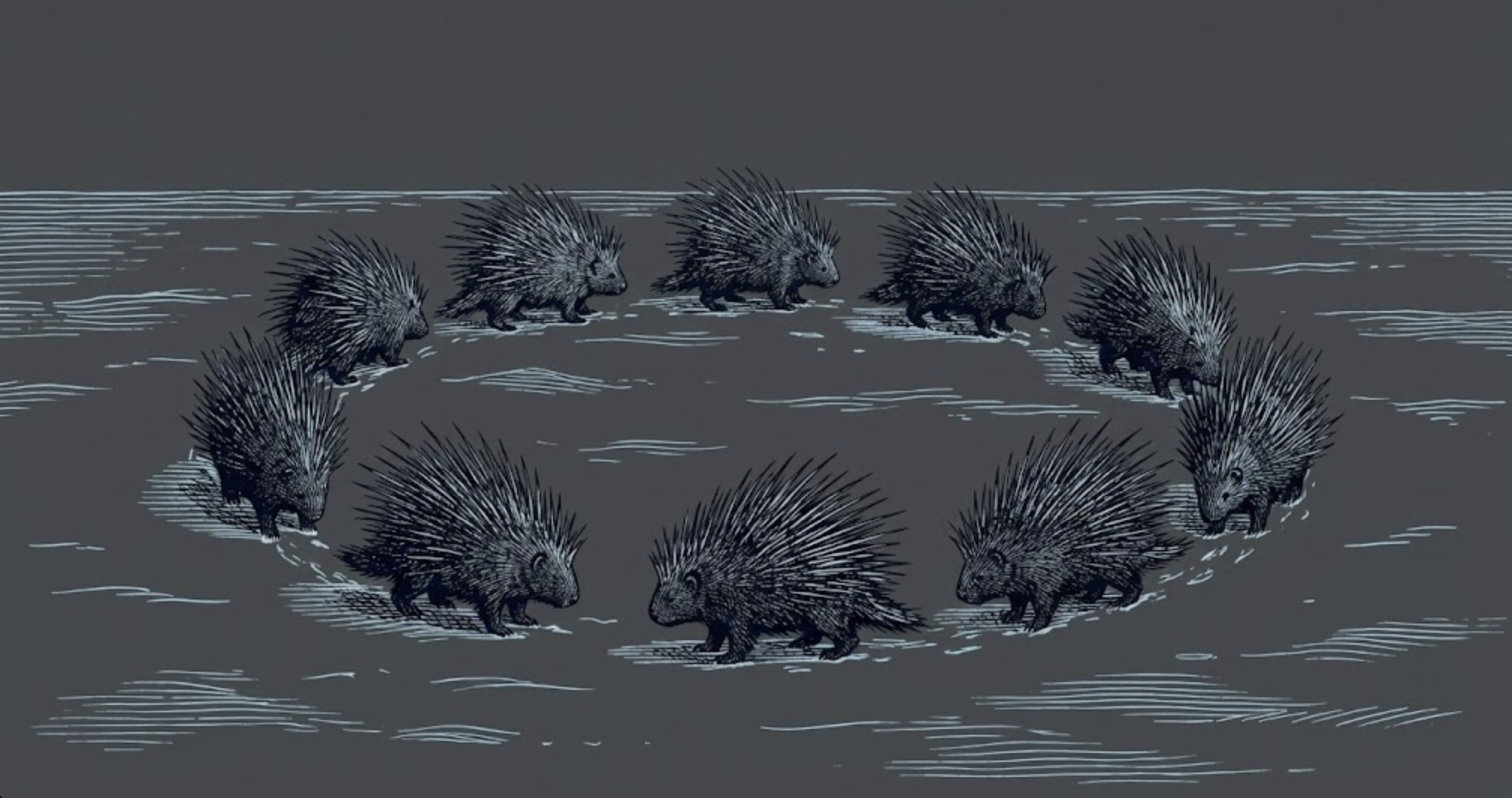
Note: We are told that a "Connected Company" is a happy company. We break down silos. We sit in open-plan offices. We Slack each other all day. But Arthur Schopenhauer, the great pessimist, warned that too much connection is painful. His parable of the "Porcupines" suggests that the secret to a high-functioning team isn't Closeness—it's Distance.
It is a cold winter day. A group of porcupines is freezing. To avoid death by hypothermia, they huddle close together to share their body heat. But as they press against one another, they feel the sharp sting of their neighbor's quills. The pain becomes unbearable, so they scatter apart again. But then the cold returns, and they begin to freeze. Driven by the need for warmth, they come back together—only to be pricked again.
Arthur Schopenhauer wrote this famous parable in 1851 (Parerga and Paralipomena) to describe human social interaction. The porcupines are eventually forced to find a "moderate distance", close enough to get some warmth, but far enough to avoid the quills. Schopenhauer calls this distance Politeness (or Manners).
"By this arrangement, the mutual need for warmth is only very moderately satisfied; but then people do not get pricked."
The Corporate "Huddle"
Modern management theory has forgotten the porcupines. For the last 20 years, we have been obsessed with eliminating distance.
- The Open Plan Office: "Let's remove all walls so everyone can collaborate!" (Result: You can hear your colleague eating an apple three desks away).
- The "Flat" Hierarchy: "We are all friends here!" (Result: No one knows who is actually responsible for the decision).
- The Slack Channel: "Instant communication at all times!" (Result: A ceaseless barrage of digital noise that destroys deep work).
We have huddled too close. And now, we are feeling the quills. The "quills" in a company are the inevitable frictions of human nature, ego, annoyance, bad habits, and gossip. When you force people into a space of "Radical Candor" and "Total Transparency" without boundaries, you don't get a family. You get a bloody mess.
The Case for Distance
A functional organization, like the porcupines, requires a "moderate distance" to survive.
1. Distance Creates Dignity
Schopenhauer notes that politeness is the cushion that prevents us from hurting each other. In a company that says "We are a family," boundaries blur. Managers take things personally. Employees overshare. In a company that says "We are a team," there is a professional distance. The Professional Mask is not fake; it is protective armor. It allows you to critique my work without attacking my soul.
2. Distance Protects Deep Work (The Cave)
Creativity requires solitude. It requires being away from the warmth of the herd. If you are constantly huddled in a brainstorming session or a Slack thread, you are warm, but you are not thinking. Schopenhauer was a loner for a reason. He believed that great ideas only come when you step away from the "market-place."
The Porcupine Strategy:
- Mornings: Complete isolation (Distance). No meetings. No Slack. Deep work.
- Afternoons: Collaboration (Warmth). Meetings. Syncs.
3. The Quill of "Radical Candor"
There is a trend in management called "Radical Candor", the idea that you should say exactly what you think to your colleagues. Schopenhauer would call this insanity. "Quills" are sharp. If I tell you exactly what I think of your presentation style, your fashion sense, and your laugh, I am not "helping" you; I am stabbing you. Manners are the lubricant of the machine. Sometimes, the kindest thing you can do for a colleague is to maintain the polite fiction that their idea is "interesting" while you gently steer them toward a better one.
The Strategic Takeaway: Build Walls
If you are a leader, your job is not to force the porcupines into a pile. Your job is to architect the Moderate Distance.
- Re-erect the Walls: Open plans are a disaster for focus. Give people "Libraries" (quiet zones) where talking is forbidden.
- Async by Default: Real-time chat (huddling) should be the exception, not the rule. Writing a memo (distance) allows for cooler, sharper thinking than a shouting match in a meeting.
- Stop Trying to be a Family: You don't need to love your colleagues. You don't even need to like them. You just need to respect them enough to work with them without quilling them.
Schopenhauer ends his parable with a savage observation:
"A man who has some heat in himself prefers to remain outside, where he will neither prick other people nor get pricked himself."
The goal of a great "Chief Wise Officer" is to hire people who have their own internal heat, people who don't need the constant validation of the huddle to survive.
No spam, no sharing to third party. Only you and me.


Member discussion