
The OODA Loop: Speed as a Weapon (And the Myth of the "Fast" Company)
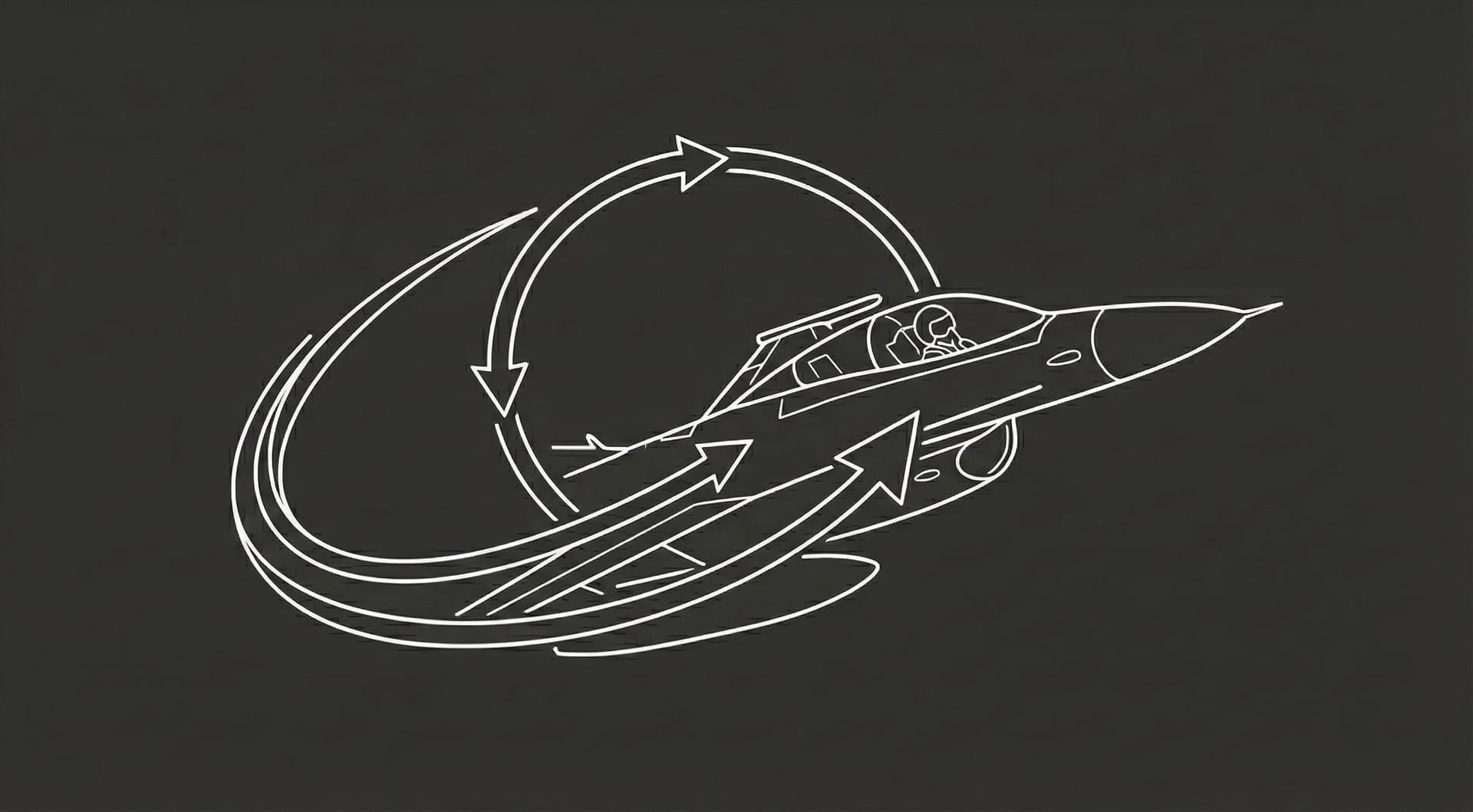
In the modern technology industry, "Speed" is a religion. We have "Sprints." We obsess over "Velocity" metrics in our issue trackers. We aim to "Move Fast and Break Things."
But most companies are not actually fast. They are just frantic.
There is a difference between rushing (moving your limbs quickly) and speed (winning the engagement quickly). You can run around a meeting room for hours, sweating and shouting, and achieve zero velocity.
The true definition of strategic speed comes from a man who never wrote a line of code, but who fundamentally changed how war is fought: Colonel John Boyd.
1. The Giant: John Boyd (The "Mad Major")
John Boyd (1927–1997) was arguably the greatest military strategist of the 20th Century, yet few outside the military know his name. He was a fighter pilot in the Korean War and later an instructor at the finest pilot school in the US Air Force.
He had a standing bet: He could defeat any pilot, in any position, in less than 40 seconds. He never lost the bet. They called him "40-Second Boyd."
How did he do it? He wasn't flying a faster plane. He often flew older, clunkier jets than his opponents.
He won because he understood the Metaphysics of Speed.
He realized that air combat wasn't about the hardware; it was about the mind. Combat was a series of time-cycles. If he could process the environment and change his strategy faster than his opponent, he could reset the game before the opponent even understood what was happening.
He codified this into a concept that now runs everything from the US Marine Corps to the boardrooms of the world's most aggressive companies: The OODA Loop.
2. The Theory: It’s Not a Circle, It’s a Short-Circuit
Most people think the OODA Loop is just a simple circle: Observe → Orient → Decide → Act.
This is the "Consultant Slides" version. It is too simplistic.
The real power of Boyd’s theory lies in the friction between the steps.
Phase 1: Observe (Data)
You look at the world. Market data, competitor pricing, system latency, customer feedback.
- The Corporate Failure: Most companies are stuck here. They suffer from "Analysis Paralysis." They think more data = better decisions. Boyd argued that too much observation slows you down.
Phase 2: Orient (The Filter)
This is the most important step.
Orientation is how you interpret what you see. It is shaped by your culture, your genetics, your past experiences, and your training.
- The Corporate Failure: This is where the incumbents die. They Observe the disruption (they see the data). But they Orient incorrectly. Their culture is "Legacy First," so they dismiss the new competitor as a toy rather than a threat.
- Wisdom Note: If your culture is rigid, your Orientation is flawed. You will see reality not as it is, but as you want it to be.
Phase 3: Decide (The Hypothesis)
You form a plan.
- The Corporate Failure: The "Committee." If your decision requires 4 signatures and a complex slide deck, your OODA Loop is broken. By the time you Decide, the market has moved.
Phase 4: Act (The Test)
You pull the trigger. You ship the code.
- The Corporate Failure: Fear. Companies optimize for "Zero Failure" rather than "Rapid Recovery." They delay the Act to polish the product endlessly.
3. The Strategy: "Getting Inside the Loop"
Boyd’s victory condition was simple: "Get inside the adversary's loop."
If your loop is 10 seconds (you observe and act in 10s), and your competitor’s loop is 10 minutes, you are effectively invisible to them.
- You strike.
- They Observe your strike.
- They start to Orient.
- BAM. You strike again from a different angle.
- They are now trying to Observe the second strike, but their Orientation for the first strike is now obsolete.
- Panic sets in.
This is how a small, agile team beats a massive Enterprise.
The Enterprise has more money, more engineers, and more data. But their OODA Loop is 6 months.
The agile team's OODA Loop is 6 hours (Deploy to Prod).
The small team changes reality faster than the Enterprise can file the paperwork to acknowledge the change.
4. The Artifact: The Decision Velocity Audit
How do you apply this? You need to find where your "Time Friction" is hiding.
As a Chief Wise Officer, you don't just ask "When will this be done?" You ask "Why is our Loop so slow?"
Use this audit to diagnose your organization.
🛠️ Tool: The Decision Velocity Audit
| OODA Stage | The Symptom of "Slowness" | The "Chief Wise Officer" Fix |
| 1. Observe | "We need another report before we can move." (Analysis Paralysis) | Implement "70% Rule": If you have 70% of the data, move. The last 30% takes too long and yields diminishing returns. |
| 2. Orient | "That's not how we do things here." (Cultural Dogma) | The "Red Team" Ritual: Assign someone to explicitly attack your company's worldview. Shatter the echo chamber. |
| 3. Decide | "Let's schedule a follow-up meeting to align." (Consensus Seeking) | Disagree and Commit: The leader decides. Dissenters must support the execution. Ban "Alignment Meetings" that have no decision agenda. |
| 4. Act | "We can't ship until Q4 because of the freeze." (Process Bloat) | Sovereign Teams: Give small teams the authority to break things. Remove dependencies. |
Summary
John Boyd died a Colonel, never a General, because he refused to play politics. He famously told his students:
"You can either be someone, or you can do something."
To Do Something in the modern age, you must respect Time as your primary resource.
Your competitors are not killing you because they are smarter. They are killing you because they are cycling through the loop while you are still staring at the data.
Don't try to be perfect. Be fast.
Orient quickly. Decide. Act.
Then look at the result, and do it again.
Further Reading
- "Boyd: The Fighter Pilot Who Changed the Art of War" by Robert Coram. (The definitive biography).
- "Certain to Win" by Chet Richards. (Applying Boyd to business).
- "A Discourse on Winning and Losing" - John Boyd’s collected briefings (Warning: Very dense).
No spam, no sharing to third party. Only you and me.
Member discussion