The Physiological Odyssey of Friedrich Nietzsche
I. Introduction: The Body as Destiny
The history of Western philosophy is traditionally charted as a spectral lineage of abstract concepts, a conversation between disembodied minds floating above the material world. From Plato to Kant, the philosopher is often portrayed as a vessel of pure reason, detached from the flesh. Friedrich Nietzsche shattered this illusion.
Nietzsche did not view philosophy as a pursuit of objective truth, but as a "confession of the body." He was a "Physio-Psychologist," a thinker who recognized that our metaphysical claims are often merely symptoms of our biological states. To understand the explosive trajectory of his thought, from the academic rigor of his youth to the hammer-blows of his final years, one must understand the vessel that contained it. His philosophy was a lifelong attempt to transmute immense physical suffering into a "Great Health," a creative affirmation of life that required not just a new way of thinking, but a new way of living.
This article traces that evolution, examining how his material conditions, from his early philological training and his optical failure to the mechanical intervention of the typewriter, forged the most radical philosophy of the 19th century.
II. The Philological Chrysalis and the Schopenhauerian Turn (1844–1869)
Born in 1844 in Röcken, Saxony, the son of a Lutheran pastor, Nietzsche was initially destined for the clergy. However, the "death of God" began for him not as a philosophical slogan, but as a personal reality: his father died of a brain ailment when Friedrich was only four. This early encounter with mortality and the subsequent domination of his household by pious women created a stifling atmosphere of moralistic heaviness he would spend his life trying to escape.
The Discovery of the Will
At the University of Leipzig, the young student stumbled upon Arthur Schopenhauer’s The World as Will and Representation in an antiquarian bookstore. It was a revelation. Schopenhauer argued that the world was driven by a blind, irrational, and insatiable "Will", a chaotic force of desire that leads inevitably to suffering. While Schopenhauer advocated for the denial of this Will (through asceticism and art), Nietzsche was captivated by the diagnosis. He saw the "Will" as the primal reality beneath the polite veneer of civilization.
The Youngest Professor
Nietzsche’s brilliance was undeniable. He threw himself into Classical Philology, the rigorous, historical study of Greek and Latin texts. His insights were so penetrating that the University of Basel appointed him Professor of Classical Philology at the unprecedented age of 24, before he had even completed his doctorate. He was an academic prodigy, yet he was already growing weary of the dry, dusty "grave-digging" of traditional scholarship. He wanted to breathe life back into the ancients.
III. The Tragic Age and the Wagnerian Seduction (1869–1876)
During his early years in Basel, Nietzsche fell under the spell of Richard Wagner. Living nearby in Tribschen, Wagner became a surrogate father figure. To Nietzsche, Wagner’s music drama represented a rebirth of the Greek spirit, a fusion of art and myth capable of saving German culture from mediocrity.
The Birth of Tragedy (1872)
Nietzsche’s first book was a declaration of war against the rationalism of his day. In The Birth of Tragedy, he introduced a dichotomy that would define his early thought:
- The Apollonian: The drive for order, individuation, dream, and plastic beauty (Sculpture).
- The Dionysian: The drive for chaos, intoxication, unity, and the destruction of the individual (Music).
Nietzsche argued that Greek greatness arose from the tension between these two forces. He claimed that Socrates and Euripides had destroyed Greek tragedy by imposing "reason" and "optimism" upon the tragic, Dionysian depths of life. He ended the book by suggesting that Wagner was the modern reincarnation of Aeschylus, destined to revive the Dionysian spirit.
The academic establishment, led by the strict philologist Ulrich von Wilamowitz-Moellendorff, savaged the book. They exposed it as "bad philology" (which it was) but missed that it was brilliant philosophy. Nietzsche’s reputation as a scholar was ruined, but his identity as a philosopher was born.
The Break with Wagner
The friendship could not last. In 1876, Nietzsche attended the first Bayreuth Festival and was horrified. Instead of a cultural revolution, he found a bourgeois spectacle suffused with German nationalism and vulgar anti-Semitism. Nietzsche, who was rapidly becoming a fierce opponent of racial hatred, realized that Wagner had pandered to the lowest instincts of the new German Reich to secure his fame.
The final intellectual severing came in 1878, when Wagner sent him the text of Parsifal. To Nietzsche, this story of chastity and redemption was a betrayal of their shared tragic ideals. He realized Wagner had "collapsed" at the foot of the Cross, trading the hard truth of life for the comforting drug of Christian salvation. The break was total; Nietzsche walked away from his father figure, entering a period of profound isolation.
IV. The Crisis of the Eye: The Free Spirit and the Machine (1876–1882)
Following the break with Wagner, the fragile truce Nietzsche had maintained with his own body shattered. He had never been a healthy man, severe migraines had plagued him since childhood, and his service as a medical orderly in the Franco-Prussian War (1870) had left him with chronic dysentery and diphtheria that permanently ravaged his digestion.
By 1879, these chronic conditions escalated into a total physiological revolt. The "Professor" could no longer function. Plagued by vomiting fits that lasted days and a progressive myopia that left him functionally blind for long stretches, he resigned his professorship at Basel. He was 34, a pensioner, a nomad, and physically broken.
Yet, it was precisely this collapse that birthed his philosophy of "Great Health." Nietzsche refused to view his illness as a defect. Instead, he began to treat his body as a laboratory, arguing that pain was not an objection to life, but a stimulant.
Human, All Too Human Liberated from the university, he began his "Free Spirit" period. He rejected Romanticism and metaphysics, turning instead to a cold, psychological dissection of human values. In Human, All Too Human (1878) and Daybreak (1881), he acted as a chemist of the soul, breaking down "divine" feelings into their base elements of vanity, fear, and survival instinct.
The Intervention of the Machine (1882) By 1882, his eyes failed him to the point where writing by hand caused agonizing pain. To save his career, his sister Elisabeth and friend Paul Rée acquired a Malling-Hansen Writing Ball, a brass hemisphere with 52 keys.
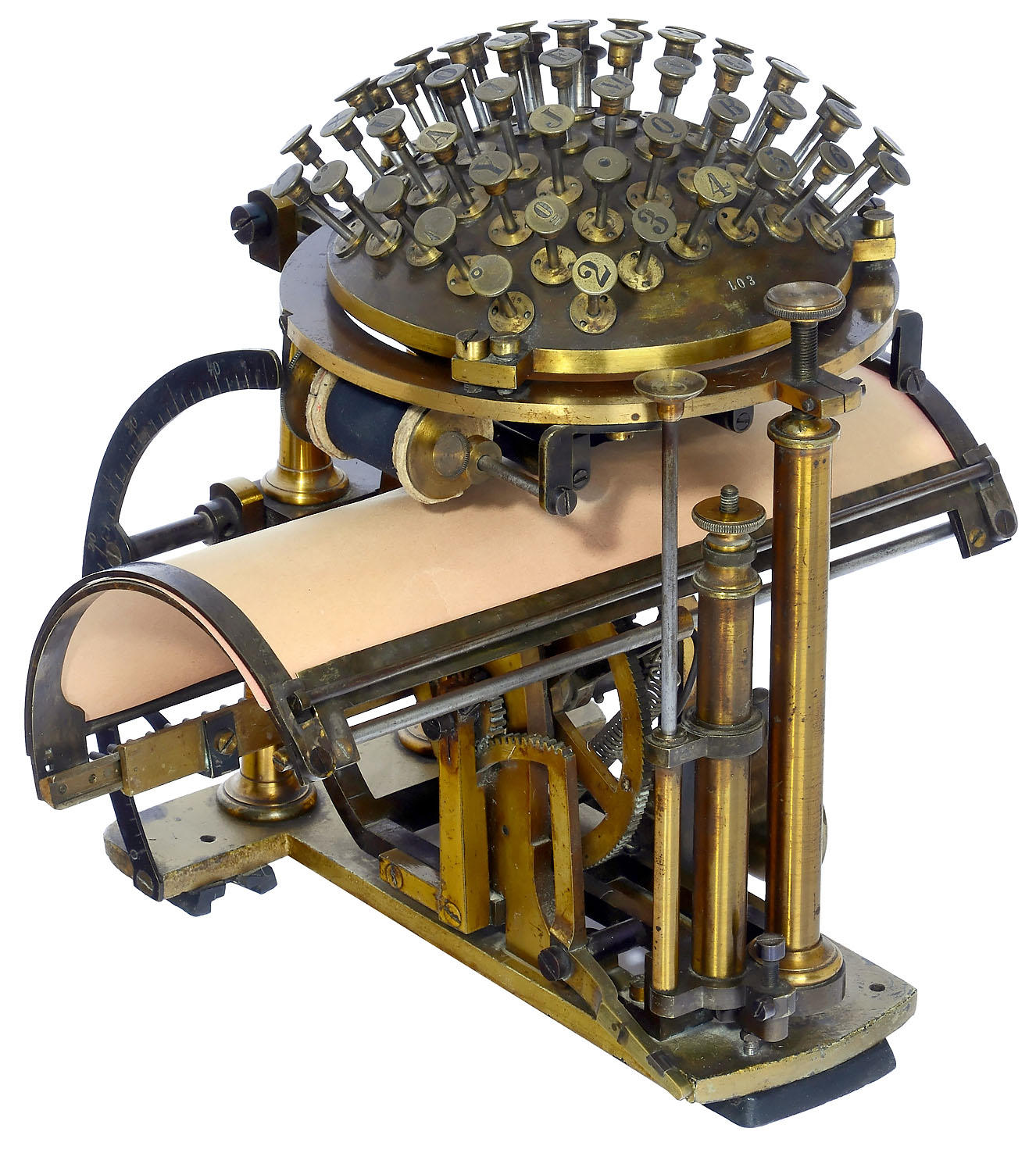
As Friedrich Kittler noted, "Our writing tools take part in the forming of our thoughts." Nietzsche’s style changed under the influence of the machine. The noise and difficulty of the device killed the long, winding sentences of his academic youth. In their place came the aphorism: punchy, metallic, and explosive:
- From Argument to Aphorism: The machine was noisy and difficult to use for long durations. It did not tolerate the long, winding German sentences of his academic youth. It demanded brevity.
- The Telegram Style: His prose became "harder," "denser," and more metallic. He moved from the treatise to the punchy, explosive aphorism.
- The Shout: The Writing Ball had no shift key, it wrote only in uppercase. His texts began to look like proclamations, devoid of the nuance of volume.
It was on this machine, and in this condition, that he wrote parts of The Gay Science, where he famously declared "God is dead." This was not a celebration, but a terrifying diagnosis: the horizon of meaning had been wiped away, and humanity was now adrift in an infinite, indifferent cosmos.
V. The High Noon: Zarathustra and the Eternal Recurrence (1883–1885)
The year 1882 also brought Lou Salomé, a brilliant Russian intellectual with whom Nietzsche fell desperately in love. Her rejection of his marriage proposal, and the subsequent "trinity" drama with Paul Rée, left Nietzsche suicidal. He retreated to the high Alps of Sils Maria, 6,000 feet above sea level. There, "6,000 feet beyond man and time," he experienced his greatest revelation.
The Eternal Recurrence
By a pyramidal rock near Lake Silvaplana, the thought struck him: What if you had to live this life, this exact life, with every spider, every headache, every heartache, over and over again for eternity? This was the Eternal Recurrence. It was the ultimate test of life-affirmation. To reject it was nihilism. To accept it, to say "Yes" to the infinite repetition of the moment, was Amor Fati (Love of Fate).
Thus Spoke Zarathustra
Fueled by this revelation, he wrote Thus Spoke Zarathustra. Written in a biblical, dithyrambic style (a parody of the Luther Bible he grew up with), it creates the figure of the Übermensch (Overman). The Übermensch is the one who can bear the weight of the Eternal Recurrence, who creates his own values on the earth, and who bridges the gap between the beast and the future. It is a book not of arguments, but of prophetic visions, largely composed during his "walks" where the rhythm of his legs dictated the rhythm of his poetry.
VI. The Campaign Against Modernity (1886–1888)
Having presented his "Yes" in Zarathustra, Nietzsche spent his final lucid years delivering a thunderous "No" to the foundations of Western culture. The "aphoristic" style honed by the typewriter became a weapon of war.
Beyond Good and Evil & On the Genealogy of Morals
In these texts, he ruthlessly dissected Christian morality. He introduced the distinction between:
- Master Morality: The values of the strong, the noble, and the life-affirming (Good vs. Bad).
- Slave Morality: The values of the weak, born of Ressentiment (resentment). The slave, unable to act, defines "Good" as whatever is harmless, humble, and obedient. He inverts the master's values, making strength "Evil" and weakness "Good."
Nietzsche argued that Europe had been poisoned by 2,000 years of Slave Morality, which had made man sick, tamed, and mediocre.
The Final Explosions (1888)
The year 1888 was a miracle of productivity. In mere months, he wrote Twilight of the Idols, The Antichrist, Ecce Homo, and Nietzsche contra Wagner.
- In Twilight of the Idols, he claims to philosophize "with a hammer," tapping the idols of the age to hear that they are hollow.
- In The Antichrist, he explicitly attacks institutional Christianity as a "curse" that sides with everything weak against everything strong.
- In Ecce Homo, his autobiography, he reviews his life not with humility, but with manic affirmation, with chapter titles like "Why I Am So Wise" and "Why I Write Such Good Books."
The tone of these late works is frantic, electric, and teetering on the edge of megalomania. The "machine" of his mind was spinning too fast for the gears to hold.
VII. The Collapse and the Silence (1889–1900)
The end came in Turin, the city of crisp lines and "aristocratic" air that Nietzsche loved. On January 3, 1889, Nietzsche exited his apartment at Via Carlo Alberto 6.
The Turin Horse
Legend holds that he saw a cab driver beating a stubborn horse. Nietzsche, the man who preached the hardness of the Übermensch, threw his arms around the beast’s neck, collapsing in tears. He had finally broken. The tension between his philosophy (hardness, distance) and his nature (immense sensitivity) had snapped. He was taken back to his room, where he scribbled "madness letters" to the erratic powers of Europe (The Pope, Bismarck, the King of Italy), signing them as "Dionysus" or "The Crucified."
The Sister and the Forgery
Nietzsche lived for another 11 years in a vegetative state, cared for by his mother and then his sister, Elisabeth. Elisabeth Förster-Nietzsche was the villain of his legacy. A fervent anti-Semite and German nationalist (everything Nietzsche detested), she took control of his literary estate. She took his disorganized notebooks—the "Nachlass"—and cut and pasted them into a book he never wrote: The Will to Power. Through this forgery, she twisted his "Will to Power"—which Nietzsche meant as a psychological drive for self-overcoming and sublimation—into a political will for domination. She dressed the invalid Nietzsche in white robes and displayed him to guests like a fallen prophet, while she sold his philosophy to the rising tide of German fascism.
VIII. Conclusion
Friedrich Nietzsche died in 1900, at the dawn of the century he predicted would be defined by "wars such as have never happened on earth." His life was a testament to the entanglement of the material and the mental. The "Great Health" he sought was not a freedom from pain, but the ability to transmute pain into perspective. From the loss of his father to the loss of his eyes, from the mechanical restrictions of the Writing Ball to the thin air of the Alps, every physical condition became a philosophical concept. He was the hammer, but he was also the stone.
Friedrich Nietzsche – Complete Bibliography
This list is organized chronologically by the period of composition. It includes the original German titles and a brief description of the work's significance.
I. The Early Period: Philology & The Tragic (1872–1876)
Traditional academic structures, heavily influenced by Schopenhauer and Wagner.
- The Birth of Tragedy (Die Geburt der Tragödie)
- Year: 1872
- Description: Nietzsche’s debut. Introduces the dichotomy between the Apollonian (order, dream) and the Dionysian (chaos, intoxication). Argues that Greek tragedy died when Socratic rationalism killed the Dionysian spirit.
- On Truth and Lie in a Non-Moral Sense (Über Wahrheit und Lüge im außermoralischen Sinne)
- Year: 1873 (Unpublished in his lifetime)
- Description: A groundbreaking essay arguing that "truth" is merely a mobile army of metaphors and anthropomorphisms; language is an artistic creation, not a reflection of reality.
- Untimely Meditations (Unzeitgemäße Betrachtungen)
- Year: 1873–1876
- Description: A series of four essays criticizing contemporary German culture:
- David Strauss: the Confessor and the Writer (Attack on pseudo-culture)
- On the Use and Abuse of History for Life (Critique of historical obsession)
- Schopenhauer as Educator (Tribute to his philosophical mentor)
- Richard Wagner in Bayreuth (Analysis of Wagner, showing early cracks in their friendship)
II. The Middle Period: The Free Spirit (1878–1882)
The Aphoristic style begins. Rejection of Romanticism and Metaphysics.
- Human, All Too Human (Menschliches, Allzumenschliches)
- Year: 1878 (Vol 1), 1879-1880 (Vol 2)
- Description: Dedicated to Voltaire. A "psychological chemistry" that dissects high ideals (art, religion, love) to reveal their base, human origins. The first definitive break with Wagner.
- Daybreak / The Dawn (Morgenröte)
- Year: 1881
- Description: Nietzsche begins his assault on Christian morality ("the morality of pity"). He explores the origins of "custom" and the fear that underpins social rules.
- The Gay Science (Die fröhliche Wissenschaft)
- Year: 1882 (Books 1-4), 1887 (Book 5 added)
- Description: The transition to his mature philosophy. Contains the first mention of the "Death of God" (Parable of the Madman) and the first formulation of the Eternal Recurrence. Written partly on the Malling-Hansen Writing Ball.
III. The Mature Period: The "Noon" and The Hammer (1883–1888)
The peak of his philosophy. The Übermensch, Will to Power, and the attack on Christianity.
- Thus Spoke Zarathustra (Also sprach Zarathustra)
- Year: 1883–1885
- Description: His literary masterpiece. A philosophical novel written in biblical style. Zarathustra descends from the mountain to teach the Übermensch (Overman), the Will to Power, and the Eternal Recurrence.
- Beyond Good and Evil (Jenseits von Gut und Böse)
- Year: 1886
- Description: A critique of modernity and "dogmatic" philosophy. Rejects the idea of universal truth. Introduces the concept of the "free spirit" who creates their own values "beyond" conventional morality.
- On the Genealogy of Morals (Zur Genealogie der Moral)
- Year: 1887
- Description: A polemic consisting of three essays. Defines Master Morality vs. Slave Morality and traces the concept of "guilt" back to the concept of "debt" (Schuld).
- The Case of Wagner (Der Fall Wagner)
- Year: 1888 (May)
- Description: A scathing critique of Richard Wagner, labeling him a "disease" and a symbol of modern decadence.
- Twilight of the Idols (Götzen-Dämmerung)
- Year: 1889 (Written Aug/Sept 1888)
- Description: Subtitled "How to Philosophize with a Hammer." A rapid-fire summary of his later philosophy, attacking the "idols" of reason, morality, and German culture.
- The Antichrist (Der Antichrist)
- Year: 1895 (Written Sept 1888)
- Description: A focused, venomous attack on institutional Christianity, which he calls the "one great curse" and a religion of pity that sides with the weak against the strong.
- Ecce Homo (Ecce Homo)
- Year: 1908 (Written Oct/Nov 1888)
- Description: His autobiography. A wild, manic review of his own works, interpreting his life as a destiny.
- Nietzsche contra Wagner
- Year: 1889 (Written Dec 1888)
- Description: A collection of passages from his earlier works selected to show that his opposition to Wagner was consistent throughout his life.
IV. Posthumous Collections (The Controversy)
- The Will to Power (Der Wille zur Macht)
- Year: 1901 (Published by Elisabeth Förster-Nietzsche)
- Description: Note: This is a compilation of his notebooks (Nachlass), not a book Nietzsche finished. It was heavily edited and arranged by his sister to support nationalist agendas. While it contains genuine Nietzschean thoughts, the structure is a forgery.
- Dithyrambs of Dionysus (Dionysos-Dithyramben)
- Year: 1891 (Written 1888)
- Description: A cycle of nine poems completed just before his collapse. They represent the lyrical, mystical side of his final days.
No spam, no sharing to third party. Only you and me.
Member discussion