
History: The Luddites Were Right — AI and the Automation of Craft
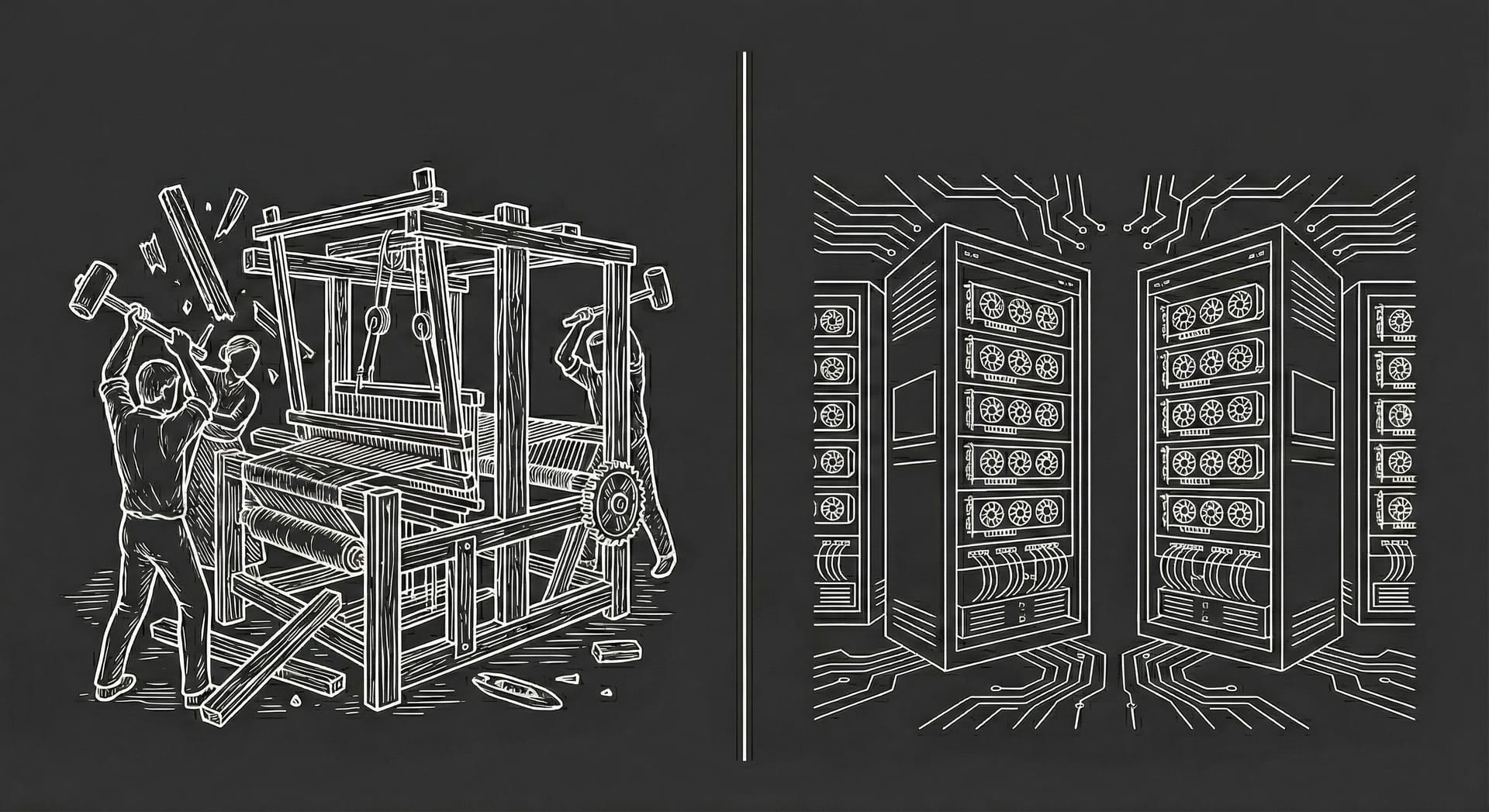
In the Tech industry, an insult you can throw at someone is to call them a "Luddite."
It implies they are backward, stupid, and afraid of progress. It suggests they are an old man yelling at a cloud (or in this case, the Cloud).
But this usage is a historical lie.
The original Luddites—the textile workers of 19th-century England—were not unskilled laborers terrified of buttons. They were Artisans. Specifically, they were Croppers and Stockingers: elite craftsmen who spent 7 years in apprenticeships to learn how to finish wool and weave complex patterns.
They did not smash machines because they were afraid of technology. They smashed machines because factory owners were using technology to bypass labor laws, produce inferior goods, and starve the skilled class.
As Generative AI (Gemini, ChatGPT) begins to automate the "weaving" of code, it is time to apologize to Ned Ludd. He wasn't wrong. He was just 200 years early.
1. The Myth of the Machine Breaker
The Luddite movement began in Nottingham in 1811. The weavers were facing a new technology: the Wide Frame loom. This machine allowed factory owners to produce stockings 6x faster.
But there was a catch. The stockings were "Cut-Ups"—inferior quality products.
- The Artisan Way: Knit a stocking in one continuous, seamless loop (custom fit, durable).
- The Machine Way: Knit a giant sheet of cheap fabric, cut it with scissors, and sew it together (seams that burst, fabric that unraveled).
The owners flooded the market with this cheap trash, driving down the price of quality goods and slashing the wages of skilled artisans.
The Luddites did not hate the machine itself; they hated the economic degradation it caused. In a famous 1812 letter signed by "General Ludd," they demanded that Parliament suppress only the:
"...machinery hurtful to Commonality."
They wanted the machines to be used to make better lives for the workers, not just higher margins for the owners. When the owners refused to negotiate, the workers picked up their sledgehammers (nicknamed "Great Enoch") and went to work.
2. The "Cut-Up" Code of the AI Era
Fast forward to 2025. We are facing our own Wide Frame loom: Generative AI.
Managers look at tools like Claude and see a way to produce code 6x faster. But just like the 1811 stockings, AI-generated code is often a "Cut-Up."
- It is syntactically correct but architecturally hollow.
- It works for the "Happy Path" but falls apart at the seams (Edge Cases).
- It introduces subtle security vulnerabilities that a Master Crafter would spot instantly.
If we blindly chase velocity ("Lines of Code per Day"), we are repeating the mistake of the textile owners. We are flooding the repo with low-quality fabric that looks like software but tears under stress.
3. The "Skill-Bias" Shift
The Luddites were eventually crushed by the British Army (who deployed more soldiers to fight the weavers than they did to fight Napoleon in Portugal). But the economic reality they fought against came true. The Artisan was replaced by the Operator.
We are seeing this similar shift in Engineering:
- The Artisan (Senior Dev): Understands the Why. Can architect a system from first principles.
- The Operator (Prompt Engineer): Understands the What. Can prompt an AI to generate a function but cannot debug it when it fails.
The Danger: If you replace your Artisans with Operators to save money, you lose the ability to innovate. You become a factory that can only produce what the machine has seen before.
4. How to be a "Neo-Luddite" Leader
To be a Neo-Luddite is not to ban AI. It is to demand that AI serves the craft, not just the bottom line.
1. Demand Quality over Quantity: Do not use AI to fire 50% of your staff. Use AI to let your staff build products that are 50% more ambitious.
- The Luddite View: "If the machine does half my work, I should work half as many hours for the same pay."
2. Protect the Apprenticeship: In the 1800s, the machines killed the apprenticeship model. Young workers became button-pushers and never learned the craft. If Juniors use AI to write all their code, they will never develop the mental models required to become Seniors. You must force them to "hand-weave" (write code manually) during their training.
3. Share the Productivity Gain: If AI makes your team 30% more efficient, reinvest that time in R&D, Learning, or Rest. Do not simply increase the ticket quota.
Summary
The Luddites didn't hate the Loom. They hated the poverty that the Loom brought.
As leaders, we must ensure that the "AI Revolution" is not just a wealth transfer from Engineers to Shareholders. We must use the machine to elevate the human, not to replace him.
If we don't, we shouldn't be surprised when the digital sledgehammers come out—in the form of "Quiet Quitting," sabotage, and the total collapse of code quality.
No spam, no sharing to third party. Only you and me.



Member discussion