
Lexicon: Validity
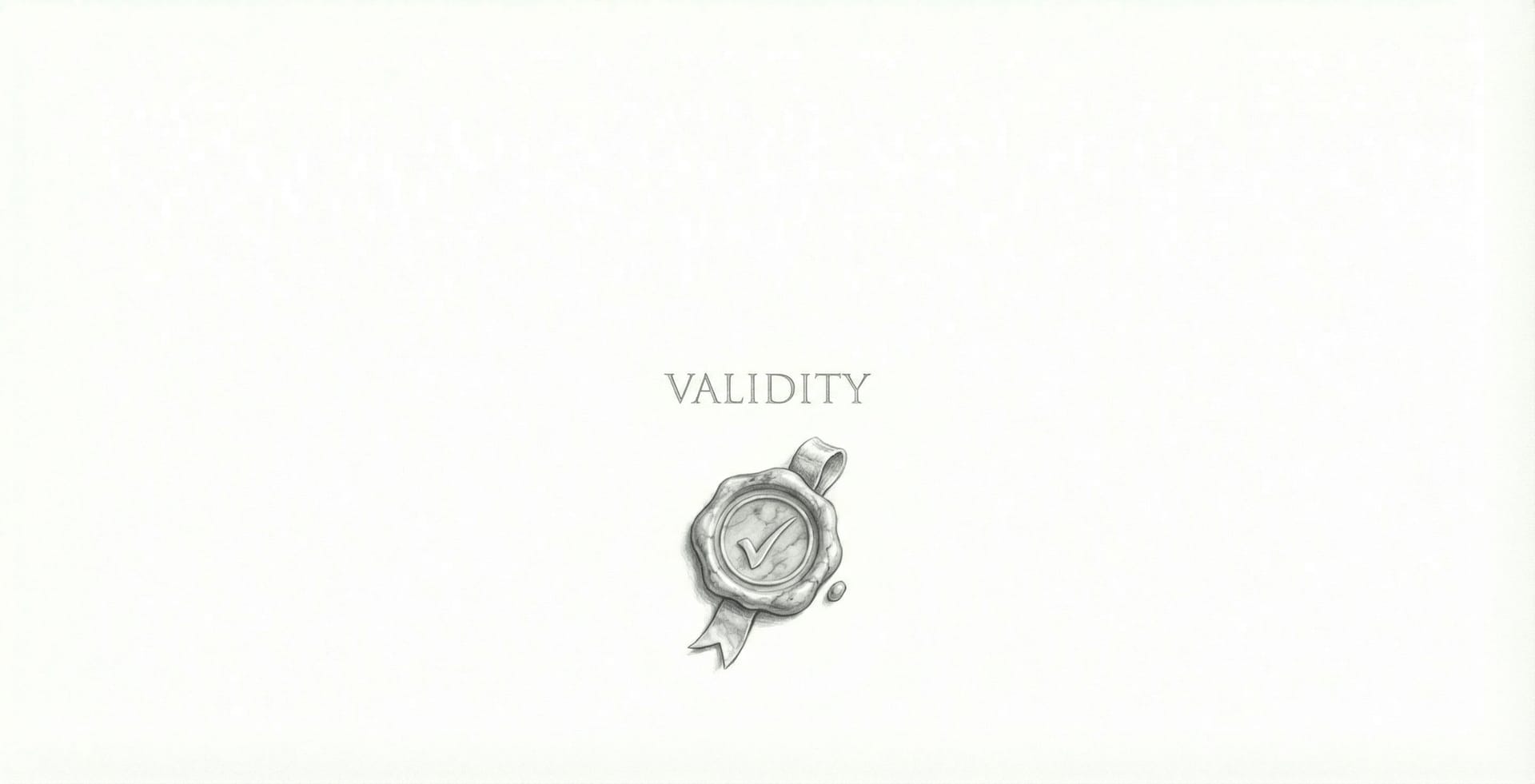
The Etymology
From the Latin validus, meaning "strong," "effective," or "powerful." In formal logic, Validity is a measure of structural strength, not factual accuracy.
The Definition
We often use the words "True" and "Valid" interchangeably in business. ("That's a valid point" usually means "I agree that is true"). But to a logician, and to a cryptographer, they are completely different concepts.
- Truth is about reality. Does this statement match the physical world? (e.g., "The sky is blue" is True).
- Validity is purely about structure. If the premises are accepted, does the conclusion mathematically or logically follow?
Consider this logical argument:
- All dogs are made of cheese.
- Fido is a dog.
- Therefore, Fido is made of cheese.
This argument is perfectly Valid. The structure is flawless. But it is completely False, because the first premise is a lie. Conversely, you can have a conclusion that happens to be True, but the argument is Invalid (e.g., "I drank coffee today, therefore it will rain tomorrow.")
Validity is about the rules of the system. Truth is about the raw data.
The Tech & Strategy Application
In the context of Zero-Knowledge Proofs (ZKPs) (see today's Main Article), understanding Validity is your strategic superpower.
1. The Verification Paradigm Historically, to verify a transaction, a bank had to look at the "Truth", they had to see your raw bank balance, your identity, and the transaction history. With cryptographic hashing and ZKPs, the blockchain doesn't look at the Truth. It only checks the Validity. The math proves that the rules of the system were followed (e.g., "Account A has sufficient funds to send to Account B") without ever revealing the underlying data (the Truth).
2. The Management Application The Chief Wise Officer applies this to organizational design. Micromanagers are obsessed with Truth. They want to see every raw data point, every email, and every line of code to ensure a project is on track. They hoard the data. Effective leaders manage by Validity. They build strong structural rules and constraints (e.g., "If the test suite passes and the budget is under $10k, ship it"). They don't need to see the underlying work to know the outcome is sound.
The Chief Wise Officer's Rule: Stop trying to hoard the Truth (toxic raw data). Instead, build systems that mathematically guarantee the Validity of the outcome. You do not need to see the secret to know the structure holds.
No spam, no sharing to third party. Only you and me.

Member discussion