
Lexicon: Logical Atomism
The Etymology
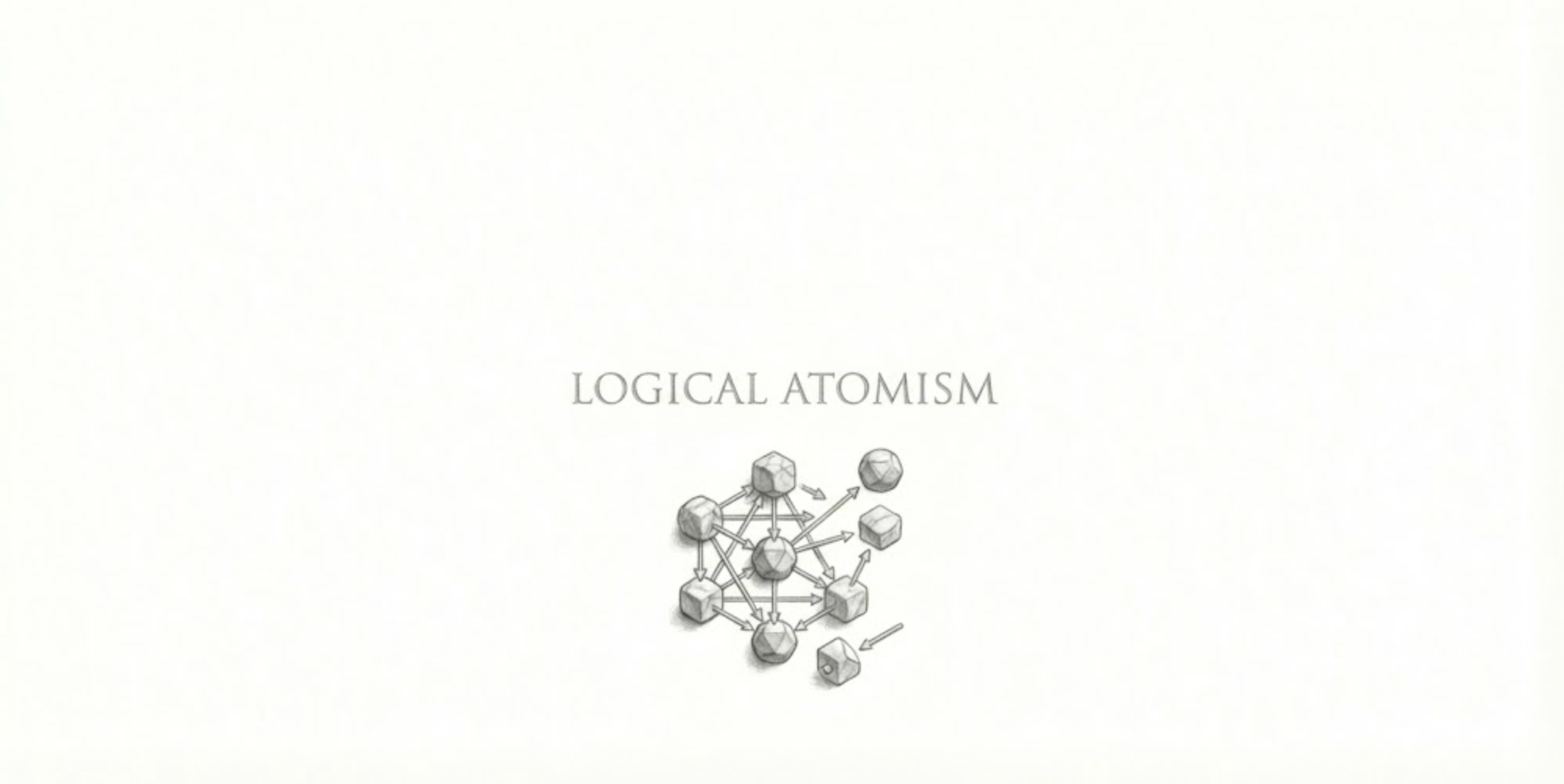
From Logic + the Greek atomos, meaning "indivisible" or "uncuttable." It is the philosophical belief that the world can be broken down into fundamental, indivisible facts, much like physical matter is composed of atoms.
The Definition
Pioneered by Bertrand Russell in the early 20th century, Logical Atomism is the ultimate reductionist philosophy. Russell argued that human language and thought are often messy, ambiguous, and full of complex assumptions. To find the "Truth," you must take a complex proposition and break it down, layer by layer, until you reach the "Atomic Facts", the absolute, indivisible units of reality that cannot be broken down any further.
- Complex Proposition: "The European market is failing." (Subjective, complex, hard to prove).
- Atomic Facts: "User acquisition in Germany dropped 12% in Q3." + "Server latency in Paris increased by 400ms." (Objective, indivisible, verifiable).
For Russell, a complex statement is only true if all of its underlying atomic facts are true. If you can map the atoms, you can understand the universe.
The Strategy Application
In the corporate world, we use Logical Atomism every day, usually calling it Root Cause Analysis or First Principles Thinking.
1. The Power of the "Atom" (Engineering) When a system breaks, panic ensues. "The entire platform is down!" The Chief Wise Officer uses Logical Atomism to cut through the panic. You apply the "Five Whys" to strip away the complex layers of the disaster until you find the atomic fact: An expired SSL certificate on the payment gateway. In technical and engineering contexts, Atomism is a superpower. It removes emotion and isolates the variable.
2. The Danger of the "Atom" (Culture & Markets) Where Russell’s philosophy fails, and where executives often stumble, is applying Atomism to human systems. You cannot reduce a toxic company culture or a sudden shift in consumer brand loyalty to a single "atomic fact." Human systems are Emergent. They are greater than the sum of their parts. If a leader tries to fix "low morale" by analyzing individual data points (e.g., "We need better snacks in the breakroom" or "We need a 2% bonus increase"), they are missing the holistic reality of the system.
The Chief Wise Officer's Rule: Use Logical Atomism to debug your software and optimize your supply chain. But abandon it when managing your people. Machines are made of atoms; cultures are made of webs.
No spam, no sharing to third party. Only you and me.
Member discussion