
Lexicon: Durée (Duration)
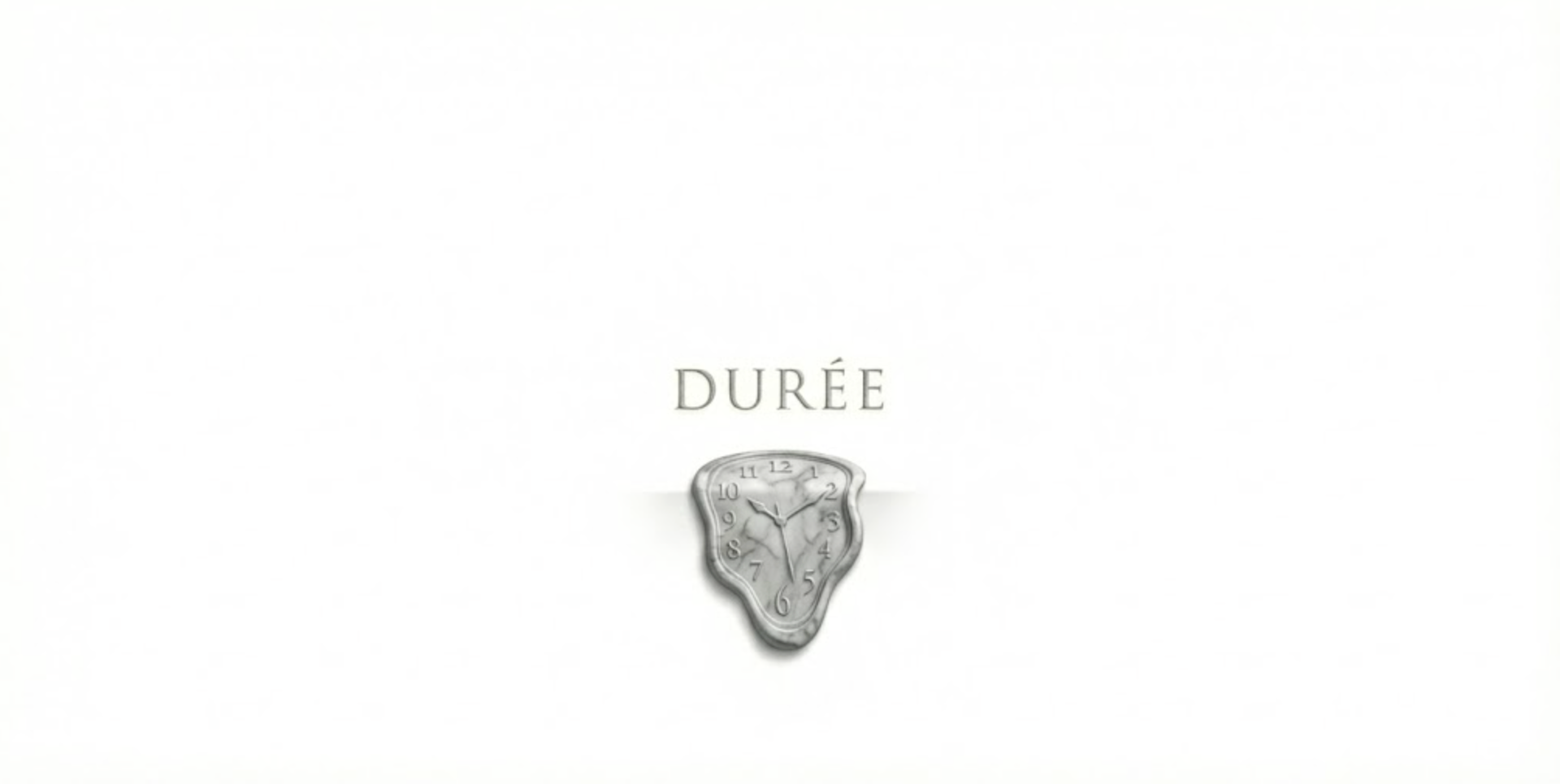
The Etymology
From the French durer (to last, to endure). Coined by Henri Bergson in his first major work, Time and Free Will (1889). It distinguishes Real Time (La Durée) from Mathematical Time (Le Temps).
The Definition
Bergson argued that we confuse Time with Space.
- Mathematical Time (Clock Time): This is time treated as a line. It is a series of discrete points (1:00, 1:01, 1:02). It is like a necklace of beads, each moment is separate, static, and measurable. This is useful for physics and train schedules.
- Duration (Real Time): This is time as experienced. It is continuous and indivisible. It is like a melody, you cannot separate one note from the next without destroying the song. The past melts into the present, which swells into the future. It is a flow, not a grid.
The Corporate Application
Corporations are obsessed with Clock Time.
- The Gantt Chart: Treats a project as a series of discrete blocks that can be stacked.
- The Hourly Rate: Treats human effort as a commodity that can be sliced into 60-minute units.
The "Duration" Error: Why do projects always slip? Because creative work happens in Duration. If you interrupt a developer or a writer for a "5-minute check-in," you haven't just lost 5 minutes of Clock Time. You have broken the Durée. You snapped the melody. The cost of the interruption is not 5 minutes; it is the time required to restart the entire flow state (often 30+ minutes).
Strategy:
- Manage Clock Time for logistics (Shipping, Meetings).
- Protect Durée for value creation (Deep Work, Strategy). Paul Graham famously called this the difference between "Manager's Schedule" (Clock Time) and "Maker's Schedule" (Durée). A wise leader respects the difference.
No spam, no sharing to third party. Only you and me.
Member discussion