
Kant’s Imperative: The Ethics of Dark Patterns (The End of "Users")
Have you ever tried to downgrade a software subscription, only to find the "Upgrade" button is one click, but the "Cancel" button requires you to "Schedule a Call with Success"?
Have you ever booked a flight, only to realize at checkout that a $30 "Travel Insurance" fee was sneaked into your basket via a pre-checked box?
Have you ever clicked "I Agree" on a cookie banner because the "Reject All" button was greyed out, tiny, and hidden in a sub-menu?In the tech industry, we call these "Dark Patterns."
We justify them with euphemisms. We call it "Conversion Rate Optimization (CRO)." We call it "Growth Hacking." We say we are "reducing friction" (for us, not the user).
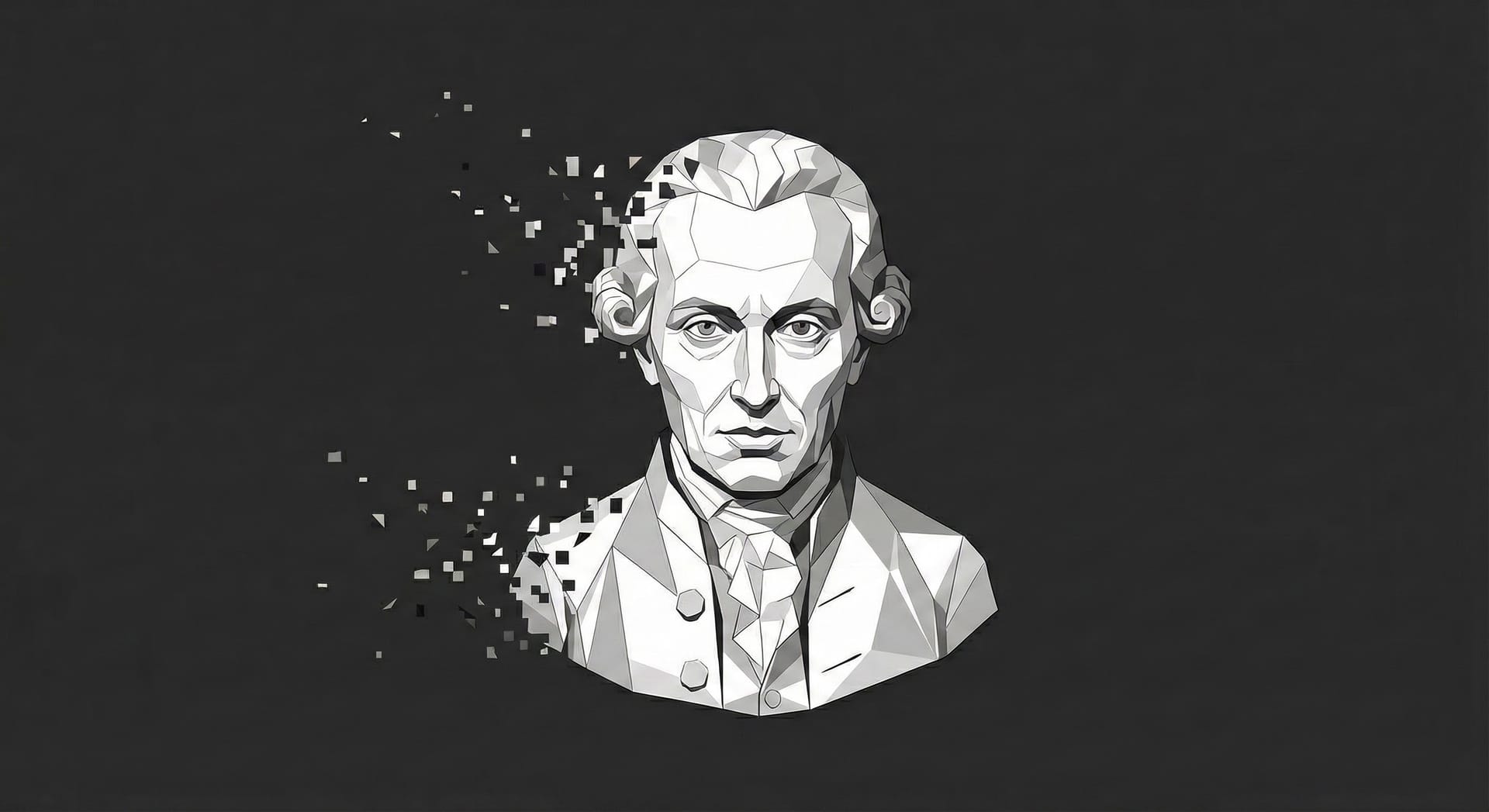
But if you ask Immanuel Kant, the 18th-century German philosopher, these aren't just annoying design choices. They are moral failures.
Kant argues that the moment you design a system that manipulates a human being solely to extract value from them, you have lost your right to call your business ethical.
1. The Giant: The Clockwork Philosopher
Immanuel Kant (1724–1804) was a man of such terrifying routine that his neighbors in Königsberg would set their clocks by his daily walk. He believed that Morality was not a matter of "feeling good" or "religion." It was a matter of Logic.
He proposed the Categorical Imperative—a supreme rule for behavior that is absolute. It has no "Ifs."
- Hypothetical Imperative: "If you want to be popular, don't lie." (Conditional).
- Categorical Imperative: "Do not lie." (Absolute).
He gave us two formulations that destroy the logic of modern Growth Hacking.
Formulation 1: The Universal Law
"Act only according to that maxim whereby you can, at the same time, will that it should become a universal law."
The UX Test:
If you hide the "Unsubscribe" button, you are effectively willing a world where everyone hides the unsubscribe button.
Imagine a world where every interaction—your toaster, your car, your door lock—required a 15-minute phone call to operate. The world would collapse.
Therefore, making cancellation difficult is not just annoying; it is logically incoherent. You are relying on a trust that you are actively destroying.
Formulation 2: The Formula of Humanity (The "User" Problem)
"Act in such a way that you treat humanity, whether in your own person or in the person of any other, never merely as a means to an end, but always at the same time as an end."
The Executive Lesson:
This is where Silicon Valley fails.
We literally call people "Users."
- To a drug dealer, a person is a user (a source of money).
- To a "Growth Hacker," a person is a user (a Monthly Active User / MAU).
When you design a "Dark Pattern" (e.g., a countdown timer to induce false urgency), you are bypassing the user's rationality. You are treating their anxiety as a tool to open their wallet.
You are treating the human merely as a means to your revenue target.
Kant would say this is the definition of evil.
2. The Ethics of "Nudging" vs. Coercion
Where is the line?
Is all marketing bad? No. Kant says we can use people as means (e.g., I use a taxi driver to get to the airport), provided I also respect them as an end (I pay them, I treat them with dignity, I don't trick them).
- Ethical Design (Respects Rationality):
- "Here is our product. It costs $10. Do you want it?"
- The user uses their reason to decide. Respects the End.
- Dark Pattern (Bypasses Rationality):
- "Start your free trial!" (Small print: charges $100 automatically in 7 days).
- The user is tricked. Their reason is bypassed. Treats them as a Means.
The Infinite Scroll Trap:
Infinite Scroll (TikTok/Instagram) is designed to suppress the user's "Stopping Cue." It exploits the dopamine loop to keep them engaged longer than they rationally intended.
It is a machine designed to override the human will. By Kantian standards, it is a violation of autonomy.
3. Why "Good Business" is not an Excuse
A CFO might argue: "But if we make cancellation easy, our Churn will go up!"
Kant does not care about your Churn.
Kant argues that if your business model requires you to trick people to survive, your business model is illegitimate.
The "Chief Wise Officer" Stance:
Profits are the result of value creation, not the justification for manipulation.
If you have to lock the doors to keep the customers inside, you aren't running a business; you are running a prison.
4. The Artifact: The Categorical Design Audit
Before you launch a new feature or marketing campaign, run it through the Kantian Audit.
Stop asking "Will this convert?" and start asking "Is this universal?"
🛠️ Tool: The Categorical Design Audit
Feature Name: ___________________
| The Design Choice | The "Universal Law" Test | The "Humanity" Test | Verdict |
| "Hard to Cancel" (Call to cancel) | Would I accept this if my bank/doctor did it to me? No. | Am I holding the user hostage against their will? Yes. | 🔴 Unethical |
| "False Urgency" (Only 2 items left!) | If everyone lied about stock levels, would anyone believe a stock counter? No. | Am I manipulating their anxiety for profit? Yes. | 🔴 Unethical |
| "Opt-In by Default" (Pre-checked boxes) | Do I want others to sign me up for things without my consent? No. | Am I respecting their active choice? No. | 🔴 Unethical |
| "Nudge" (Recommendation Engine) | Do I appreciate recommendations? Yes. | Does this help them find what they want, or what I want them to buy? Debatable. | 🟡 Caution |
Summary
The term "User Experience" (UX) implies that we care about the user.
But often, we only care about the User Exploitation.
Kant teaches us that you cannot build a long-term legacy on a foundation of short-term tricks.
Eventually, the users realize they are being treated as "Means." They feel the lack of dignity. And they leave.
The most "disruptive" thing you can do in 2025 is to treat your customer with radical, Kantian respect.
- Make cancellation one click.
- Make pricing transparent.
- Respect their attention.
Treat them as Ends, not Means.
Further Reading (Scholarship)
- "Groundwork of the Metaphysics of Morals" by Immanuel Kant. (The primary text).
- "Deceptive Patterns" (formerly darkpatterns.org) by Harry Brignull. (The modern catalog of UX sins).
- "Hooked: How to Build Habit-Forming Products" by Nir Eyal. (Read this critically as the "anti-Kant" manual).
No spam, no sharing to third party. Only you and me.



Member discussion