
The Hiring Bar: Why A-Players Hire A-Players (and B-Players Hire Disasters)

There is a moment in every startup’s life—usually around 50 employees—where the culture suddenly changes.
The velocity slows down. The meetings get longer. The "spark" seems to fade.
This is not an accident. It is a mathematical inevitability known as the Bozo Explosion.
Coined by Steve Jobs and popularized by Guy Kawasaki, the theory states:
- A-Players (Top performers) hire A-Players (or A+ players). They are confident and want to be challenged by the best.
- B-Players (Mediocre performers) hire C-Players. They are insecure and hire people they can dominate or who won't threaten their job.
- C-Players hire D-Players.
Once you hire your first B-Player in a management role, the Talent Density of your organization begins a recursive decline toward mediocrity.
Here is why maintaining the Hiring Bar is the single most important strategic decision a CEO makes, and how to stop the slide.
1. The Math of Talent Density
Most companies treat hiring as "filling a seat." If the seat is empty, we are losing productivity.
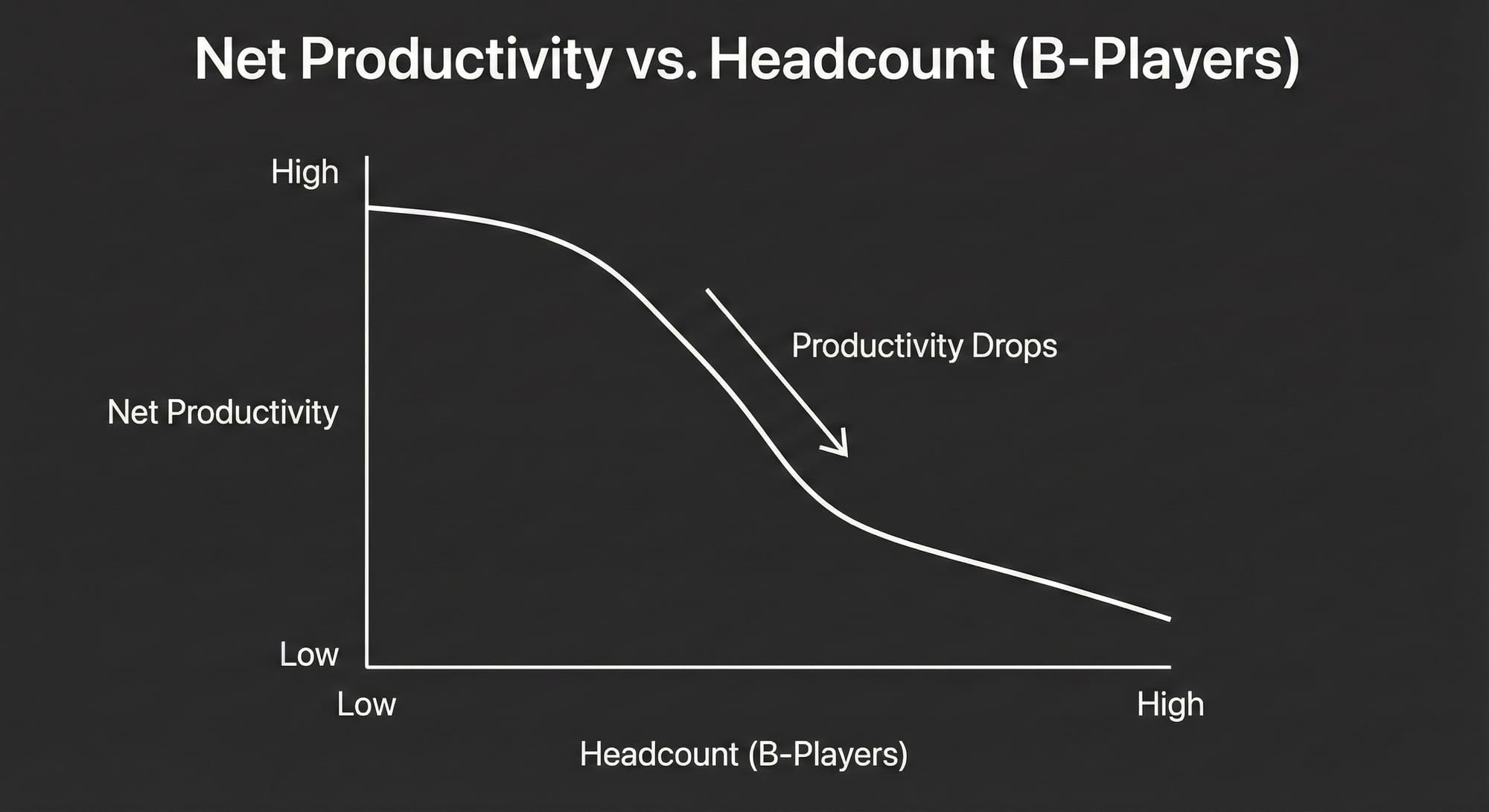
This is false. A bad hire is negative productivity.
Netflix CEO Reed Hastings argues that Talent Density is the primary driver of success.
- High Density: 10 Amazing Engineers. They communicate via shorthand. They trust each other. They ship fast.
- Low Density: 10 Amazing Engineers + 5 Mediocre Engineers.
You might think the output is "10 + 5 = 15."
In reality, the output drops to 8.
Why? Because the 10 A-Players now have to spend 30% of their time correcting the B-Players' code, explaining simple concepts, and fixing bugs. The "Net Output" decreases because the Coordination Cost explodes.
2. The Psychology of the "B" Manager
Why do B-Players hire C-Players? It isn't always incompetence; it is Survival Strategy.
- The A-Player looks at a candidate who is smarter than them and thinks: "This person will make me look good by delivering great work. I can learn from them."
- The B-Player looks at a candidate who is smarter than them and thinks: "This person will expose my mediocrity. They might take my job. I better hire someone 'manageable' instead."
This is the institutional cancer. Once B-Players infiltrate the hiring loop, they act as an immune system, rejecting excellence because excellence looks like a threat.
3. The "Bar Raiser" Mechanism (The Amazon Protocol)
How do you stop this? You cannot rely on the Hiring Manager alone (they are biased by the urgent need to fill the role).
You need a structural defense mechanism.
Amazon solved this with the "Bar Raiser" program.
In every interview loop, one interviewer is designated the "Bar Raiser."
- They are from a different department (no bias).
- They have Veto Power. Even if the Hiring Manager says "Yes," the Bar Raiser can say "No."
- Their only job is to answer one question: "Is this candidate better than 50% of the people currently in this role?"
If the answer is No, you don't hire.
This ensures that mathematically, the quality of the team increases with every hire, rather than regressing to the mean.
4. The "Hell Yes" Rule
If you are a smaller startup, you don't need a Bar Raiser program. You just need the "Hell Yes" rule.
When the interview team gathers to debrief:
- Pass: "They are okay. They can do the job. We are desperate."
- Fail.
If the reaction isn't "Hell Yes!"—if you aren't excited to sit next to this person and solve hard problems—it is a No.
"Maybe" is always "No."
A "Maybe" candidate becomes a "B-Player" employee who hires "C-Player" subordinates. The cost of an empty seat is high, but the cost of a "Maybe" is existential.
Summary
In our article on The Ship of Theseus, we argued that the "Crew" is the true identity of the ship.
If you replace your crew with B-Players, you haven't just lowered your velocity; you have fundamentally changed the nature of your company.
- Audit your Hiring Loop: Who has the final say?
- Implement the Veto: Give someone outside the team the power to kill a mediocre hire.
- Accept the Pain: It is better to leave a role open for 3 months than to fill it with a B-Player for 3 years.
A-Players attract A-Players. B-Players drive them away.
Protect your density at all costs.
No spam, no sharing to third party. Only you and me.


Member discussion