
The Architect of Duration: Henri Bergson’s Life, Philosophy, and Legacy
Introduction: The Philosopher Celebrity and the Modern Crisis of Time
In the intellectual history of the West, there are moments when a philosopher transcends the academy to become a cultural force, a prism through which an entire era views itself. In the opening years of the twentieth century, before the cataclysm of the Great War fractured the European psyche, that figure was Henri Bergson. To the contemporary observer, accustomed to the specialization and often marginalization of philosophical discourse, the scale of Bergson’s celebrity is difficult to fathom. He was not just a professor at the Collège de France; he was a phenomenon that prompted a fundamental re-evaluation of science, art, and faith. His lectures were events of such magnitude that they caused the first traffic jams in the history of Broadway during his visit to New York, and in Paris, society ladies sent their servants to hold seats in the lecture hall hours in advance, climbing drainpipes to catch a glimpse of the man who promised to liberate them from the tyranny of the clock.
Yet, the trajectory of Bergson’s legacy is as dramatic as it is instructive. From being the most celebrated thinker in the world, a Nobel laureate whose name spawned an "ism" that influenced Cubism, literature, and syndicalist politics, he descended into a period of relative obscurity, dismissed by the rising tides of analytic philosophy and hard physics. This report seeks to correct the historical record and resuscitate the vital insights of Bergson for the "Chief Wise Officer", the modern leader tasked with navigating complexity in an age dominated by algorithms and artificial intelligence.
We will traverse the arc of his life, from his origins as a mathematical prodigy to his stoic death in Nazi-occupied Paris. We will dismantle the misconceptions regarding his debate with Einstein, analyze the vitriolic attacks from Bertrand Russell, and explore the theological nuances that led the Catholic Church to ban his works despite his spiritual sympathies. Finally, we will demonstrate why Bergson’s philosophy is not an artifact of the past but a vital tool for the future, offering critical insights into artificial intelligence, neuroscience, and complexity leadership in the 21st century.
Chapter 1: The Mathematician Who Rejected Math
1.1 Roots and Early Genius
To truly grasp the magnitude of Bergson’s rebellion against scientific determinism, one must first appreciate his origins. He was not an outsider throwing stones at the citadel of science; he was a child of that citadel. Henri-Louis Bergson was born on October 18, 1859, in the Rue Lamartine, Paris, into a cosmopolitan Jewish family. His father, Michał Bergson, was a Polish-Jewish composer and pianist, a background that arguably instilled in Henri an early, intuitive appreciation for the temporal flow of music, a metaphor he would later use extensively to explain the continuity of time. His mother, Katherine Levison, was English-Jewish, and English was spoken fluently in the household, giving Bergson a cross-channel intellectual heritage that would later help him bridge Continental and Anglo-American thought.
It is a common error to dismiss Bergson as "anti-scientific" or ignorant of the hard sciences. In truth, his academic origins were deeply rooted in the very disciplines he would later critique. At the Lycée Fontanes (now Lycée Condorcet), Bergson was a brilliant student, excelling in both the humanities and the sciences. In 1877, he won the prestigious Concours Général prize in mathematics for his solution to a difficult problem by Pascal. This was no minor feat; it placed him among the intellectual elite of his generation before he had even entered university. His mathematics teacher, observing his pupil's eventual pivot toward philosophy, famously lamented: "You could have been a mathematician; you will be a mere philosopher".
This mathematical proficiency is not a trivial biographical detail; it is the cornerstone of his philosophical authority. Bergson did not reject mechanism because he could not understand it; he rejected it because he understood it too well. He saw that the beauty of mathematics lay in its ability to freeze the world into static symbols, an approach perfect for engineering and spatial analysis but, he would come to argue, fatal for understanding life. He possessed the technical rigor to dismantle the mechanistic worldview from the inside, understanding the limits of the calculus that others accepted as absolute truth.
1.2 The Crisis at Clermont-Ferrand
After graduating from the École Normale Supérieure in 1881, ranking second in the Agrégation de Philosophie, Bergson took up teaching posts in Angers and later at Clermont-Ferrand. It was here, in the quiet provincial capital of the Puy-de-Dôme, that Bergson experienced the intellectual epiphany that would define his career, a moment of insight that he would spend the rest of his life unfolding.
He had been a dedicated follower of Herbert Spencer, the English philosopher who attempted to explain all phenomena, including life and mind, through mechanistic evolution. Spencer’s philosophy was the dominant paradigm of the day, promising a unified theory of the universe based on matter and force. Bergson set out to refine Spencer’s theories, intending to shore up their foundations. However, as he contemplated the fundamental variables of mechanics, he hit a wall. He realized that the "time" used in physics and mechanics was not time at all. It was a spatial construct, a line drawn on a paper, a sequence of points on a clock face.
Real time, the time we experience when we wait for sugar to melt in a glass of water, had no such spatial quality. It was a continuous flow, an indivisible progression where the past gnawed into the future. Scientific time was reversible; if you ran the equations of mechanics backward, nothing changed. But lived time was irreversible; you could not un-melt the sugar or un-live a moment. This realization, that scientific time does not "endure", became the seed of his doctoral thesis, Time and Free Will (Essai sur les données immédiates de la conscience), published in 1889. This work launched his lifelong project: to save the concept of human freedom from the determinism of science by proving that science was looking at the world through the wrong lens.
Chapter 2: The Core Intuition — Time vs. Duration
To understand Bergson is to understand a single, difficult distinction: the difference between Time (as measured by science) and Duration (durée). This is the foundation upon which his entire metaphysics rests, and it is the key to resolving the apparent contradictions between his philosophy and the physics of his day.
2.1 The Spatialization of Time
Bergson argues that the human intellect is an evolutionary tool designed for action, not for speculation. To act upon the world, to hunt, to build, to calculate, we must break the world down into discrete, manageable units. We treat space as a "homogeneous medium," a grid where objects can be placed side by side, counted, and manipulated. This spatializing tendency is the source of our power over matter.
The error of the intellect, Bergson asserts, is that it treats time the same way it treats space. We visualize time as a line. We break it into seconds, minutes, and hours. We say that 2:00 PM is "after" 1:00 PM just as a chair is "next to" a table. Bergson calls this "spatialized time" or "quantitative multiplicity". In this view, time is a container filled with discrete moments, like pearls on a necklace. Each pearl is distinct, separate, and identical to the others in terms of spatial presence.
However, Bergson argues this is an illusion. A moment in time is not a physical object. The second that has just passed no longer exists; the second to come does not yet exist. When we measure time with a clock, we are not measuring time itself; we are measuring space. We are noting that the hand of the clock is at point A, and then later at point B. We are measuring the simultaneity of the clock hand with a moment of our life, but the measurement itself is static. The intellect, in its quest for precision, kills the very thing it seeks to measure. It turns the living flow of reality into a series of dead snapshots.
Bergson famously critiqued this "cinematographical" view of reality. Just as a film strip is composed of static images that, when run through a projector, create the illusion of movement, our intellect takes static snapshots of the world and strings them together. But the movement, the life, is in the projector, not the frames. Science studies the frames; philosophy must study the projector.
2.2 Qualitative Multiplicity: The Melody of Being
If scientific time is a necklace of pearls or a strip of film, what is real time? Bergson calls it durée (duration).
Duration is a "heterogeneous, qualitative multiplicity". The best metaphor, one Bergson uses frequently, is a melody. When we listen to a symphony, we do not hear a sequence of isolated notes: "C... then D... then E." If we did, there would be no melody, only a disjointed series of sounds. Instead, the notes melt into one another. The past notes endure into the present, coloring the current note, which leans into the future. The whole is an organic unity. If you interrupt the melody, you don't just "pause" a collection of objects; you destroy the qualitative experience of the flow.
This distinction is visually represented by contrasting the stark, segmented nature of a film strip with the fluid, interpenetrating nature of a color spectrum. In the "cinematographical" view (Quantitative Multiplicity), time is represented as discrete frames or distinct points on a line, rigid, separate, and countable. In the Bergsonian view (Qualitative Multiplicity), durée is represented as a flowing spectrum of interpenetrating colors, illustrating how the past gnaws into the future without separation. There are no boundaries where "red" stops and "orange" begins; there is only the transition.
This is how we experience our own consciousness. We are not a series of distinct psychological states (anger, then hunger, then joy). We are a flowing river where states interpenetrate.
- Quantitative Multiplicity: Countable, discrete, spatial (e.g., a flock of sheep). It is governed by number and space.
- Qualitative Multiplicity: Indivisible, continuous, temporal (e.g., a feeling of sadness deepening into despair). It is governed by intensity and flow.
By confusing these two, science falls into the trap of determinism. Determinists argue that the "state A" of the brain at time T1 causes "state B" at T2. Bergson counters that there is no "state A" or "state B", there is only a continuous flux. To slice the flux is to kill it. Therefore, human action cannot be predicted mathematically because the human personality is a growing, creative duration, not a mechanism. Freedom is found in the very flow of duration, where the self grows and creates itself in a way that is not determined by the past, but is a continuation of it.
Chapter 3: Matter, Memory, and the Body
Following the success of Time and Free Will, Bergson turned his attention to the relationship between the mind and the body, publishing Matter and Memory (Matière et mémoire) in 1896. This work is considered his hardest and most technical, as he engaged directly with the neuroscience of his day, specifically the study of aphasia (language disorders). It was a bold move for a philosopher to step onto the turf of the physiologists, but Bergson felt it was necessary to prove that his metaphysics could withstand empirical scrutiny.
3.1 The Brain is Not a Hard Drive
The prevailing scientific view in the 1890s, which persists in many popular understandings of neuroscience today, was the "container" theory of memory: the brain stores memories like a library stores books, or a hard drive stores files. The assumption was that if you damage a specific part of the brain (the shelf), the memory (the book) is destroyed. This parallelism suggested that every mental state had a corresponding physical state in the brain tissue.
Bergson rejected this entirely. He spent five years studying the literature on aphasia (loss of speech) and noted a peculiar pattern. Patients with brain lesions often lost the ability to speak words but still understood them, or could use the word in one context but not another. He argued that if the memory were truly "erased" from the tissue, such partial recall, or the sudden return of memories in moments of shock, would be impossible. The physical trace theory could not explain the dynamic fluidity of memory recall.
Bergson proposed a radical alternative: The brain is not a reservoir of images; it is a telephone exchange. Its function is not to store the past, but to filter it. The past, for Bergson, preserves itself automatically. Every moment we have ever lived exists in our "pure memory" or the virtual. If we remembered everything all the time, we would be overwhelmed, paralyzed by the sheer volume of information, and unable to act in the present. The brain's job is to suppress 99.9% of our memories, acting as a reducing valve that allows through only those that are relevant to the present action.
3.2 The Cone of Memory
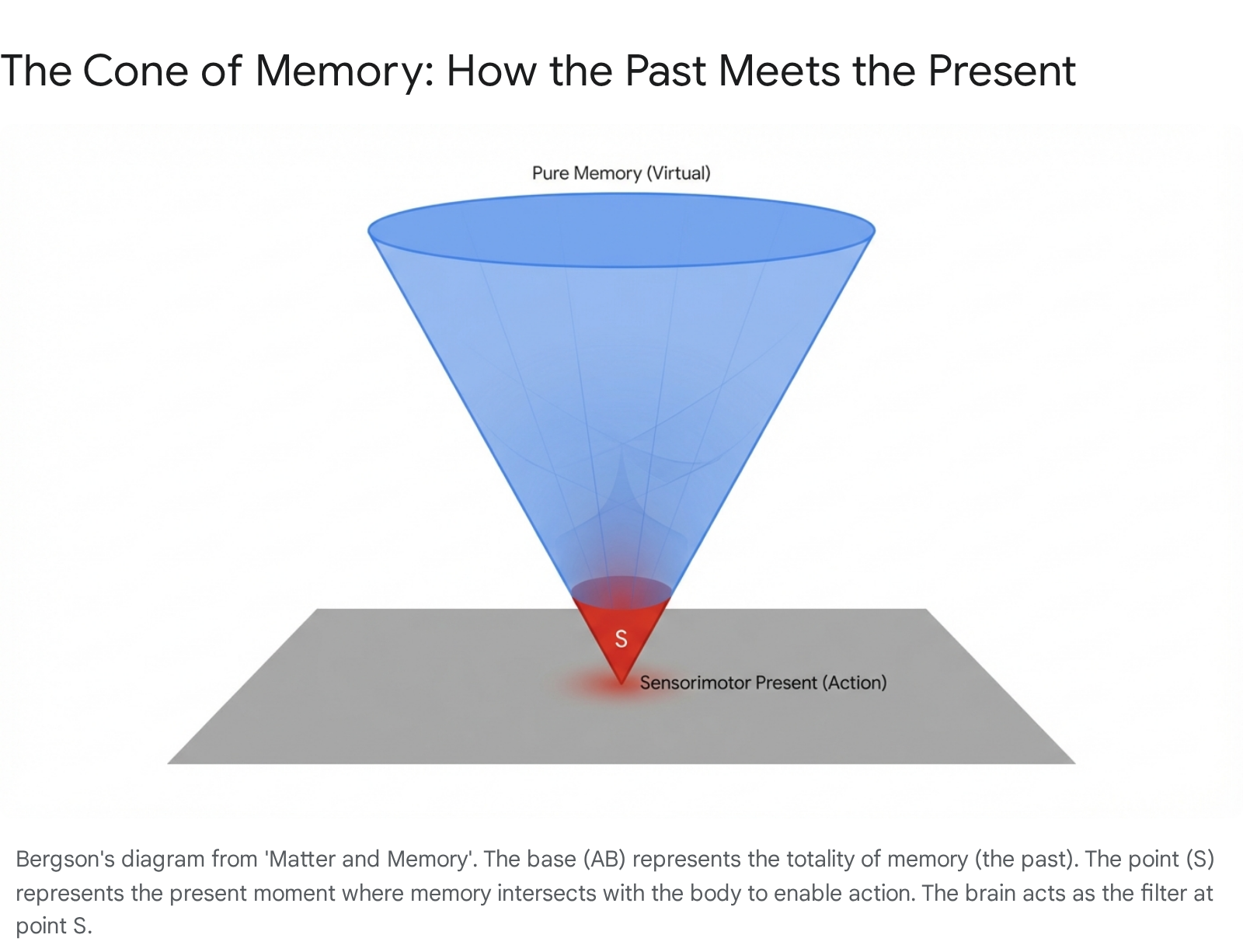
To explain this interaction between the limitless past and the focused present, Bergson introduced one of the most famous diagrams in the history of philosophy: the Inverted Cone.
The diagram visualizes the totality of the self.
- The Base (AB): Represents the totality of our past, hovering in the "virtual." It contains every memory, detailed and personal, immobile and timeless. This is the "Pure Memory."
- The Point (S): Represents the present moment, where the cone touches the plane of matter (the body). This is the "Sensorimotor Present."
- The Mechanism: To act, we must "contract" our memory. We bring the relevant memories from the base down to the point S, where they are "motorized" into action by the body.
The body, therefore, is the mechanism that anchors the spirit to reality. It limits the life of the mind to ensure biological survival. When the brain is damaged, the memories are not destroyed; rather, the mechanism for accessing them, the point of the cone, is broken or blunted. The "connection" to the plane of reality is severed, leaving the memories floating in the virtual, inaccessible but intact. This theory allowed Bergson to maintain a form of dualism (spirit vs. matter) while integrating them tightly through the function of memory. It suggests that consciousness is not in the brain, but uses the brain to focus on the world.
Chapter 4: The Vital Impetus — Creative Evolution
In 1907, Bergson published his masterpiece, Creative Evolution (L'Évolution créatrice). This book catapulted him to international fame and remains his most controversial work. It addressed the hottest topic of the era: Darwinism. While Bergson accepted evolution as an undeniable fact, he launched a devastating critique against the mechanistic explanations for how it occurred.
4.1 Beyond Mechanism and Finalism
Bergson identified two dominant philosophical approaches to evolution, both of which he found wanting:
- Mechanism (Darwin/Spencer): This view treats evolution as the result of random accidents (mutations) and external forces (environment) pushing matter around. It assumes that the future is calculated by the past; if one knew the position of every atom at the beginning of time, one could predict the entire history of life. Mechanism denies time because everything is implicitly given in the cause.
- Finalism (Leibniz/Aristotle): This view argues that evolution is the realization of a pre-existing plan or goal (telos). The oak tree is already "in" the acorn; the history of life is just the unveiling of a blueprint existing in the mind of God.
Bergson argued that both views make the same fundamental mistake: they assume that "all is given" (tout est donné). They both deny the reality of creation. In mechanism, the future is just a rearrangement of the past. In finalism, the future is just the realization of the eternal. Neither allows for the emergence of true novelty.
4.2 The Élan Vital and the Eye of the Scallop
Bergson proposed a third way. He suggested that life is driven by an original internal current, the élan vital (vital impetus). This is not a mystical fluid or a physical force in the Newtonian sense, but a tendency toward organization and creation, a blast of potentiality that struggles against the entropy and inertia of matter.
As the élan vital pushes through matter, it encounters resistance. To overcome this, it splits and diverges, much like an exploding shell or a river meeting obstacles. This explains the branching tree of life: plants took the path of torpor and energy accumulation (photosynthesis), insects took the path of instinct, and vertebrates took the path of intelligence.
To demonstrate why mechanism is insufficient, Bergson famously analyzed the evolution of the eye. He compared the eye of the Pecten (a scallop) with the eye of a vertebrate. These two lineages diverged millions of years ago, long before the development of complex eyes. Yet, both evolved an incredibly complex structure, lens, retina, cornea, that functions in a remarkably similar way.
- The Bergsonian Critique: If evolution were only the result of random, accidental mutations (Mechanism), the mathematical probability of two separate lineages independently stumbling upon the same complex arrangement of thousands of parts is vanishingly small. It would be like two people walking blindly in opposite directions and both accidentally building identical watches.
- The Vitalist Solution: Bergson argues this convergence proves there is a common impulse behind life. The eye is not built by adding part upon part; it is a simple act of vision trying to manifest itself through matter. The complexity of the mechanism is just the shadow cast by the simple act of the élan vital pushing against the resistance of matter.
This book was not just a biological thesis; it was a cosmological one. It argued that the universe is not a clockwork machine but a "machine for the making of gods", a creative process that is open-ended, indeterminate, and constantly generating novelty. The universe is not "made"; it is "being made" continuously.
Chapter 5: The Era of "Bergsonism" and the Cult of the Drainpipes
By 1910, "Bergsonism" was not just a philosophy; it was a vogue, a mania, a cultural zeitgeist. Bergson was appointed to the Chair of Ancient Philosophy at the Collège de France in 1900, and his lectures became the hottest ticket in Paris.
5.1 The Scene at the Collège de France
The atmosphere at Bergson's lectures was unlike anything the academic world had seen. The audiences were a heterogeneous mix of students, tourists, artists, clergy, and, famously, society ladies. The crowds were so immense that the lecture halls overflowed. People stood in the corridors, and students would climb up the drainpipes of the building to peer in through the windows or listen from the courtyard, a detail that became part of the Bergson legend and a symbol of his crossover appeal.
This popularity was double-edged. To the rationalist establishment and the hard left, Bergson was a dangerous peddler of irrationalism. They viewed the crowds as evidence that his philosophy was a fashion statement, a comfort for the wealthy who wanted to believe in the soul without adhering to the dogmas of the Church. The anti-Semitic right, led by the nationalist movement Action Française, attacked him viciously. They framed his philosophy as a corruption of French Cartesian clarity, which they saw as masculine, logical, and orderly, by "Jewish fluidity," vagueness, and cosmopolitanism. Critics mocked the "fashionable" nature of his audience, dismissing his philosophy as something for "swooning ladies" rather than serious thinkers.
5.2 Influence on Proust and Art
Despite the mockery, Bergson’s influence on the arts was profound and lasting. Marcel Proust, who was Bergson’s cousin by marriage (Bergson married Louise Neuburger in 1891), was deeply influenced by the concept of durée and memory. Proust’s monumental work, In Search of Lost Time, is effectively a literary application of Bergson’s theory of memory, the idea that the past is not dead but alive in the virtual, waiting to be triggered by a sensory experience (like the taste of a madeleine) to flood back into the present.
Bergson’s emphasis on intuition and the fluidity of experience also resonated with the Cubists and Modernists, who sought to break down the static, single-point perspective of traditional art (a spatialized view) to capture the simultaneity and movement of lived reality.
Chapter 6: The Great Schisms — The 1922 Einstein Debate
The standard narrative is that Bergson, the philosopher, tried to correct Einstein, the physicist, on a matter of science, failed miserably, and was rightly relegated to the dustbin of history. This narrative is not only reductive; it is a distortion of the intellectual stakes of the 20th century.
6.1 The Meeting in Paris
On April 6, 1922, the Société française de philosophie hosted a meeting between Henri Bergson and Albert Einstein. It was billed as the dialogue of the century: the greatest philosopher of time meeting the greatest physicist of time.
Bergson spoke first. He praised Einstein’s mathematical achievement but argued that relativity, while physically true, did not capture the whole of time. He argued for a "lived time" (temps vécu) that underpinned the mathematical abstractions of relativity. He suggested that before one can measure time with clocks, one must first have a concept of simultaneity that is derived from the immediate experience of life.
Einstein’s response was brutal and brief. Speaking in German, and then translated, he dismissed Bergson’s entire project with a single, devastating sentence: "Il n'y a donc pas un temps des philosophes" ("There is therefore no time of the philosophers"). He asserted there is only psychological time (which is an illusion) and physical time (which is reality). This remark signaled a rupture between philosophy and physics that has arguably never healed.
6.2 The "Twin Paradox" Controversy and the Nature of Time
The conflict centered on the interpretation of the Twin Paradox. In special relativity, if one twin stays on Earth and the other travels at light speed, the traveler returns younger than the one who stayed. Bergson, in his controversial book Duration and Simultaneity, argued that this paradox was a result of confusing the perspective of the physicist with the reality of the traveler. He argued that while moving, the traveler does not experience slowed time; the slowing is only a mathematical artifact calculated by the observer on Earth.
The Correction: The standard scientific view is that Bergson simply "didn't understand the math" and was humiliated when experimental evidence later proved time dilation is physically real (e.g., atomic clocks on airplanes run slower). This view, propagated by later physicists, damaged his reputation for decades.
However, recent scholarship, notably by Jimena Canales in The Physicist and the Philosopher, argues that Bergson was not making a mathematical error. He was making a metaphysical point about the nature of measurement that Einstein missed. Bergson accepted the equations of the Lorentz transformation. What he rejected was the interpretation that time itself (as a lived reality) dilates in a way that makes it reversible or spatial.
Bergson argued that Einstein was "spatializing" time into a fourth dimension, treating it as a reversible coordinate in a block universe. For Bergson, if time is reversible (as it is in the equations of block-universe physics), it is not time. Real time involves aging, creation, and irreversibility. You cannot turn the clock back on a life.
While Bergson was technically wrong about the specific physical outcome of the Twin Paradox in terms of clock readings, his core philosophical critique, that physics ignores the experience of time and the irreversibility of becoming, remained potent. Nobel laureate Ilya Prigogine, a pioneer in non-equilibrium thermodynamics, later defended Bergson, arguing that classical and relativistic physics indeed failed to account for the "arrow of time" which is fundamental to thermodynamics, biology, and human life. Prigogine viewed Bergson not as a confused mystic, but as a precursor to a physics that would finally take time seriously as a constructive force.
Chapter 7: Critics and The Church — The Index Librorum Prohibitorum
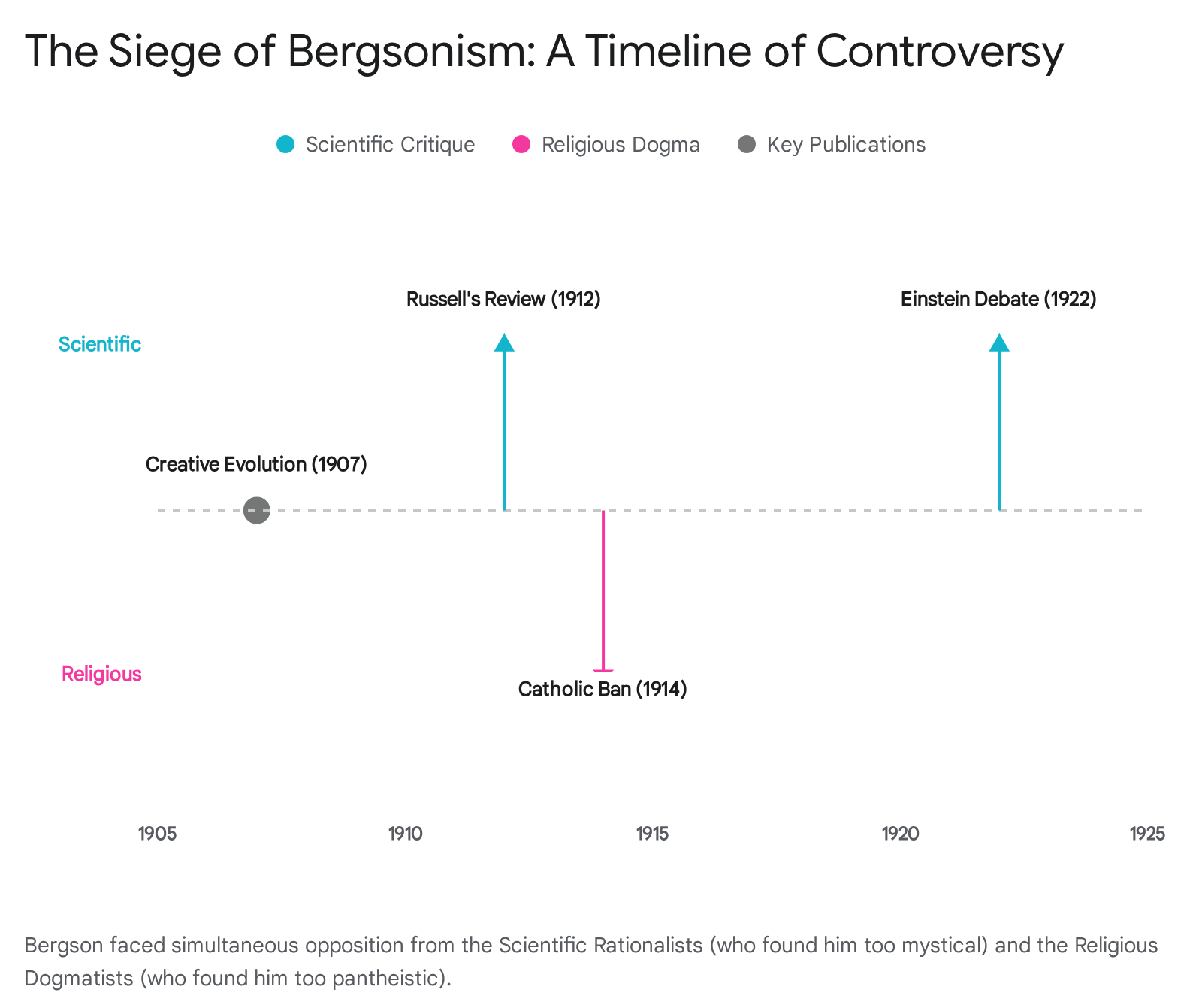
Bergson fought a war on two fronts: against the materialist scientists (like Einstein) who thought he was too mystical, and against the rationalist and dogmatic theologians who thought he was too radical.
7.1 Bertrand Russell’s "Bees and Ants"
Bertrand Russell, the champion of analytic philosophy, logic, and pacifism, despised Bergsonism with a passion that bordered on the irrational. He viewed Bergson’s reliance on "intuition" as anti-intellectual, a surrender of reason to emotion that paved the way for dangerous irrationalism.
In his polemics, Russell famously quipped that Bergson’s philosophy of instinct was best suited for "bees and ants" rather than human beings, who should aspire to reason. He argued that:
- Bergson’s "intuition" was just a fancy word for instinct, which is blind and limited.
- Bergson’s critique of the intellect was self-defeating because he used his intellect to formulate it.
- The philosophy of durée was simply a confusion of mathematics; Russell believed that the calculus had solved Zeno’s paradoxes and that "continuity" could be mathematically defined without resorting to mystical flow.
Russell’s critique was instrumental in solidifying the split between "Analytic Philosophy" (Russell, Anglo-American, logic-focused) and "Continental Philosophy" (Bergson, French/German, experience-focused). He effectively excommunicated Bergson from the anglophone philosophical canon for decades.
7.2 The Catholic Ban
Initially, many Catholic intellectuals embraced Bergson. In an era where science was becoming increasingly atheistic and deterministic, Bergson seemed to be a savior. He attacked materialist determinism, argued for the reality of the spirit, and defended free will. He seemed to open a door for the soul.
However, the romance was short-lived. In 1914, the Vatican placed all of Bergson’s major works on the Index Librorum Prohibitorum (The Index of Forbidden Books). This was a severe blow to Bergson, who had hoped his philosophy would be compatible with Christian faith.
Why? The primary charge was Pantheism. In Creative Evolution, Bergson described the élan vital as a creative force immanent in the world, evolving through struggle. He did not describe a transcendent God who stands outside the world and creates it from nothing (creation ex nihilo). To the Church, Bergson’s "God" was not a sovereign ruler but a process, a God who is "making himself" along with the universe. This view, where God is synonymous with the creative effort of life, was dangerously close to the heresies of Modernism that Pope Pius X was actively stamping out. The Church feared that Bergson’s "fluid" God undermined the eternal, unchanging nature of dogma.
Chapter 8: The Final Years and the Myth of the Star
As Bergson aged, his body failed him. He suffered from severe, crippling arthritis that left him largely confined to his home, forcing him to retire from public life after receiving the Nobel Prize in Literature in 1927, an award he could not accept in person. Yet, his mind continued to evolve, moving from the biological focus of Creative Evolution toward the spiritual and moral.
His final major work, The Two Sources of Morality and Religion (1932), distinguished between:
- Closed Morality: Morality based on social pressure, instinct, and survival. It is the morality of the "tribe" or the ant-hill, focused on social cohesion and defense against the "other."
- Open Morality: Morality based on the creative emotion of the mystic and the saint. It breaks the boundaries of the group to encompass all humanity. It is dynamic, driven by love rather than obligation.
8.1 The "Standing in Line" Story: Truth vs. Legend
The "truth" about Bergson's death and the yellow star, it is one of the most poignant stories in the history of philosophy, often retold with varying degrees of accuracy.
The popular legend is this: In Nazi-occupied Paris, the elderly Bergson, though offered an exemption from the anti-Semitic laws by the Vichy government, refused it. He famously rose from his sickbed, donned his slippers and dressing gown, and stood in line in the rain to register as a Jew. As a result, he contracted pneumonia and died a martyr to solidarity.
The Historical Reality:
The core of the story, his profound act of solidarity, is true, but the dramatic details are often exaggerated or conflated.
- Refusal of Exemption: It is a documented fact that the Vichy government, respecting his immense global fame and contribution to French culture, offered him an exemption from resigning his honorary posts and registering as a Jew. Bergson explicitly refused to accept this "special treatment." He wrote to the authorities that he would not accept an exemption while his people were being persecuted.
- The Registration: It is debated by biographers whether he physically stood in the line. Some accounts suggest he wanted to go but was too ill to leave his bed. Others say he did go to the police station, supported by a nurse. What is documented is his intent and his formal rejection of safety.
- The Conversion: Bergson had drifted very close to Catholicism in his later years. He stated in his will (written in 1937) that his "reflections had led him to Catholicism," and that he felt a great spiritual affinity with the mystics of the Church. However, he refused baptism. Why? Because he foresaw the "formidable wave of anti-Semitism" rising in Europe and wanted to remain among "those who will be persecuted".
He died on January 3, 1941, of bronchitis/pneumonia, exacerbated by the cold and the occupation conditions. A Catholic priest said prayers at his funeral, as he requested, but he died a Jew, maintaining a "moral position" of absolute integrity.1
Chapter 9: Bergson in the Age of AI — Why He Matters Now
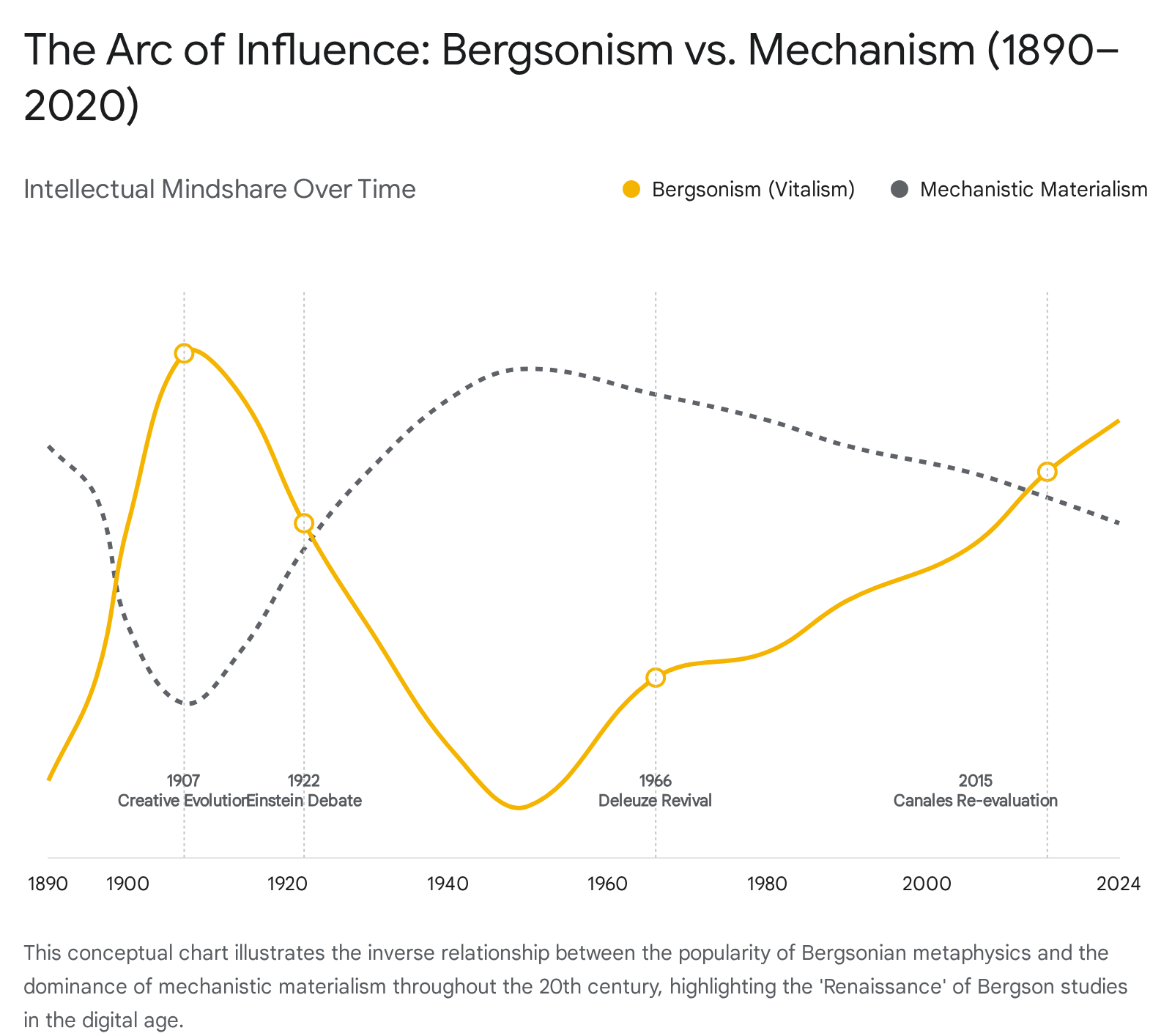
Bergson's philosophy fell dormant after WWII, eclipsed by Existentialism (Sartre) and Structuralism. However, we are witnessing a resurgence, driven paradoxically by the very technology that seeks to simulate the mind: Artificial Intelligence.
9.1 Intuition vs. Artificial Intelligence
Bergson’s distinction between Intellect and Intuition is perhaps the most relevant philosophical tool for understanding the limits of Large Language Models (LLMs) and Generative AI.
- Intellect (AI/System 2): The intellect is spatial and analytical. It works by taking snapshots of reality and processing them. LLMs are the perfection of the Bergsonian "Intellect", they analyze vast quantities of static data (past tokens) to predict the next one. They operate on "spatialized" language. They are "cinematographical", stitching together frames to simulate a flow.
- Intuition (Human Consciousness): Intuition, for Bergson, is not a magical guess. It is a rigorous method of entering into the flow of reality. It grasps the whole duration. Bergson would argue that AI can never be truly conscious because it simulates the results of intelligence without participating in the duration of life. It manipulates symbols but does not experience the passage of time. It has no past that gnaws into the future; it only has a dataset.
9.2 Complexity Leadership for the "Chief Wise Officer"
For the modern leader, Bergson offers a critique of the "management by spreadsheet" approach. Spreadsheets are spatial; they freeze the company into static numbers (Q1 revenue, Q2 projection). But a company is a living organism with an élan vital (culture, momentum, morale).
- System 1 vs. System 2: Daniel Kahneman’s modern distinction mirrors Bergson’s to an extent. System 2 is Bergson’s "Intellect" (slow, analytical, distinct). System 1 is often compared to intuition, but Bergson’s "Intuition" is deeper, it is not just a fast, automatic reaction, but a deep, empathetic "entering into" the problem.
- The Bergsonian Leader: A "Chief Wise Officer" uses intellect to manage the mechanics (logistics, finance) but uses intuition to sense the direction of the market's flow. They understand that innovation comes not from rearranging existing components (mechanism) but from tapping into the vital impulse of the organization to create something genuinely new.
Conclusion: The Philosopher of the Future
Henri Bergson was a thinker who dared to suggest that the map is not the territory. He argued that science, for all its undeniable power, offers us a "frozen" view of a world that is actually melting, flowing, and creating itself anew at every instant.
He was right about the fundamental nature of time: it is irreversible, and physics still struggles to explain this "arrow of time." He was right that the evolution of life is creative and open-ended, not a closed loop of mechanical causes. And in his personal life, he demonstrated that a philosophy of "vital impulse" culminates not in selfishness, but in a morality of open love and absolute solidarity with the oppressed.
The "Bergson vs. Einstein" debate was not a defeat; it was a warning. It warned us that if we let the abstract equations of physics overrule the immediate data of our consciousness, we lose something essential about what it means to be human. As we stand on the precipice of an AI revolution that threatens to reduce all human thought to algorithms, Bergson’s voice, insisting on the irreducible novelty of the living moment, is not just "culture"; it is a necessary corrective for the wise.
Principal Works (Chronological)
- 1889: Essai sur les données immédiates de la conscience (Time and Free Will: An Essay on the Immediate Data of Consciousness).
- His doctoral thesis, introducing the concept of Durée (Duration) and distinguishing it from spatialized time.
- 1896: Matière et mémoire (Matter and Memory).
- A study of the relationship between body and mind, famously introducing the "cone of memory" and the filter theory of the brain.
- 1900: Le Rire (Laughter: An Essay on the Meaning of the Comic).
- An analysis of humor as a social corrective, famously defining the comic as "something mechanical encrusted on the living".
- 1903: Introduction à la métaphysique (An Introduction to Metaphysics).
- A seminal essay (later included in The Creative Mind) that outlines his method of Intuition versus Analysis.
- 1907: L'Évolution créatrice (Creative Evolution).
- His most famous work, proposing the élan vital (vital impetus) as the driving force of biological evolution.
- 1919: L'Énergie spirituelle (Mind-Energy).
- A collection of essays and lectures on psychology and philosophy, including works on dreams and the soul.
- 1922: Durée et simultanéité (Duration and Simultaneity).
- His controversial critique of Einstein’s Theory of Relativity, arguing for a "lived time" distinct from the physicist's variable time.
- 1932: Les Deux Sources de la morale et de la religion (The Two Sources of Morality and Religion).
- His final major book, exploring the distinction between "closed" (tribal) morality and "open" (universal/mystical) morality.
- 1934: La Pensée et le mouvant (The Creative Mind).
- A retrospective collection of essays where Bergson clarified his philosophical method and the development of his thought.
Posthumous Collections & Critical Editions
- 1959: Œuvres (Centenary Edition).
- Published by Presses Universitaires de France (PUF), this anthology collects his major published books.
- 1972: Mélanges.
- A collection of articles, lectures, and correspondence not included in the major books, offering insight into his political and academic life.
- 1990–2000: Cours au Collège de France (Lectures at the Collège de France).
- Transcriptions of his famous lectures, published in multiple volumes by PUF (e.g., Leçons de psychologie et de métaphysique, L'idée de temps).
- 2002: Correspondances.
- A comprehensive collection of his letters, shedding light on his relationships with William James, Proust, and others.
No spam, no sharing to third party. Only you and me.

Member discussion