
Diogenes: The Art of Radical Candor
In modern corporate culture, we value "Politeness" above almost anything else. We wrap every failure in soft language to avoid the pain of reality.
We say "We are pivoting" when we mean "Our product failed." We say "We are streamlining resources" when we mean "We are firing people."
We are terrified of the truth.
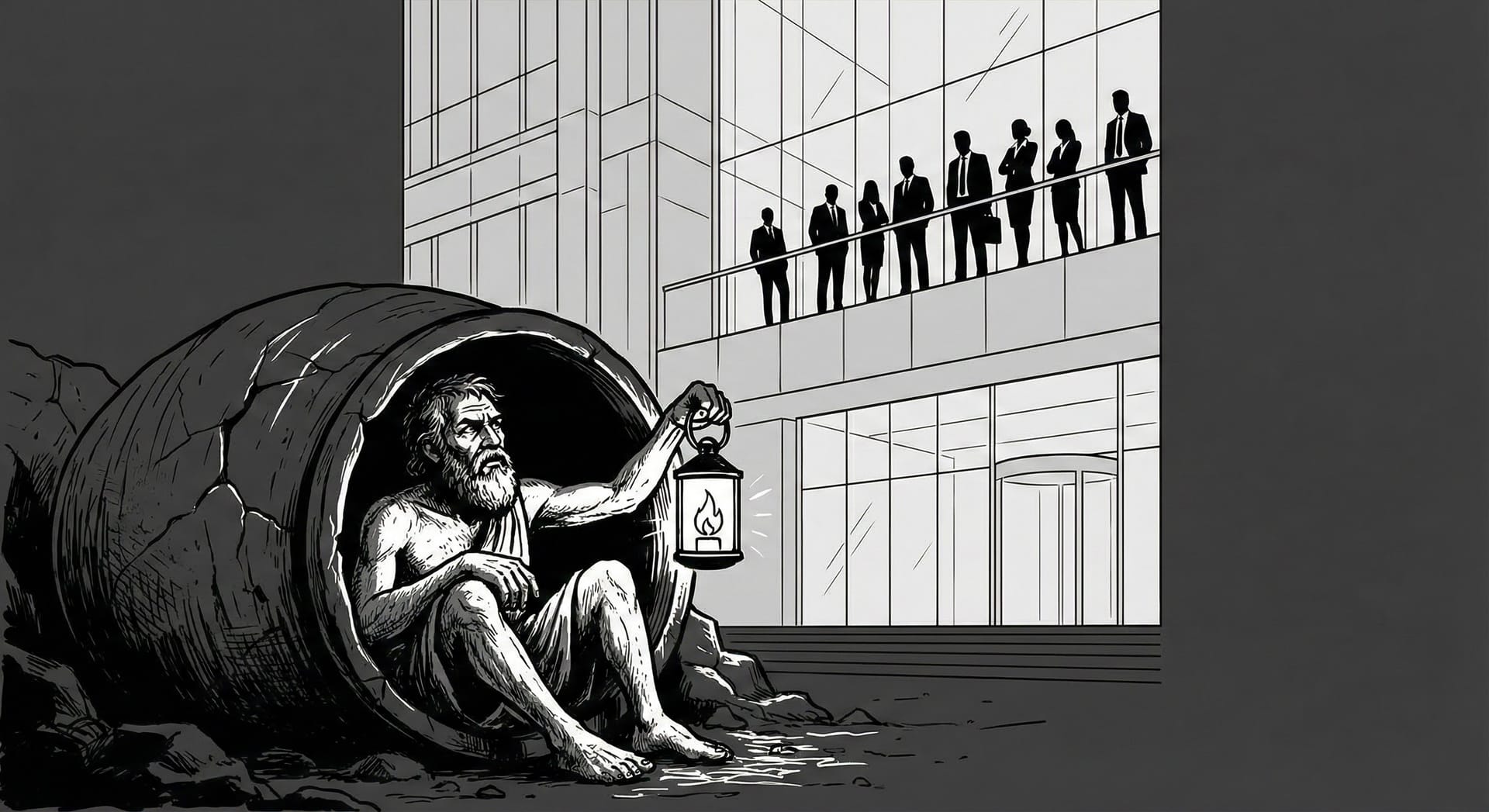
In 4th Century BC Athens, there lived a man who was terrified of nothing. Diogenes of Sinope, the founder of Cynicism, lived in a ceramic wine jar (a pithos) on the streets. He owned nothing but a cloak and a staff. He famously walked through the market in broad daylight with a lit lantern, staring into people's faces.
When asked what he was doing, he replied:
"I am looking for a human."
His point was brutal: Athens was full of people, but empty of character. He saw the wealthy merchants and politicians around him not as "Men," but as frauds—actors playing a role, devoid of virtue or honesty.
Diogenes was the original "Disruptor." He didn't just challenge the status quo; he mocked it to its face. Every modern C-Suite needs to understand his philosophy. Here is why.
1. Parrhesia: The Obligation to Speak Truth
The Greeks had a specific word for what Diogenes practiced: Parrhesia. It translates to "Fearless Speech." It is the act of speaking the truth to power, even when it is dangerous.
In a startup, Parrhesia is the only antidote to the Reality Distortion Field. When a CEO says, "We will migrate the entire platform in 2 weeks," the room usually nods. They want to be "team players."
- The Sycophant says: "Great vision, boss."
- The Diogenes says: "That is impossible. If we try, we will kill our operations. We need 8 weeks."
The truth-teller is often annoying. They are labeled "not a culture fit." But they are often the only reason the company survives the delusion of its leaders.
2. "Stand Out of My Sun"
The most famous story of Diogenes involves Alexander the Great. The most powerful man in the world heard about this strange philosopher and visited him. Alexander stood over Diogenes (who was sunbathing) and said: "I am Alexander the Great. Ask of me anything you desire, and I shall give it to you."
Diogenes didn't stand up. He squinted and said:
"There is one thing. Stand out of my sun. You are blocking my light."
The Executive Lesson: In an engineering organization, "Management" is often Alexander. You think you are helping by offering resources, meetings, and "Vision." But often, you are just standing in the light.
- You are blocking the flow.
- You are adding process where none is needed.
Sometimes, the best thing a leader can do for their best engineers is to get out of the way.
3. The Art of Subtraction (Asceticism)
Diogenes once saw a child drinking water from his hands. Diogenes immediately threw away his own wooden cup, saying: "A child has beaten me in simplicity."
He was obsessed with Subtraction. In software, we are obsessed with Addition.
- We add features.
- We add microservices.
- We add middle managers.
We call this "Growth," but Diogenes would call it "Bloat." A Diogenes Culture asks: "Do we really need this workflow? Do we really need this library? Can we do it with less?" Complexity is the enemy of execution. Simplicity is the ultimate sophistication.
4. How to Operationalize Candor (Without Toxicity)
There is a fine line between a Cynic (Diogenes) and a Jerk.
- A Jerk criticizes to humiliate others.
- A Cynic criticizes to reveal the truth.
To harness Parrhesia without destroying psychological safety, you cannot rely on "brave individuals" (who often get fired). You must build it into the system.
Ritualized Dissent (The Pre-Mortem): Do not assign one person to be the "critic" (this creates bias and politics). Instead, make everyone the critic for 30 minutes.
- The Exercise: Before a project launches, stop the optimism. Ask the Team: "We launch in 6 months. Express: Why are we going to fail? What is going to break?"
- The Result: Because everyone is criticizing the plan simultaneously, the social pressure to be "nice" evaporates. You get the truth without the interpersonal conflict.
Summary
We don't live in barrels anymore but the risk of "Civilized Delusion" is higher than ever.
We build decks that say "Everything is Green" while the servers are burning. We hire consultants to tell us what we want to hear.
Diogenes walked the streets with a lantern, looking for a man of virtue—someone who wasn't pretending, someone who wasn't playing a role.
The challenge for the C-Suite is not just to hire a truth-teller. The challenge is to become the person he was looking for.
Don't force your engineers to carry the lantern looking for a leader. Be the human.
No spam, no sharing to third party. Only you and me.
Member discussion