
The DevOps Bottleneck: Moving from "TicketOps" to Platform Engineering

In most engineering organizations, the workflow looks like this:
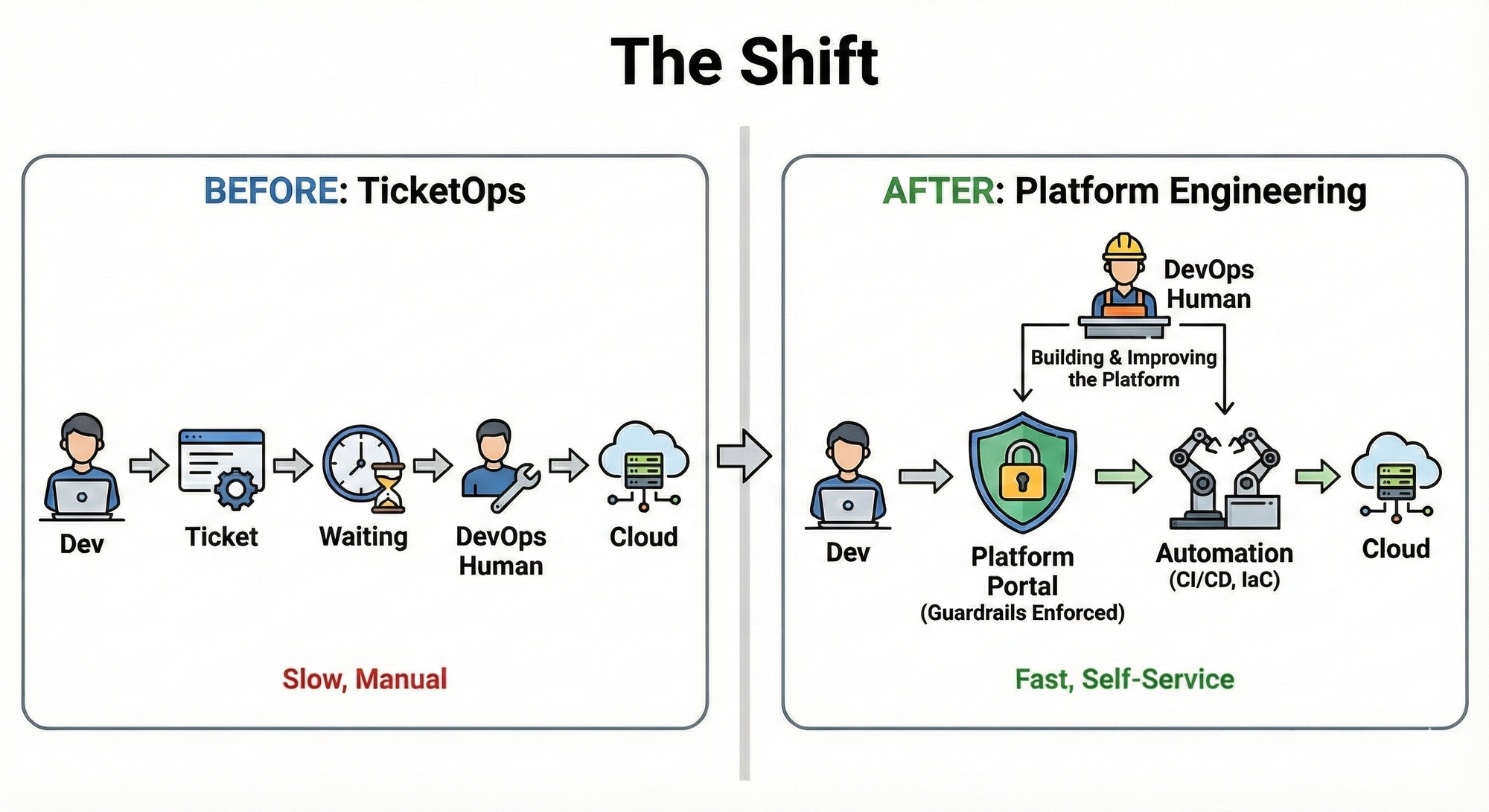
- Developer finishes code.
- Developer opens a ticket: "Please provision an S3 bucket and a Redis instance."
- The Wait: The ticket sits in the backlog for 3 days because the DevOps team is fighting a production fire.
- DevOps Engineer picks up the ticket, manually runs a Terraform script, and closes the ticket.
This is "TicketOps."
It is the standard operating model for 90% of companies. It feels safe because it maintains strict separation of duties: Developers write code, and Operations controls infrastructure.
But as you scale, this model hits a mathematical wall.
If you hire 50 new developers, you dramatically increase the volume of infrastructure requests. However, you rarely hire 50 new DevOps engineers to match. You might hire two.
The ratio of Developers-to-DevOps stretches from 10:1 to 30:1.
As a result, a small team of 5 DevOps engineers ends up servicing the tickets of 100 developers. They become buried. The Queue Time explodes.
The DevOps team becomes the bottleneck of the entire organization. They stop being "Engineers" and become "Ticket Processors."
Here is how to break the bottleneck using the concept of The Golden Path.
1. The Trap: The "Service Desk" Mentality
Why do we stick to TicketOps? Because we are afraid of Governance.
CTOs worry that if we let developers provision their own resources, they will spin up massive EC2 instances, leave S3 buckets open to the public, and blow the budget.
So we put a human (DevOps) in the middle to act as a Gatekeeper.
- The Good: Security is enforced.
- The Bad: Velocity dies.
The Financial Impact:
If a developer waits 2 days for a resource, that is 16 hours of idle salary. Multiply that by the hundreds of tickets generated by a growing team, and the "Ticket Queue" becomes one of the most expensive hidden costs in your company.
2. The Solution: Platform as a Product
The shift to Platform Engineering is not about forcing Developers to become SysAdmins. It is about the DevOps team shifting their role:
- Old Role: The team that does the work (provisioning).
- New Role: The team that builds the product (the platform) that does the work.
We call this "The Golden Path."
The Golden Path is a pre-approved, automated template that allows a developer to get what they need without opening a ticket, while still enforcing the rules the Ops team cares about.
How it works in practice:
Instead of running the Terraform script manually for every ticket, the DevOps team wraps that Terraform script in an API or a GUI (Internal Developer Platform).
- The Guardrails: The script hard-codes the security policy (e.g., "S3 buckets must be private," "EC2 instances cannot be larger than
t3.medium"). - The Vending Machine: The developer clicks a button (or runs a CLI command), and the system provisions the resource instantly.
The DevOps team still "sets up the service," but they do it once (by writing the template), not 1,000 times (by running it manually).
3. Governance: From "Gatekeeper" to "Guardrails"
The fear is that moving to self-service means losing control.
However, with a Platform approach, you actually increase control.
In a TicketOps model, the "Guardrail" is a human being checking the config. Humans get tired. Humans make mistakes.
In a Platform model, the Guardrail is code.
The Permission Shift:
We are not giving developers permission to "Configure AWS." We are giving them permission to "Trigger a Pre-Defined Script."
When a developer clicks "Create Database" in the platform:
- They get the utility: The database is created instantly.
- They don't get the danger: They cannot choose the wrong instance size or open the wrong port, because the template doesn't offer those options.
They get Autonomy, but the Ops team keeps the Governance.
4. How to Start (Without Building a Monster)
You don't need to install Spotify's Backstage tomorrow. That is overkill.
Start by identifying the "Top 3 Tickets."
Look at your DevOps board. What are the tickets that annoy your team the most?
- "Create a new Repo."
- "Add a Secret to CI/CD."
- "Provision a Database."
The Action Plan:
- Pick one of these.
- Write a script/automation that does it perfectly, securely, and according to your standards.
- Give the developers a simple interface (even a Slackbot) to trigger it.
Summary
The goal of Platform Engineering is not to make Developers do Ops work. It is to save the DevOps team from drowning in tickets.
If your DevOps team is spending >50% of their time "servicing requests" rather than "improving infrastructure," you have a TicketOps problem.
Build the Golden Path not just for the developers' speed, but for your Ops team's sanity.
No spam, no sharing to third party. Only you and me.





Member discussion