
From De Oratore to the Digital Age: Ethics as a Lever for Efficacy
Introduction
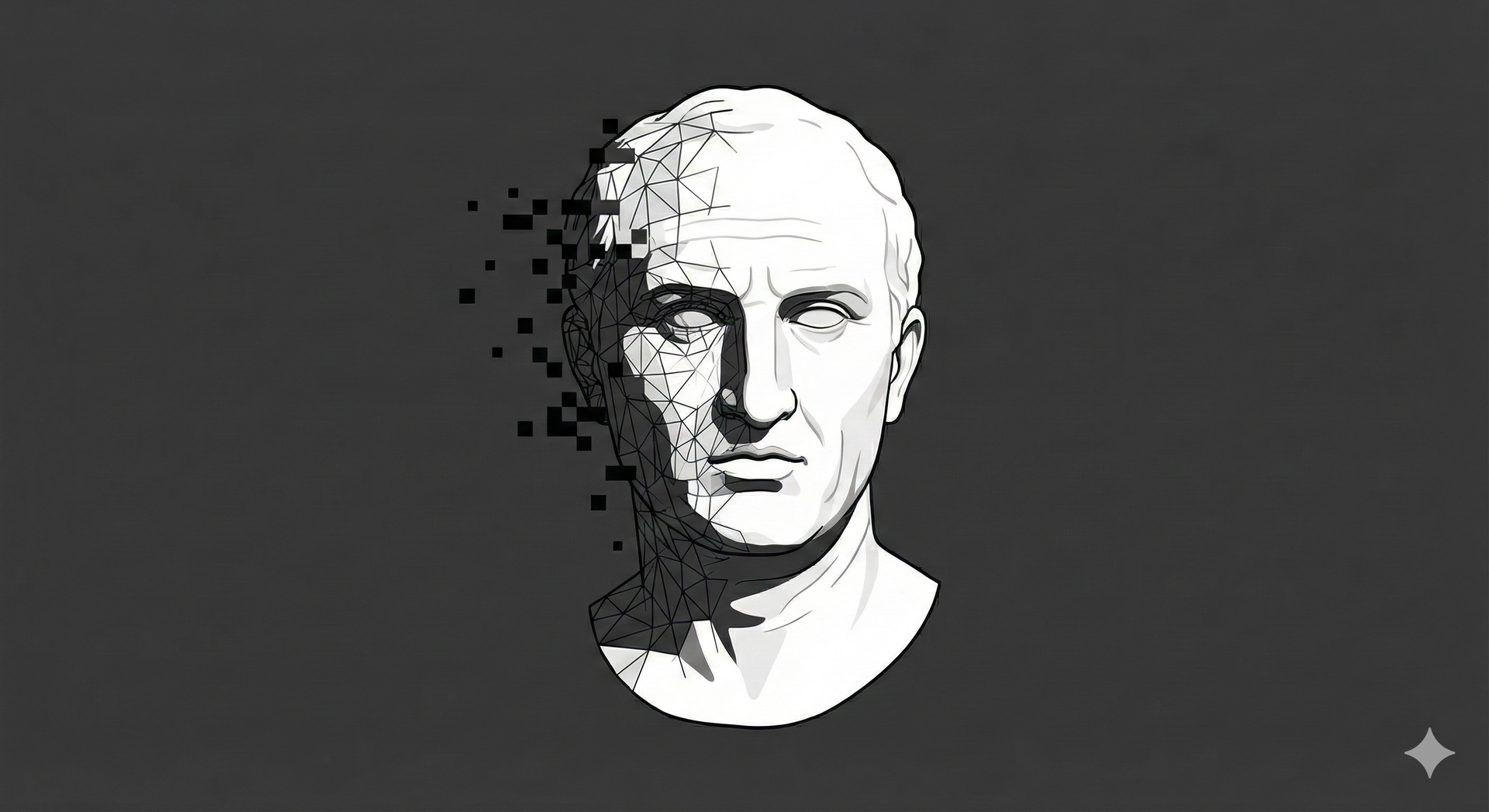
Written in 55 BC, De Oratore is not merely a technical manual; it is Cicero’s philosophical testament on the art of speech. Conceived as a dialogue between eminent figures of the Roman Republic, this text responds to an urgency that resonates strangely with our own era: how do we prevent public speech from becoming a weapon of manipulation?
Cicero posits a radical thesis: True efficacy is inseparable from morality. Where the Sophists—ancestors of certain modern "growth hackers"—viewed speech as a simple tool for domination, Cicero defines it as a tool of civilization, necessarily founded on truth.
In the age of Deepfakes, AI hallucinations, and "infobesity," the return to a "rhetoric of proof" and the ethics of the orator (the Vir Bonus) is not a philosophical luxury. It is an operational necessity for any technical leader wishing to build lasting authority.
Part I: The Ethical Foundations of Rhetoric (Credibility)
1. Truth as a Structural Imperative
For Cicero, an orator cannot afford to distort facts without destroying their own foundation. In Book II, he establishes a golden rule, initially intended for the historian but which he extends to all honest public speech:
"Quis nescit primam esse historiae legem, ne quid falsi dicere audeat? Deinde ne quid veri non audeat?" (De Oratore, II, 62)
Translation: "Who does not know that the first law of history is not to dare to say anything false? And then, not to lack the courage to say anything true?"
In a modern context, this imperative goes beyond simple direct lies. It condemns manipulative omission. A CTO who conceals a critical technical debt or an algorithmic bias violates this fundamental law. The resulting loss of credibility alienates the message, often irreversibly: once trust is broken, even the most skillful rhetoric becomes inoperative.
2. The Vir Bonus: Authority Precedes Speech
Cicero adopts and sublimates Cato the Elder's definition: the ideal orator is a vir bonus dicendi peritus (a good man, skilled in speaking). The order of the words is crucial: moral virtue (vir bonus) precedes technical competence (dicendi peritus).
Ethics is not a "layer" added to speech to look good; it is its bedrock. Crassus, Cicero's spokesperson in the dialogue, insists on the necessity of Prudentia (wisdom) and Probitas (integrity):
"Indeed, nothing is more insane than to associate a flow of words [...] with the absence of thought or virtue." (De Oratore, I, 51)
If the orator is not perceived as virtuous, their technical skills become suspect. This is the current drama of Big Tech: the industry possesses the expertise (dicendi peritus), but the public increasingly doubts its virtue (vir bonus), leading to a systemic crisis of trust.
Part II: Technique at the Service of Reason (The Process)
1. The Ciceronian Triptych: Docere, Delectare, Movere
Rather than separating logic from emotion, Cicero develops a functional trinity indispensable to all modern management:
- Docere (To Instruct/Prove): The rational base, facts, logic.
- Delectare (To Delight): Capturing attention through elegance, clarity, or humor.
- Movere (To Move): Driving adherence through emotion and shared values.
"Ita omnis ratio dicendi tribus ad persuadendum rebus est nixa: ut probemus vera esse quae defendimus; ut conciliemus eos nobis, qui audiunt; ut animos eorum, ad quemcumque causa postulabit motum, vocemus." (De Oratore, II, 115)
Translation: "Thus the whole art of speaking relies on three things for persuasion: that we prove what we allege to be true; that we win the favor of those who listen; that we call their minds to whatever emotion the cause may demand."
The danger lies in imbalance. A purely technical speech (Docere) bores and fails to mobilize (the "Death by PowerPoint" syndrome). A purely emotional speech (Movere) manipulates and collapses under the first logical analysis. The complete orator masters the dynamic balance between these three poles.
2. Epistemic Humility: Constructive Doubt
Philosophically attached to the New Academy (moderate skepticism), Cicero knows that absolute certainty is rare. The honest orator does not sell dogma; they sell probability (verisimile) supported by rigorous proof.
This is a major lesson for IT: never present a software estimate or an AI prediction as an absolute truth, but as a probability. This epistemic humility distinguishes the reliable expert from the charlatan. Accepting uncertainty in speech respects the intelligence of the audience and invites them to co-construct the truth.
Part III: Concrete Applications for IT Leadership
How do we translate these ancient concepts for a CIO or VP of Engineering today?
1. Algorithmic Transparency (The Law of Truth)
Just as the orator must not hide facts (Book II, 62), the systems architect must not hide the functioning of the "Black Box." AI Explainability (XAI) is the modern version of the judicial Narratio. If you cannot explain how your model made a decision, you have not respected your audience, and you have failed in your duty of Docere (to instruct).
2. Parrêsia and Responsible Disclosure
In digital risk management, Ciceronian ethics (truth-telling) collide with the necessity of prudence (Prudentia). Total and immediate transparency can be suicidal. We must distinguish between two situations:
- The Vulnerability (Potential Flaw): Publicly revealing a flaw before it is patched would endanger users. Here, virtue commands temporary public silence, but total transparency toward the technical teams capable of fixing it. This is the principle of Responsible Disclosure. Silence here is not a lie; it is protection.
- The Incident (Confirmed Breach): This is where the ethics of truth apply without compromise. If a breach has occurred, attempting to conceal it to protect one's reputation is a moral and strategic error. The ethical approach requires admitting the known incident, informing victims, and communicating clearly on the remediation in progress.
"It is better to offend with the truth than to please with a lie."
Trust is not lost because a system failed (statistically inevitable), but because the organization lied about the reality of the situation.
3. Audience Adaptation (The Leader as Translator)
Cicero insists: "It is a great fault to speak a language that is not that of one's audience." (De Oratore, I, 12). The modern technical leader must act as a "Translation Layer":
- To Engineers (Docere): Speak technical debt, refactoring, latency.
- To the Board (Movere): Speak financial risk, Time-to-Market, reputation.
The substance of the message remains the same (the need to change the system), but the rhetorical angle adapts to be ethically effective.
Conclusion
Cicero teaches us that rhetoric is not the art of "winning a debate" at any cost, but the art of constructing a shared truth. In a fragmented technological world, the modern orator—the leader—must not choose between being effective (persuading) and being ethical (speaking the truth). The two are interdependent.
As Crassus summarizes in Book III: eloquence without wisdom is like a weapon in the hands of a madman. It is up to us to ensure that our digital tools are guided by wise speech.
No spam, no sharing to third party. Only you and me.


Member discussion