
Concept: Chesterton’s Fence — The Dangers of "Cleaning Up"
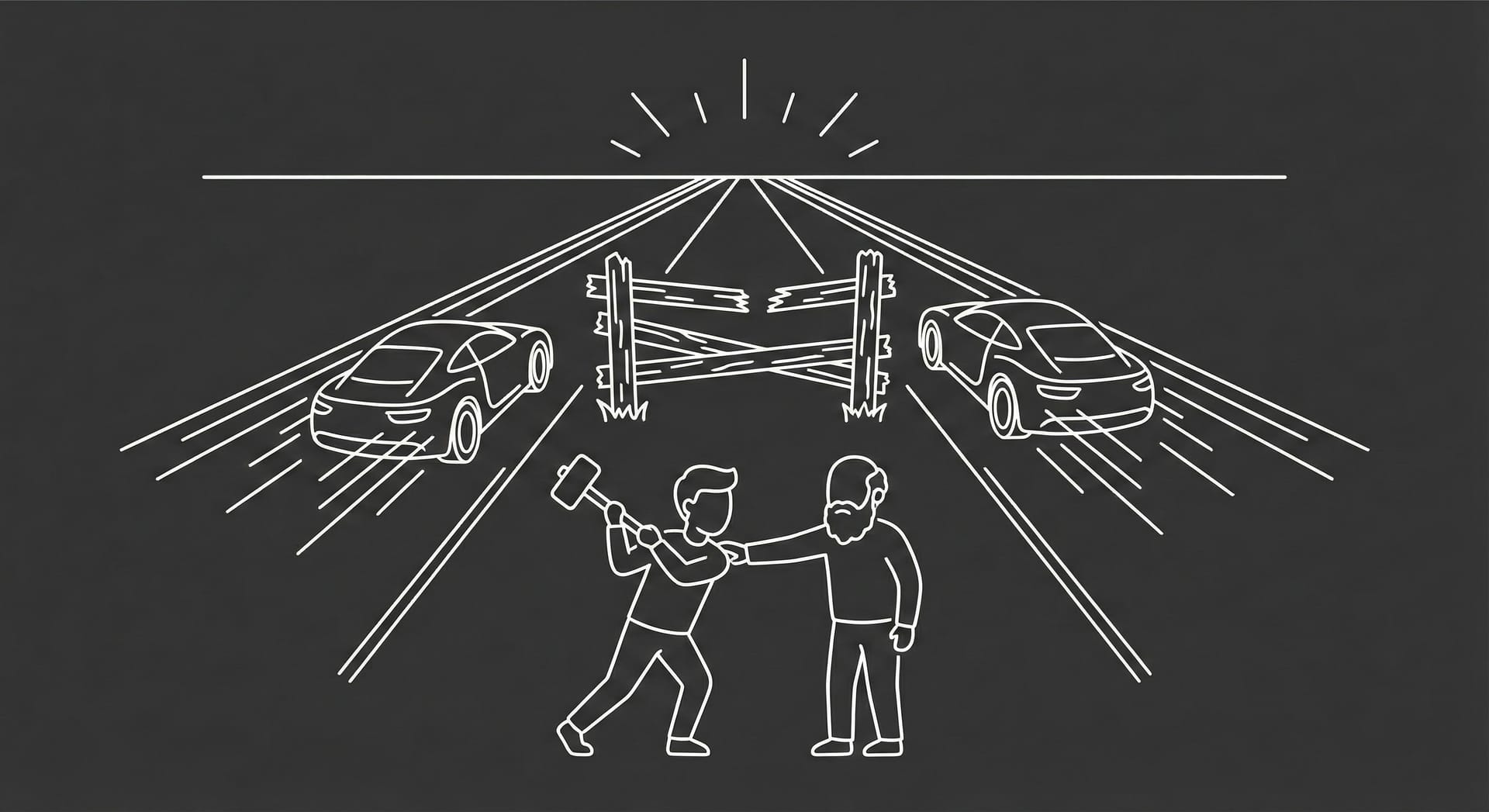
There is a specific arrogance that comes with being a "New Leader" or a "Senior Architect" entering a legacy codebase.
You look at a process, or a block of code, and you say:
"This makes no sense. This is stupid. Remove it."
In software, we call this "Refactoring." In management, we call it "Transformation."
But often, six months later, the system collapses. The "stupid" code was actually load-bearing. The "bureaucratic" process was actually a safety valve.
You have just run into Chesterton’s Fence.
This principle, coined by G.K. Chesterton in 1929, is the most important mental model for anyone dealing with Legacy Systems. It states:
"Do not remove a fence until you know why it was put there in the first place."
Here is why your "Clean Up" initiative might be a disaster in disguise.
1. The Parable of the Fence
In his book The Thing, Chesterton describes a scene:
Two reformers are walking down a road and find a fence built across it.
- Reformer A says: "I don't see the use of this; let us clear it away."
- Reformer B (The Wise Man) replies: "If you don't see the use of it, I certainly won't let you clear it away. Go away and think. Then, when you can come back and tell me that you do see the use of it, I may allow you to destroy it."
The Logic: Fences don't grow out of the ground. People don't build things for no reason. Even if the reason is not obvious to you (the newcomer), it existed for the builder.
Until you discover that reason, you are operating on First-Order Thinking (Action) without Second-Order Thinking (Consequences).Getty Images Explore.
2. Application: The "Useless" Legacy Code
We often mock "Legacy Code." We see a weird if (user_id == 412) statement or a redundant database call, and we delete it to "clean up the technical debt."
Suddenly, the payroll system fails.
It turns out user_id == 412 was the test account used by the bank's 1990s mainframe to validate transfers.
The Chesterton Rule for Refactoring:
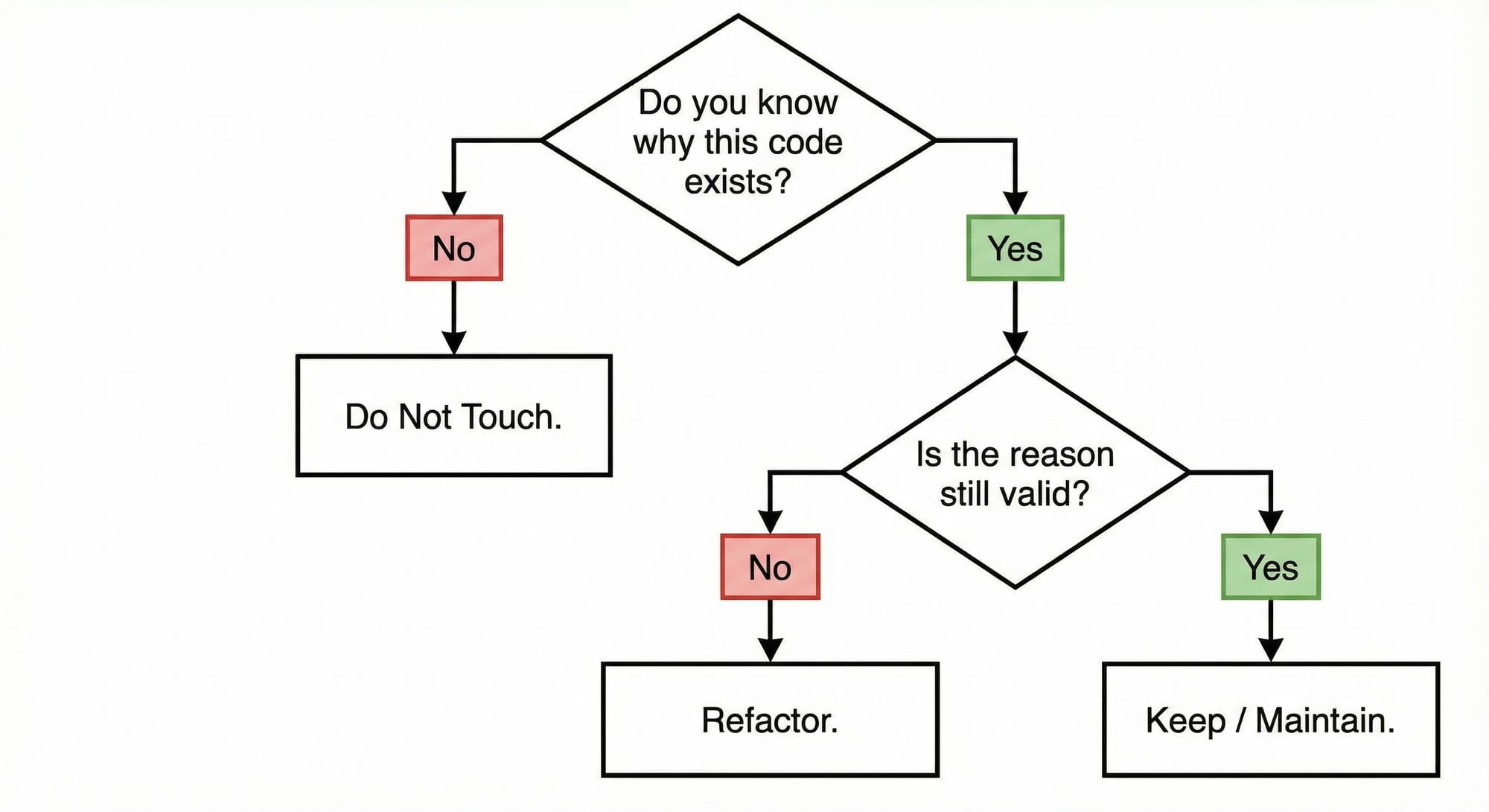
You are not allowed to deprecate a function until you can write a paragraph explaining exactly why the previous engineer wrote it that way.
- "They wrote it this way because they were stupid" is not an explanation; it is vanity.
- "They wrote it this way because in 2015, the MySQL driver had a latency bug with async calls" is an explanation. Now you can check if the bug is fixed. If yes, remove the fence.
3. Application: The "Bureaucratic" Process
New COOs love to "slash red tape."
They see a rule—"All deployments must be approved by Dave"—and they say: "This is a bottleneck! We are Agile! Remove Dave!"
Three weeks later, you deploy a bug that wipes the production database.
It turns out Dave wasn't just a bottleneck; Dave was the only person who knew how to check for Schema drift.
The Hierarchy of Knowledge:
Processes are usually Organizational Scar Tissue.
Every "stupid rule" in the employee handbook was likely written in blood after a previous disaster.
- We have the "Dave Rule" because in 2019, we lost $1M due to a bad deploy.
- Before you fire Dave, you must automate Dave's knowledge (CI/CD Guardrails). You cannot just remove the fence; you must replace it with a gate.
4. The Inverse: Chesterton’s Gate (When to actually remove it)
This is not an argument for hoarding junk. We must refactor. We must streamline.
But we must do it with Epistemic Humility.
The Protocol for Removal:
- Archaeology: Git Blame is your friend. Find the commit. Read the PR description. Talk to the "Old Guard."
- The "Scream Test": If you can't find the reason, turn the feature off temporarily (Feature Flag) but don't delete the code. See who screams.
- Documentation: When you do remove it, document why it is safe now. "We are removing the fence because the wolves it was keeping out are extinct."
Summary
The next time you see something "ugly" or "inefficient" in your company, assume it is a Solution, not a Problem.
It is a solution to a problem you do not yet understand.
- The Arrogant Leader removes the fence and gets eaten by the wolves.
- The Wise Leader finds out where the wolves are, builds a better wall, and then removes the fence.
Respect the fence. It saved your predecessor's life.
No spam, no sharing to third party. Only you and me.

Member discussion