
The Physician of Silence: A Comprehensive Analysis of Sextus Empiricus, the Pyrrhonian Tradition, and the Architecture of Suspended Judgment
1. Prolegomena: The Historical and Textual Preservation of Pyrrhonism
The figure of Sextus Empiricus stands as a colossal paradox in the annals of Western philosophy. He is at once the definitive executioner of Hellenistic dogmatism and its most faithful preservationist. Without his voluminous writings, specifically the Outlines of Pyrrhonism (Pyrrhōneioi Hypotypōseis, hereafter PH) and the eleven books traditionally grouped as Against the Mathematicians (Adversus Mathematicos, hereafter M), our understanding of the intricate logical systems of the Stoics, the epistemological nuances of the Epicureans, and the dialectical subtleties of the New Academy would be reduced to a scattering of fragments and hostile doxographies. Sextus occupies the terminus of the ancient skeptical tradition, a codifier who flourished likely in the late 2nd or early 3rd century CE, bringing together five centuries of skeptical evolution into a coherent, therapeutic "way of life" (agōgē).
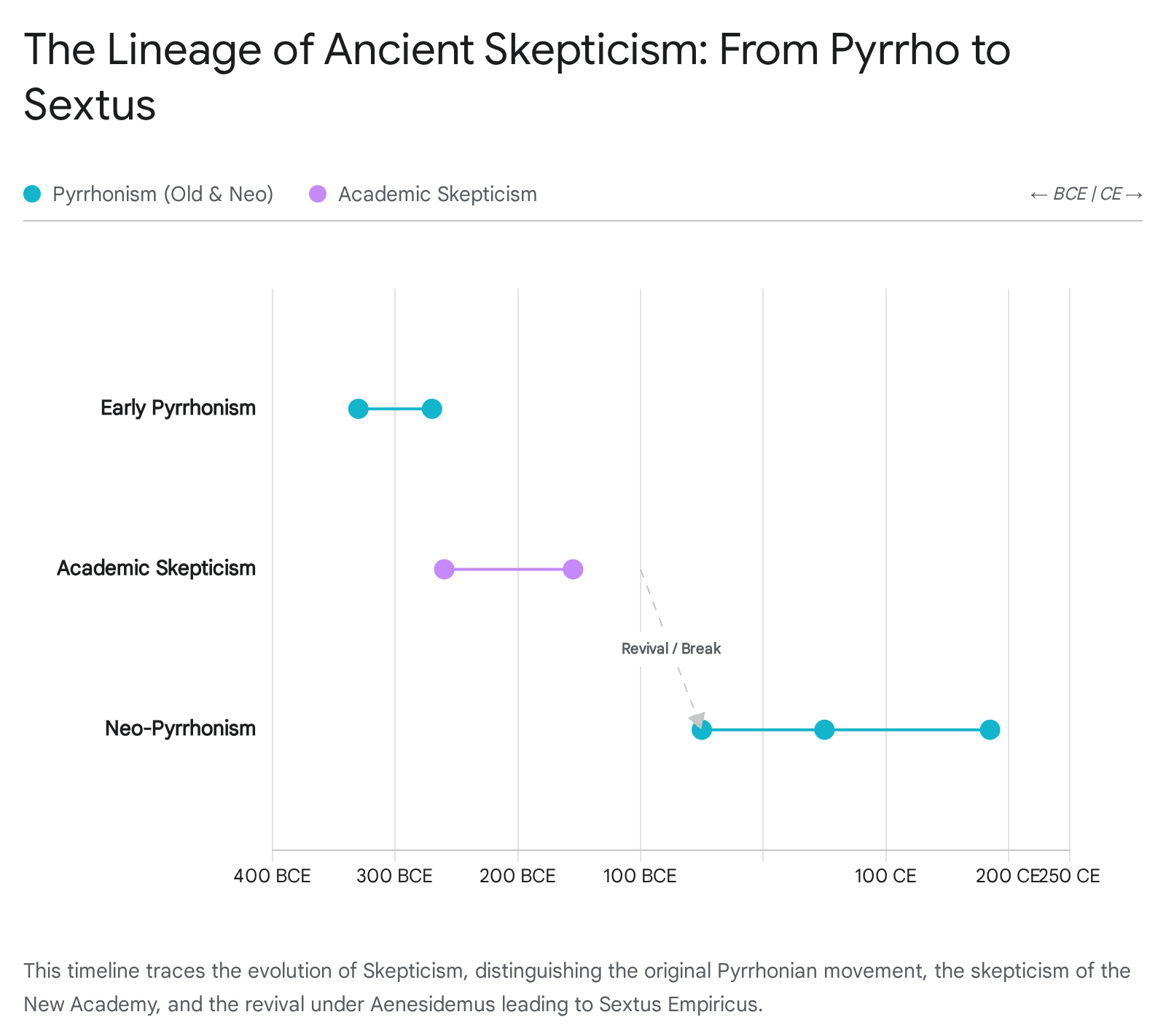
Unlike the foundational figures of other schools, Plato for the Academy, Zeno for the Stoa, Sextus is not an originator but a synthesizer. He represents the mature phase of "Neo-Pyrrhonism," a revival movement initiated by Aenesidemus in the 1st century BCE that sought to strip skepticism of its Academic accretions and return to the austere example of Pyrrho of Elis. Yet, despite his pivotal role, Sextus the man remains a cipher, hidden behind the vast wall of his dialectic. His works do not offer a positive doctrine but a "purgative" method, intended to cleanse the mind of the disease of dogmatism, the rash assent to non-evident propositions, and thereby induce a state of tranquility (ataraxia).
2. Biography and Context: The Elusive Physician
2.1 The Chronological Debate
Establishing the precise dates of Sextus Empiricus is a matter of triangulation rather than direct attestation. The consensus among modern philologists situates his active period in the late 2nd or early 3rd century CE. This dating relies primarily on internal evidence found within his medical writings. Sextus makes reference to the "Methodic" physician Soranus of Ephesus, who is known to have practiced during the reigns of Trajan and Hadrian (early 2nd century CE). Thus, Sextus must postdate Soranus. Conversely, Diogenes Laertius, writing in the early to mid-3rd century CE, lists Sextus in the succession of skeptical teachers, placing an upper limit on his timeline.
This places Sextus in the intellectual milieu of the "Second Sophistic," a period characterized by a renewed interest in classical Greek rhetoric and a sprawling, encyclopedic approach to knowledge. It was an era where the compilation and organization of past wisdom were prized, fitting Sextus' profile as a master cataloger of arguments.
2.2 Geographical Provenance
The question of where Sextus lived and taught is equally opaque, with three primary candidates emerging from the scholarship: Alexandria, Rome, and Athens.
- Alexandria: This is the most favored hypothesis. Alexandria was the epicenter of ancient medical research and the Empirical school. The sheer volume of technical medical data in Sextus' work, along with his deep familiarity with the specialized debates of Hellenistic science, suggests access to the Library of Alexandria.
- Rome: As the political capital, Rome attracted intellectuals from across the empire. Sextus' Latin name (Sextus) suggests Roman citizenship or at least a strong connection to the Roman sphere, although he wrote exclusively in Greek. His detailed attacks on Roman jurists and customs in Against the Ethicists might imply a Roman audience.
- Athens: While Athens remained a philosophical hub, the specific medical nature of Sextus' professional identity makes it a less likely candidate than the other two metropolises.
2.3 The Professional Identity: Empiric or Methodist?
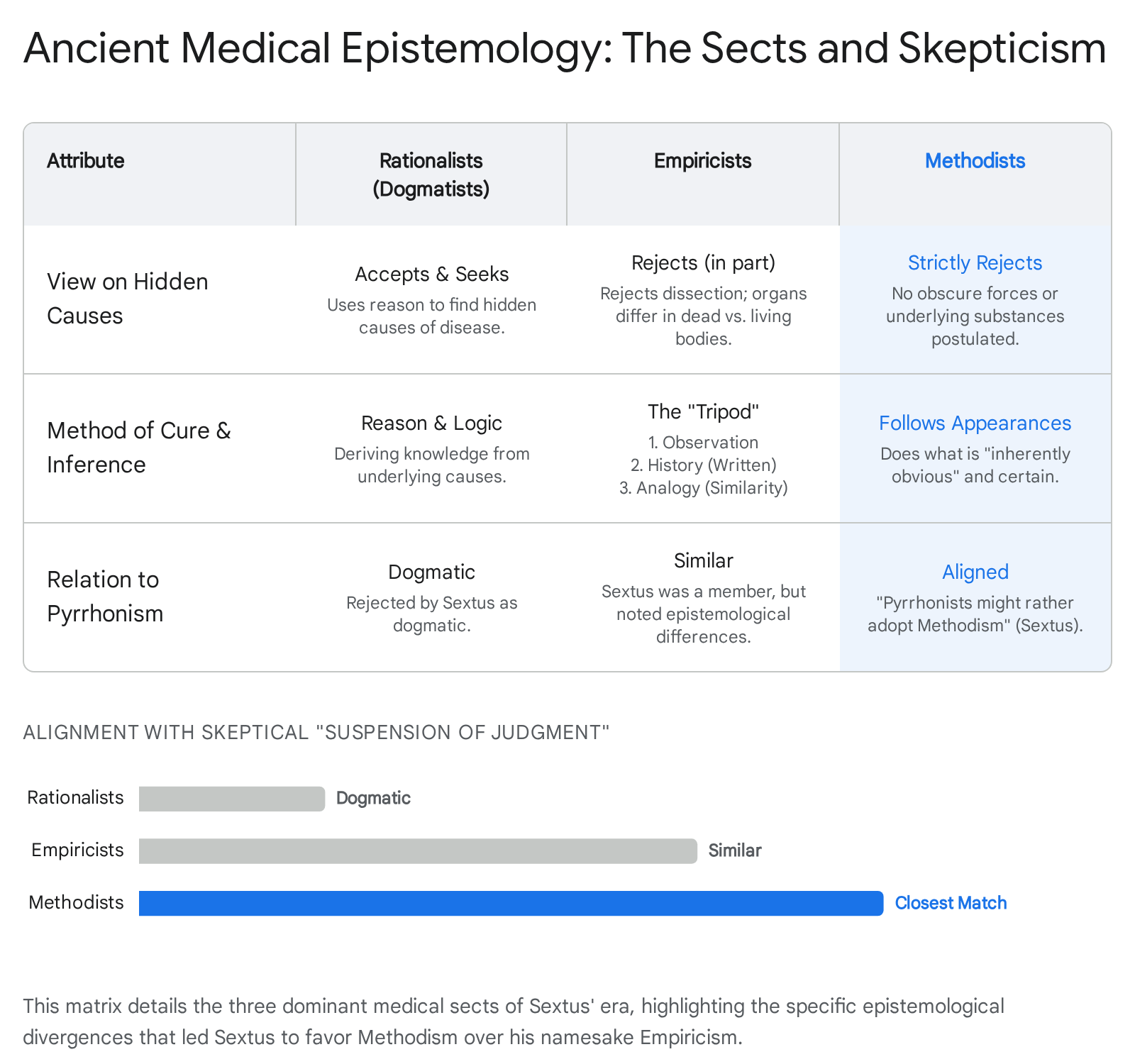
Sextus bears the cognomen "Empiricus," which explicitly identifies him as a member of the Empiric school of medicine. In the rigid tripartite division of ancient medicine, Dogmatists, Empiricists, and Methodists, this label carried significant epistemological weight. The Empiricists rejected the search for "hidden causes" (adēla) and relied solely on experience (empeiria), observation, and history.
However, a careful reading of Outlines of Pyrrhonism (PH I 236–241) reveals a startling divergence: Sextus explicitly distances the skeptical philosophy from the Empiric medical sect. He argues that the Empiricists, in their zealous rejection of hidden causes, inadvertently slide into a form of "negative dogmatism." By asserting that hidden causes are knowable as unknowable or by affirming their non-existence, the Empiricist makes a positive claim about the nature of reality.
Instead, Sextus expresses a philosophical preference for the Methodic school (Methodikoi). The Methodists, he argues, are the true medical counterparts to the Pyrrhonist. They do not claim to know the nature of the disease or the body; they simply follow the "apparent affections" (phainomena). If a body appears constricted (status strictus), they apply relaxing remedies; if it appears in flux (status laxus), they apply constricting ones. This practice mirrors the Pyrrhonian life of following appearances without theoretical commitment. The Methodist does not dogmatize about the cause of the constriction; they merely treat the evident symptom. This misalignment between his traditional name and his philosophical text suggests "Empiricus" may have been a label applied by others, or perhaps indicative of his early training before his full conversion to Pyrrhonism.
3. The Nature of Pyrrhonism: Definition, Goal, and Origin
Sextus begins his Outlines with a rigorous definition of the skeptical persuasion, distinguishing it fundamentally from other philosophical inquiries. He classifies philosophers into three groups:
- Dogmatists: Those who claim to have discovered the truth (Aristotle, Epicurus, Stoics).
- Academics: Those who claim to have discovered that the truth cannot be apprehended (Clitomachus, Carneades).
- Skeptics: Those who continue to investigate (zētousin).
3.1 The Definition (Dynamis)
Sextus defines skepticism not as a doctrine (hairesis in the sense of a set of dogmas) but as a "skill" or "ability" (dynamis).
"Skepticism is an ability to set out oppositions among things which appear and are thought of in any way at all, an ability by which, because of the equipollence in the opposed objects and accounts, we come first to suspension of judgment and afterwards to tranquility" (PH I 8).
This definition contains several critical technical components:
- Opposition (Antithesis): The core activity of the skeptic is to place things in opposition: appearances against appearances, thoughts against thoughts, or appearances against thoughts.
- Equipollence (Isostheneia): The realization that the opposing arguments are equal in terms of persuasiveness and credibility. No one argument overrides the other.
- Suspension of Judgment (Epoché): A standstill of the intellect where one neither affirms nor denies anything.
- Tranquility (Ataraxia): The untroubled state of soul that follows suspension.
3.2 The Teleology of Doubt: Ataraxia and the Story of Apelles
A common misconception is that the skeptic aims for suspension of judgment as an end in itself. Sextus clarifies that the ultimate goal (telos) is tranquility (ataraxia) in matters of opinion and moderate feeling (metriopatheia) in matters of unavoidable necessity.
The skeptic begins as a person of talent who is troubled by the anomaly of things. They begin philosophizing in order to discover the truth and thereby gain peace of mind. However, upon investigation, they find equally weighty arguments on all sides. Unable to decide, they suspend judgment. At this precise moment, tranquility follows, accidentally.
Sextus illustrates this chance occurrence with the famous anecdote of Apelles the Painter. Apelles, attempting to paint the foam on a horse's mouth, failed repeatedly. In a fit of frustration, he threw his sponge, which he used to wipe his brushes, at the picture. The impact of the sponge created the perfect representation of foam.
"So too the Skeptics were in hopes of gaining tranquility by establishing a decision on the anomalies of things; but being unable to do this, they suspended judgment; and when they had done so, tranquility followed, as it were, fortuitously, as a shadow follows a body" (PH I 29).
This narrative highlights that ataraxia is not a constructed state but a release. It is the cessation of the "agony of opinion", the anxiety that comes from believing one possesses the absolute truth and the fear of losing it, or the belief that one is undergoing something "naturally" evil.
3.3 The Distinction from Academic Skepticism
Sextus devotes significant energy to distinguishing Pyrrhonism from the "New Academy" (the skeptical phase of Plato's Academy). This distinction is vital for his claim to philosophical purity.
- Academic Position (Negative Dogmatism): According to Sextus, the Academics (like Carneades) assert that truth is inapprehensible (akatalēpsia). They make a negative dogmatic claim about the nature of knowledge. Furthermore, in practical life, they rely on "probability" or "persuasiveness" (to pithanon) as a guide.
- Pyrrhonian Position: The Pyrrhonist does not claim that truth is impossible to find; they merely say, "I have not found it yet." They remain open to the possibility of discovery. Regarding daily life, they reject "probability" because it implies a standard of truth. Instead, they live by appearances (phainomena) without belief. They follow laws, customs, and bodily drives undogmatically, simply because it is the path of least resistance.
4. The Methodological Arsenal: The Modes of Suspension
To achieve the state of epoché, Sextus provides a systematized collection of argumentative templates known as "Modes" (tropoi). These are not metaphysical truths but dialectical tools designed to generate opposition.
4.1 The Ten Modes of Aenesidemus
These modes, likely codified by Aenesidemus in the 1st century BCE, focus primarily on the relativity of perception. They demonstrate that the same object appears differently depending on the variation in the subject or the conditions of observation.3
While Sextus lists them sequentially, they can be conceptually grouped into three categories: those concerning the Subject (the perceiver), those concerning the Object (the perceived), and those concerning the Relation between them.
Group I: The Subject (Modes 1-4)
- Differences in Animals: Different animals have different sense organs (e.g., the elongated eye of a goat vs. the round eye of a human; the night vision of an owl). These physiological differences imply different perceptions of the same object (color, shape). We have no justification to privilege the human perception over the animal one.
- Differences in Humans: Even among humans, there are vast differences in body and mind. One man's medicine is another's poison (e.g., hemlock fattens quails but kills humans). Preferences in food and beauty vary wildly, suggesting the object has no intrinsic nature.
- Differences in Senses: The same object presents contradictory qualities to different senses. An apple is yellow to the eye, sweet to the taste, and fragrant to the nose. Does the apple have three qualities? Or only one? Or perhaps a thousand qualities that we lack the senses to perceive? We cannot know the "true" apple.
- Circumstances (Peristaseis): The perception of the subject changes based on their state: drunk vs. sober, sleeping vs. waking, young vs. old, moving vs. stationary. A drunk man sees two suns; a sober man sees one. Which state reveals the "true" reality? The dogmatist claims the "sober/waking" state is true, but this is circular reasoning, as it assumes a criterion of truth that is currently under debate.
Group II: The Object and Relation (Modes 5-9)
5. Positions, Intervals, and Places: A tower looks square from close up and round from a distance. A ship's oar looks bent in water and straight in air. A pigeon's neck changes color as it turns. Since we never perceive the object outside of a specific position or place, we cannot know its nature "in itself".
6. Admixtures: We never perceive an object in isolation. It is always mixed with the medium (air, light, moisture, heat). We see the color through the air; we taste the flavor mixed with saliva. We cannot separate the object from the admixture.
7. Quantities and Constitutions: Silver filings appear black, but a silver bar appears white. Wine in moderation strengthens the body; in excess, it poisons. The quality depends on the quantity, which is variable.
8. Relativity (The General Mode): This mode encompasses all others. Everything appears relative to something (the subject, the accompanying circumstances, etc.). Since nothing appears absolute (anapaphorikon), we cannot assert anything about its absolute nature.
9. Frequency and Rarity: The sun is more amazing than a comet, but because we see the sun daily, we are not amazed. We value rare gold over common water, though water is more useful. Value is determined by rarity, not intrinsic worth.
Group III: Ethics and Logic (Mode 10)
10. Customs, Laws, and Beliefs: This mode opposes customs to customs, and laws to dogmas. Sextus provides a catalog of cultural divergences to shock the dogmatist:
- Persians marry their mothers; Greeks view this as unlawful.
- Egyptians mummify the dead; Romans burn them; Paeonians throw them into lakes.
Since moral values fluctuate entirely based on geography and culture, there is no "natural" good or evil.
4.2 The Five Modes of Agrippa
While the Ten Modes focus on perception, the Five Modes (attributed to Agrippa) attack the structure of logical justification itself. They are more abstract and are considered the most potent weapon against Dogmatic syllogisms.
- Disagreement (Diaphōnia): On any matter proposed, there is an undecidable dissension among philosophers and ordinary people. To settle the dispute, we need a criterion. But the criterion itself is disputed.
- Infinite Regress (Eis apeiron ekballon): If a Dogmatist offers a proof for their claim, the Skeptic asks for a proof of the validity of that proof. If provided, the Skeptic asks for a proof of that second proof, and so on ad infinitum. The foundation is never reached.
- Relativity (Pros ti): Nothing is apprehended in itself, but only in relation to the subject and observations.
- Hypothesis (Ex hypotheseōs): To stop the Infinite Regress, the Dogmatist might simply assume a starting point (an axiom) without proof. The Skeptic replies that if one can assume X without proof, one can equally assume Not-X without proof. Mere assertion has no force.
- Reciprocity/Circularity (Diallēlos): This occurs when the proof requires the conclusion to establish itself. For example, to prove the reliability of the senses, one uses reason. But to prove the reliability of reason, one relies on sensory data (since concepts come from senses). Thus, neither is established.
These modes are often deployed as a "net" or "trap": If the Dogmatist tries to prove something, they fall into Regress. If they stop proving, they fall into Hypothesis. If they try to support the proof with the conclusion, they fall into Circularity (The Agrippan Trilemma).
4.3 The Causal Modes (Aenesidemus)
Sextus also preserves eight modes specifically designed to refute causal explanations (Aetiology). These argue that dogmatists often construct causes from things that are non-evident, fail to agree on a method of identifying causes, and often assign causes that conflict with observed phenomena. A key insight here is the critique of the "unseen world", dogmatists claim to know the hidden mechanics of the universe (atoms, humors) based on visible signs, but since the hidden mechanics are never seen, the link can never be verified.
5. Against the Dogmatists: Logic and the Criterion
In the treatises Against the Logicians (M VII-VIII), Sextus dismantles the epistemological foundations of the Dogmatic schools.
5.1 The Criterion of Truth
The central debate in Hellenistic philosophy concerned the "Criterion of Truth" (kriterion tēs alētheias), the standard by which one distinguishes true impressions from false ones. The Stoics proposed the "cognitive impression" (kataleptikē phantasia), while Epicureans held that all sensations are true.
Sextus attacks the very possibility of a criterion using the Mode of Disagreement and the Mode of Regress.
- The Subject of the Criterion: Who decides the truth? If we say "Man," which man? They disagree. If we say "The Wise Man," how do we recognize him without being wise ourselves? To find the wise man, we need a criterion of wisdom. To find the criterion, we need a wise man to teach it. This is circular.
- The Instrument: Do we use senses or intellect? Senses deceive (the oar in water). Intellect disagrees (philosophers hold contradictory views). Neither is self-certifying.
5.2 The Critique of the Sign
Sextus offers a sophisticated semiotic analysis, distinguishing between two types of signs:
- Commemorative Signs (hypomnēstikon): These are based on observed conjunctions. We see smoke and remember fire, which we have seen before with smoke. Sextus accepts these signs, as they rely on experience and are useful for daily life (Empiricism).
- Indicative Signs (endeiktikon): These claim to reveal something that has never been observed. For example, the Dogmatist sees a bodily function (sweat) and infers the existence of "invisible pores" in the skin. Since the pores are by definition unobservable, the connection between sign and signified can never be verified by experience. Sextus rejects these signs as Dogmatic fiction.
This distinction allows the Skeptic to function in the world (reacting to commemorative signs) while rejecting Dogmatic metaphysics (indicative signs).
5.3 The Impossibility of Demonstration (Syllogism)
Sextus anticipates the modern "problem of induction" in his critique of the syllogism.
Consider:
- Every man is an animal.
- Socrates is a man.
- Therefore, Socrates is an animal.
Sextus argues this is circular. To establish the universal premise "Every man is an animal," one must have examined all particular men, including Socrates. If Socrates was not examined, the universal is not established. If he was examined, the conclusion "Socrates is an animal" was already known before the syllogism began. Thus, the syllogism does not prove the conclusion; it merely restates what is already known or begs the question.
6. Against the Dogmatists: Physics and Metaphysics
In Against the Physicists (M IX-X), Sextus deconstructs the fundamental concepts of nature: God, Cause, Time, and Motion.
6.1 God and Theology
Sextus compiles arguments both for and against the existence of God, setting them in opposition to induce suspension.
- Against Providence: If God controls everything and evil exists, God is the author of evil (which is impious). If God cannot prevent evil, he is weak. If he can but won't, he is malicious. The Dogmatist is trapped in theological contradictions.
- The Skeptical Stance: The Skeptic does not assert "God does not exist." Instead, they follow the laws and customs of their country, worshipping the gods in accordance with tradition, but without the dogmatic belief that they exist in absolute reality.
6.2 The Critique of Causality
Sextus attacks the necessary connection between cause and effect.
- Relativity: A cause is relative to an effect. A "father" is only a father because of the "son."
- Simultaneity vs. Succession: If a cause produces an effect, does it do so while it exists or before/after?
- If A causes B, and A exists before B, then the cause exists without the effect (impossible, as cause implies effect).
- If A and B are simultaneous, how can one generate the other? They are just two events happening together. This analysis dissolves "causality" into mere observed correlation, stripping it of its metaphysical power.
6.3 Time and Motion
Utilizing arguments from Zeno and Diodorus Cronus, Sextus argues for the unreality of Time.
- The Tripartite Division: Time consists of Past, Present, and Future.
- The Past no longer exists.
- The Future does not yet exist.
- The Present is an indivisible instant (if it had duration, part would be past and part future). An indivisible instant cannot be "time."
- Therefore, Time does not exist.
Regarding Motion: A body must move either in the place where it is or the place where it is not. It cannot move where it is (it would be at rest). It cannot move where it is not (it isn't there to do anything). Thus, motion is impossible.
7. Against the Dogmatists: Ethics and Value
In Against the Ethicists (M XI), Sextus targets the claim that things are "good" or "bad" by nature (physei).
7.1 The Subjectivity of Value
If "Good" were a natural property of an object (like heat is to fire), it would affect everyone equally. Fire warms the Greek and the Barbarian alike. However, "The Good" is endlessly disputed. Epicureans say it is Pleasure; Stoics say it is Virtue. Since there is no natural consensus, "Good" and "Bad" are merely conventional (nomō).
7.2 The Art of Living
Dogmatists claim to possess a technē peri ton bion (Art of Living) that ensures happiness. Sextus argues that this art is non-existent because its subject matter (Good/Evil) is undefined. Furthermore, the belief in this art causes misery.
- The Dogmatist: Believes "Pain is evil." When in pain, they suffer twice: once from the sensation, and once from the belief that "something terrible is happening."
- The Skeptic: Suspends judgment on whether pain is by nature evil. They feel the sensation (unavoidable), but they do not add the opinion. Thus, they suffer less. This is the state of Metriopatheia (moderation of feeling).
8. Against the Professors: The Liberal Arts
Often overshadowed by his philosophical critiques, Sextus' Against the Professors (M I-VI) represents a massive cultural critique of the standard Hellenistic curriculum (enkyklios paideia).
- Against Grammarians (M I): Sextus attacks the authority of grammarians to dictate "correct" language. He argues that language is defined by common usage (synētheia), not by technical rules. The grammarian who corrects a native speaker is engaging in a useless dogmatism.
- Against Rhetoricians (M II): Rhetoric claims to be the art of persuasion. Sextus argues it is not an art because it lacks stable rules and often aims at deception rather than truth.
- Against Geometricians and Arithmeticians (M III-IV): He attacks the ontological status of mathematical objects. Points, lines, and surfaces do not exist in the physical world (nothing is without breadth). Therefore, geometry is built on false hypotheses.
- Against Astrologers (M V): Sextus distinguishes between "Astronomy" (observation of cycles for agriculture/navigation, which he accepts) and "Astrology" (Genethlialogy, predicting fate from birth charts). He refutes the latter by pointing out that people born at the same time have different fates (e.g., kings and slaves born in the same hour), and animals born at the same time as humans do not share their destiny.
- Against Musicians (M VI): He challenges the Pythagorean view that music aligns the soul with the cosmos. Music may distract us from pain, but it does not cure it or alter the soul's nature.
9. The Skeptical Way of Life
A common charge against Skepticism was apraxia, that suspension of judgment would lead to inactivity and death. If one does not believe bread is food, how will one eat?
Sextus responds that the Skeptic does not live according to philosophical reason (logos), but according to the Fourfold Guidance of Nature (biōtikē tērēsis):
- Guidance of Nature: The Skeptic follows sensory and cognitive faculties. When they see bread, they are impelled to eat.
- Constraint of the Passions: When thirsty, they drink. They yield to hunger and thirst because these are compelling forces, not judgments.
- Tradition of Laws and Customs: The Skeptic acts in accordance with their society's laws and religious observances, not because they are "true," but to avoid disturbance and integrate socially.
- Instruction of the Arts: The Skeptic can practice a craft (like medicine or painting) undogmatically, following the rules of the art without theorizing about absolute reality.
This "conformism" allows the Skeptic to live a normal, unobtrusive life, insulated from the anxieties of the dogmatic philosopher who is constantly at war with the world's contradictions.
10. The Renaissance Reception and Legacy
The survival of Sextus Empiricus is a historical anomaly. For centuries during the Middle Ages, his works were largely unread, as the Latin West was dominated by Aristotle and Augustine. The "Skeptical Crisis" of the Renaissance began with the recovery and translation of Sextus' manuscripts.
The pivotal moment was the publication of Henri Estienne's Latin translation of the Hypotyposes in 1562. This text fell into the hands of Michel de Montaigne, who was undergoing a personal intellectual crisis. Montaigne absorbed Sextus deeply, inscribing Pyrrhonian maxims onto the ceiling beams of his library. His famous motto, "Que sais-je?" ("What do I know?"), is a direct vernacular adaptation of the Sextan method.
Montaigne used Sextus to humble human reason, arguing that without Divine Grace, man can know nothing. This "Fideistic Skepticism" was used by Catholic Counter-Reformers to attack Protestant claims to theological certainty (the "Rule of Faith"). If reason is flawed (as Sextus shows), one must submit to the authority of the Church.
Later, this weapon turned against religion. Thinkers like Pierre Bayle and David Hume radicalized Sextus' arguments against causality and substance, laying the groundwork for the Enlightenment and modern empiricism. Hume's admission that "Nature is always too strong for principle", that we must act despite our skepticism, is a direct echo of Sextus' Fourfold Guidance.
11. Conclusion
Sextus Empiricus describes his philosophy using the metaphor of a purgative drug: it eliminates the "humors" of dogmatism from the body, and then eliminates itself. The arguments are not truths to be held, but ladders to be climbed and discarded.
His work offers a profound alternative to the Western obsession with "Certainty." By meticulously documenting the failures of human reason to grasp the absolute, Sextus does not advocate for nihilism or despair. Instead, he points toward a life of "human" scale, a life lived within the limits of appearances, tolerant of uncertainty, and free from the violent need to be right. In an age of ideological rigidity, the "Physician of Silence" prescribes the ultimate cure: the suspension of judgment.
12. Bibliography and Works
12.1 The Surviving Corpus
The extant works of Sextus Empiricus are traditionally divided into two main groups, though the second group actually consists of two distinct works.
1. Outlines of Pyrrhonism (Pyrrhōneioi Hypotypōseis, PH)
- Book I: A general overview of the skeptical method, the definition of skepticism, the Modes (Tropes), and the differences between Skepticism and other schools.
- Book II: Arguments against Dogmatic Logic (Criterion, Sign, Demonstration).
- Book III: Arguments against Dogmatic Physics (God, Cause, Time) and Ethics (Good and Evil).
2. Against the Mathematicians (Adversus Mathematicos, M) This title is traditionally applied to a collection of eleven books, but it actually comprises two separate works:
- M I–VI (Against the Professors/Liberal Arts):
- M I: Against Grammarians
- M II: Against Rhetoricians
- M III: Against Geometricians
- M IV: Against Arithmeticians
- M V: Against Astrologers
- M VI: Against Musicians
- M VII–XI (Against the Dogmatists): This is often considered a surviving portion of a larger work (possibly titled Skeptical Treatises). It covers the same ground as PH II-III but in much greater detail.
- M VII–VIII: Against the Logicians
- M IX–X: Against the Physicists
- M XI: Against the Ethicists
12.2 Standard Editions (Greek)
- Mutschmann, H. & Mau, J. (Eds.). Sexti Empirici Opera. (Teubner Series).
- Vol. I: Pyrrhoneion Hypotyposeon (1912).
- Vol. II: Adversus Dogmaticos (M 7–11) (1914).
- Vol. III: Adversus Mathematicos (M 1–6) (1954).
- Vol. IV: Indices (1962).
12.3 English Translations
Complete Works (Loeb Classical Library)
- Sextus Empiricus. 4 Volumes. Translated by R. G. Bury. Harvard University Press (1933–1949). Contains facing Greek text.
- Vol. I: Outlines of Pyrrhonism.
- Vol. II: Against the Logicians.
- Vol. III: Against the Physicists; Against the Ethicists.
- Vol. IV: Against the Professors.
Modern Critical Translations
- Annas, J., & Barnes, J. (2000). Sextus Empiricus: Outlines of Scepticism. Cambridge University Press. (The standard modern translation of PH).
- Bett, R. (1997). Sextus Empiricus: Against the Ethicists. Oxford: Clarendon Press. (Translation of M XI with extensive commentary).
- Bett, R. (2005). Sextus Empiricus: Against the Logicians. Cambridge University Press. (Translation of M VII–VIII).
- Bett, R. (2012). Sextus Empiricus: Against the Physicists. Cambridge University Press. (Translation of M IX–X).
- Bett, R. (2018). Sextus Empiricus: Against the Grammarians. Oxford University Press. (Translation of M I).
- Mates, B. (1996). The Skeptic Way: Sextus Empiricus's Outlines of Pyrrhonism. Oxford University Press. (Includes a translation of PH and an influential philosophical commentary).
No spam, no sharing to third party. Only you and me.
Member discussion