
Bio: Bertrand Russell — Logic and Madness

In the contemporary corporate landscape, the organizational ethos is heavily defined by an overarching devotion to quantitative certainty. Within boardrooms, executive suites, and strategic planning divisions, there exists a pervasive, almost theological belief that systemic uncertainty can be entirely eradicated. The prevailing philosophy, often championed under the banner of "Data-Driven Decision Making", suggests that if an enterprise simply constructs a sufficiently sophisticated data infrastructure, cleanses its data lakes of all ambiguity, and executes the optimal algorithmic model, the future can be perfectly mapped. This paradigm treats strategic leadership as an inherently mathematical puzzle, promoting the illusion that the messy, unpredictable, and dynamic reality of human enterprise can be seamlessly translated onto a pristine logical grid.
This modern administrative ambition, however, is far from novel. At the dawn of the twentieth century, one of the most formidable intellects in human history embarked on an identical quest, not in the realm of corporate strategy, but within the foundational architecture of reality itself. Bertrand Russell sought to rid human knowledge of all epistemological ambiguity. He did not merely wish to be reasonably confident about reality; he demanded absolute, unassailable, mathematical certainty. Over the course of a punishing intellectual journey spanning over a decade, Russell attempted to build a flawless system of pure logic that would encompass and prove all mathematical truth from the ground up.
The ensuing effort broke his intellectual stamina, alienated his most brilliant protégé, and ultimately led to the mathematical proof that the very system he sought to construct was a structural impossibility. For the modern strategist, executive, and organizational architect, the life and intellectual tragedy of Bertrand Russell serves as a cautionary tale. It is a profound exploration of the trap of hyper-rationality.
The Genesis of the Logicist Dream and the Crisis of Foundations
To comprehend the sheer magnitude of the project Bertrand Russell undertook, one must first understand the historical and psychological context from which his intellect emerged. Born on May 18, 1872, in Trelleck, Monmouthshire, Wales, Bertrand Arthur William Russell was a direct heir to the highest echelons of the British aristocracy. He was the grandson of Lord John Russell, a prominent Whig politician who served twice as Prime Minister to Queen Victoria during the mid-nineteenth century, and the godson of the philosopher John Stuart Mill. The Russell family was historically steeped in progressive reform politics, deeply embedded in the governance and intellectual elite of the British Empire.
Despite this immense privilege, Russell's early life was defined by profound tragedy and pervasive isolation. By the time he was six years old, a devastating series of bereavements had stripped him of his immediate family; his sister Rachel, his mother Viscountess Amberley, his father Viscount Amberley, and his grandfather Lord John Russell had all passed away. Left in the care of his grandmother, Countess Frances Russell, Bertrand was educated privately at home, entirely isolated from peers of his own age. In this environment of lonely, aristocratic stricture, the young Russell experienced severe depression. He utilized a diary to write his reflections in Greek letters to hide his inner thoughts from his household. Later in his autobiography, he confessed that the primary force keeping him from suicide during his adolescence was a burning, insatiable desire to learn more mathematics. Mathematics offered something that the chaotic, tragic reality of his youth could not: a realm of eternal, incorruptible truth.
However, as Russell matriculated at Trinity College, Cambridge in 1890, his pursuit of absolute truth encountered a devastating epistemological obstacle. Upon rigorous examination of his chosen field, he discovered a horrifying reality: the entire edifice of mathematics, the very discipline utilized to engineer bridges, map celestial bodies, and quantify physical risk, did not rest upon unshakeable logical truths. Instead, it was built upon unproven assumptions, postulates, and axioms. Mathematicians historically accepted certain foundational postulates simply because they appeared self-evident to human spatial or numerical intuition.
For Russell, intuition was indistinguishable from guesswork. If the foundational axioms of mathematics were merely assumptions based on human perception, the entirety of human scientific knowledge was a precarious house of cards. The distinction between a priori knowledge (deductive logic, derived from definitions and first principles entirely independent of sensory experience) and a posteriori knowledge (inductive logic, derived from observational evidence) became central to his existential crisis. Russell sought to prove that mathematics was not reliant on empirical observation or spatial intuition, but was instead a direct extension of pure, a priori logic. He believed that logical forms were the fundamental grammar of reality, a concept that eventually evolved into his philosophy of Logical Atomism, wherein the world is composed of simple, mutually independent atomic facts.
Russell's ambition was nothing less than Promethean. He intended to tear down the intuitive foundations of mathematics and rebuild the discipline entirely from a limited set of undeniable logical constants and variables. He aimed to rigorously prove that

not because it practically functions when counting apples in the physical world, but because the fundamental, tautological laws of the universe necessitate it.
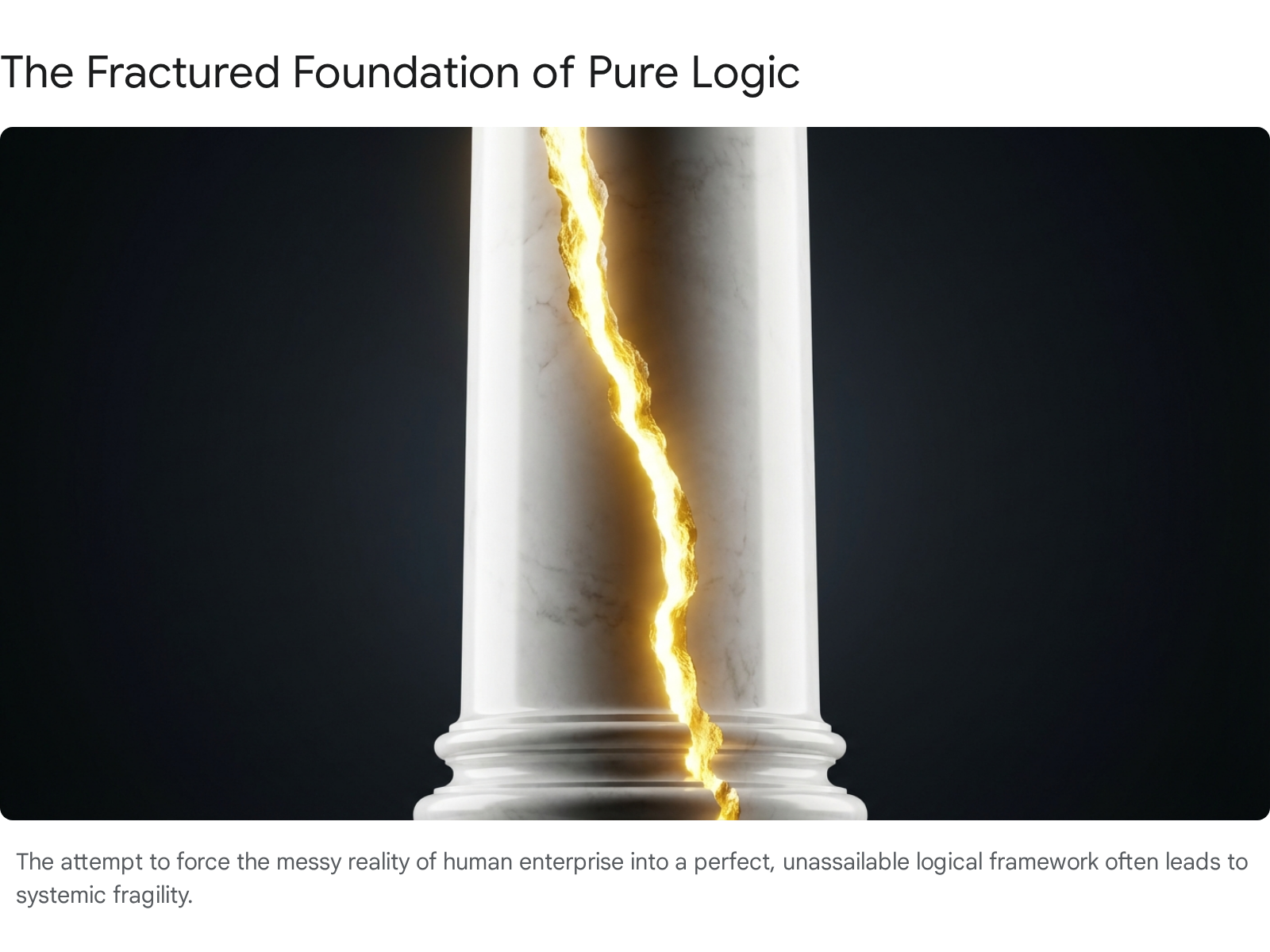
The Monumental Grind of Principia Mathematica
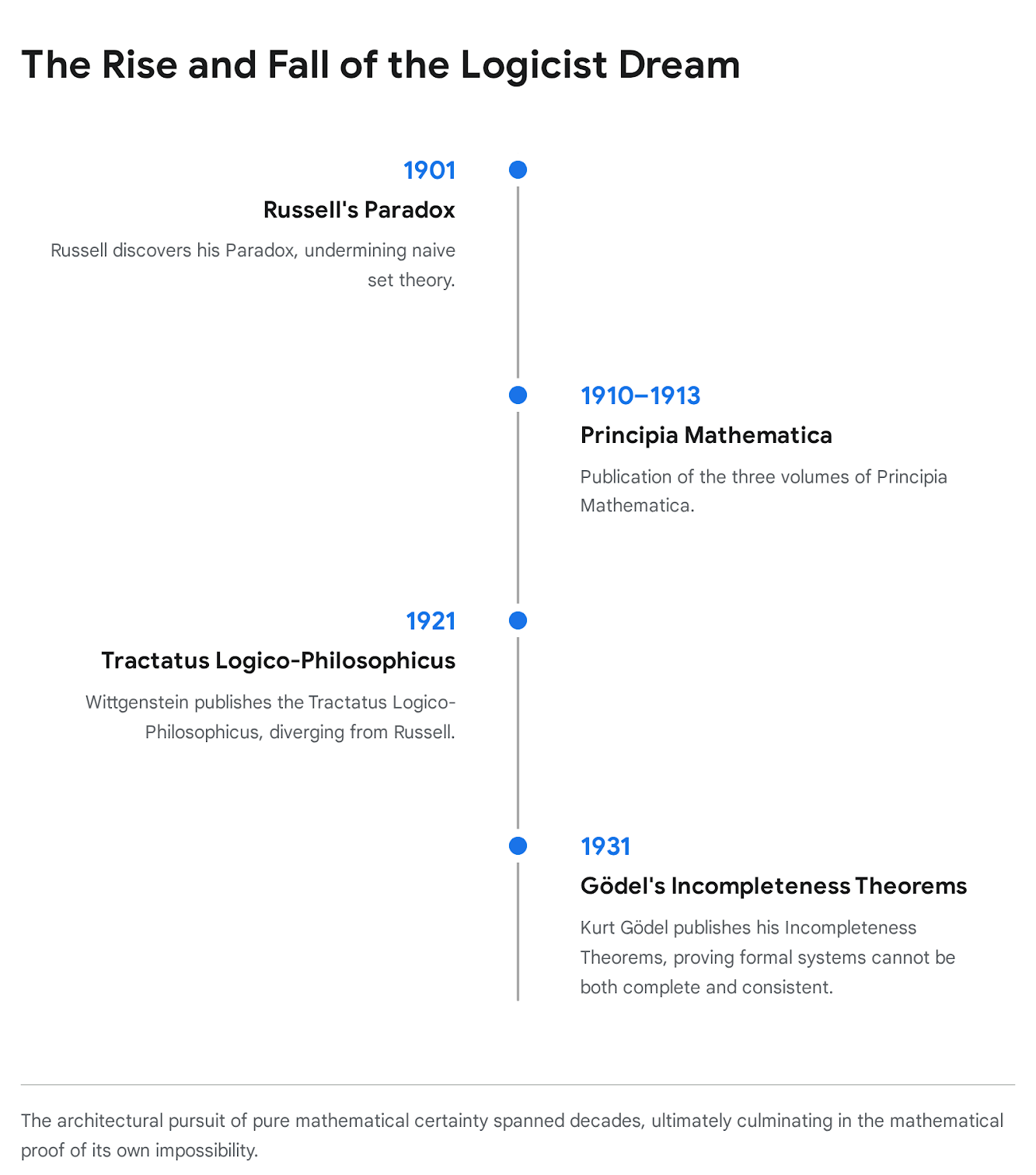
To execute this monumental diagnostic and architectural task, Russell joined forces with his former tutor and examiner at Cambridge, Alfred North Whitehead. Whitehead, senior to Russell in both age and academic standing, had previously published A Treatise on Universal Algebra in 1898, while Russell had recently published The Principles of Mathematics in 1903. Recognizing their profoundly aligned intellectual goals, they abandoned their individual secondary volumes and merged their efforts into a joint work that would utterly dominate a decade of their lives: the three-volume Principia Mathematica, published sequentially in 1910, 1912, and 1913 by Cambridge University Press.
Principia Mathematica (PM) is widely considered by specialists to be one of the most seminal, complex, and opaque works in the history of mathematical logic and philosophy since Aristotle's Organon. To prevent the inherent ambiguities, emotional connotations, and historical baggage embedded within natural human language, Russell and Whitehead realized they had to invent an entirely new syntax. They adopted and heavily expanded upon the symbolic logic notations of Giuseppe Peano and Gottlob Frege. They built a dense, highly specific formal language utilizing dots for punctuation and bracketing, alongside specialized primitive symbols for the "Contradictory Function" (negation, denoted by ∼), the "Logical Sum" (disjunction, denoted by ⋁), and logical implication (denoted by ⊃
). Furthermore, they adopted Frege’s assertion sign (⊢) to denote "it is true that" a proposition holds.
The methodology of Principia required starting from an absolute minimum of primitive ideas and propositions. The authors attempted to analyze the ideas and methods of mathematical logic to the greatest possible extent, building every single mathematical concept from the most basic logical foundations. Because they refused to take the concept of a "number" for granted, they had to philosophically and logically construct the very definition of numerical cardinality. In the system of Principia, properties were represented by classes. Therefore, the number 1 was rigorously defined not as an intuitive quantity, but as the set of all unit classes, a class containing elements identical to a single term 𝒙. The number 2 was subsequently defined as the logical sum of two distinct unit classes.
The sheer granularity of this undertaking cannot be easily overstated. The proof that 1 + 1 = 2 does not appear in the text as a simple equation; it is the culmination of hundreds of pages of dense symbolic derivations that define sets, cardinal numbers, and ordinal numbers before addition can even be addressed. The foundational theorem bridging toward this proof appears late in Volume I at proposition *54.43, which asserts that if two sets each contain exactly one element, and they share no elements in common, their union contains exactly two elements. The text explicitly notes: "From this proposition it will follow, when arithmetical addition has been defined, that 1 +1 =2". However, arithmetic addition is not fully defined until Part III of the work. The actual proof of 1 + 1 = 2 is finally completed in Volume II, on page 86 of the first edition, at proposition *110.643. The authors famously accompanied this exhausted milestone with the wry, understated marginal note: "The above proposition is occasionally useful".
The physical and psychological cost of this intellectual labor was catastrophic for Russell. For roughly ten years, he sat at his desk for up to eight hours a day, staring at blank pieces of paper, attempting to force his mind through grueling, microscopic steps of symbolic deduction. The effort to maintain the vast logical architecture in his head essentially caused severe cognitive burnout. Russell later confessed in his autobiographical writings that the sheer mental strain of Principia permanently diminished his intellect. He felt that his mind had lost its elasticity; he had achieved his goal of mapping the foundations of mathematics, but he had burned out his own cognitive hardware in the process.
The Axiomatic Collapse: Russell's Paradox and the Flaw in Reality
The tragedy of Bertrand Russell is not the cognitive burnout he suffered in pursuit of absolute certainty, but the devastating fact that he mathematically discovered the impossibility of his own quest. While organizing the logical categories that would form the basis of his theory in 1901, Russell uncovered a catastrophic contradiction at the very bedrock of set theory. This logical anomaly, now famously known as Russell's Paradox, proved that pure logic contained inescapable structural flaws.
At the turn of the century, mathematicians like Georg Cantor and Gottlob Frege were relying heavily on "naive set theory," which operated on the unrestricted comprehension principle: the assumption that any definable property, condition, or predicate could naturally and logically form a set. Russell asked a devastatingly simple question that broke this assumption: Consider the set of all sets that are not members of themselves. Is this master set a member of itself? If it is a member of itself, then by its own strict definition, it must not be a member of itself. If it is not a member of itself, then it meets the precise criteria for inclusion, and therefore must be a member of itself.
This paradox is most frequently popularized for lay audiences as the "Barber Paradox": Imagine a town with only one barber. The rigid rule of the town dictates that the barber shaves all those, and only those, who do not shave themselves. The question arises: Does the barber shave himself? If he does, he violates the rule. If he does not, he also violates the rule. The logic loops infinitely; it crashes. While the Barber Paradox is a first-order logic contradiction that can be resolved simply by acknowledging that such a barber cannot physically exist, Russell's actual paradox struck at the structural, metaphysical heart of mathematical sets.
When Russell formalized this paradox and communicated it in a letter to Gottlob Frege in 1902, the timing could not have been worse. Frege was finalizing the second volume of his life's work, Grundgesetze der Arithmetik (Basic Laws of Arithmetic), an exhaustive attempt to reduce arithmetic to logic. The realization that his foundational axioms contained a fatal, undeniable flaw devastated Frege, who never fully recovered from the intellectual blow. He was forced to append a heartbreaking note to his book essentially admitting that his system was compromised before it even went to print.
To salvage Principia Mathematica from suffering the exact same fate, Russell and Whitehead were forced to invent a complex workaround known as the "Ramified Theory of Types". This theory imposed strict grammatical and hierarchical restrictions on mathematical formulas, placing sets and their elements into disjointed types to fundamentally rule out self-referential "ill-formed" objects. To make this hierarchy functional for actual mathematics, they had to introduce the "Axiom of Reducibility," a mechanism that allowed the hierarchy of ramified types to collapse into simpler forms. However, this patch added immense complexity to the symbolic language. Furthermore, many contemporary and subsequent mathematicians felt that the Axiom of Reducibility was an empirical assumption rather than a pure a priori logical truth, thereby philosophically undermining the strict logicist goal of the entire project.
The Rebellion of Wittgenstein and the Limits of Logic
The collapse of the logicist dream was not purely a mathematical phenomenon; it was intensely personal, manifesting in the philosophical rebellion of Russell's most brilliant pupil, Ludwig Wittgenstein. Russell's philosophical methodology during the Principia years was deeply tied to "Logical Atomism". This metaphysical thesis posited that the world consists of a plurality of independently existing atomic facts, and that all complex truths could be perfectly analyzed and broken down into simple, logical components. Russell believed that by refining language into a perfectly logical syntax, philosophers could accurately map the exact structure and substance of reality.
In 1911, acting upon the recommendation of Gottlob Frege, a young, intensely driven Austrian engineer named Ludwig Wittgenstein arrived at Cambridge to study under Russell. Russell quickly recognized Wittgenstein's staggering genius, initially noting him as "obstinate and perverse, but I think not stupid," before developing a deep intellectual and emotional commitment to him. Russell began to view Wittgenstein as the intellectual heir who would complete the work that Principia Mathematica had initiated, solving the philosophical problems Russell felt too exhausted to address. Their pre-war collaboration was remarkably intense, with Wittgenstein frequently pacing Russell's rooms late into the night, debating the foundations of logic with agonizing, borderline-mad fervor. In 1913, Wittgenstein dictated his Notes on Logic directly to Russell, essentially reversing the traditional roles of teacher and pupil.
However, the outbreak of the First World War physically and philosophically separated the two men. Serving in the Austrian army, Wittgenstein constantly requested placement in the most dangerous combat zones, possessing a morbid desire to confront death. It was during this brutal military service, scribbling notes while on leave in the summer of 1918, that Wittgenstein refined his thoughts and completed his seminal work, the Tractatus Logico-Philosophicus, first published in German in 1921 and in English in 1922.
The Tractatus was written in an austere, highly structured, hierarchical numbering system, containing 525 declarative statements that presented a staggering vision of language and reality. At first glance, the Tractatus appeared to validate Russell's worldview. Wittgenstein advanced a "Picture Theory" of meaning, asserting that the world consists of facts (existent states of affairs), and that thoughts and propositions serve as logical "pictures" or models of those facts. For a proposition to have sense and be communicable, its internal logical structure must be strictly isomorphic with the logical structure of the reality it represents.
Yet, the ultimate conclusion of the Tractatus was a devastating, systemic repudiation of Russell's core philosophical project. Wittgenstein realized that while logic dictates the structure of language, it cannot describe its own pictorial form. Logic does not provide a metaphysical map of the universe's ultimate material substance; it merely outlines the tautological boundaries of what can be meaningfully communicated. Crucially, Wittgenstein argued that the most vital aspects of human existence, ethics, aesthetics, the meaning of life, religious feeling, and values, exist entirely outside the boundaries of facts and logic. They cannot be "said" through logical propositions; they can only be "shown" through lived experience.
The book famously concludes with Proposition 7: "Whereof one cannot speak, thereof one must be silent". Believing he had solved all the fundamental problems of philosophy by demonstrating their nature as linguistic confusions, Wittgenstein abandoned the discipline entirely, gave away his vast family fortune, and departed to teach elementary school in rural Austrian villages.
When the Tractatus was translated into English in 1922, Russell provided the introduction, believing he was championing his protégé's masterpiece to the philosophical world. Wittgenstein, however, was appalled by Russell's introduction, accusing his former mentor of fundamentally misunderstanding the work. Russell had interpreted the Tractatus through his own epistemological lens of logical atomism, viewing it merely as a treatise on constructing an ideal, logically perfect language. He failed to grasp Wittgenstein's central, almost mystical revelation: that the attempt to force the totality of existence into a logical framework is fundamentally absurd. The fracture between the two men was complete, perfectly mirroring the fracture of the logicist paradigm itself.
Gödel’s Incompleteness and the Death of the Dream
The ultimate death blow to the logicist dream of a complete, unassailable, and perfect formal system arrived decades later, firmly closing the door that Russell's Paradox had opened. In 1931, the Austrian logician Kurt Gödel published his First and Second Incompleteness Theorems, fundamentally altering the landscape of modern logic.
Gödel mathematically proved that any consistent formal system capable of carrying out basic arithmetic (precisely the type of system laboriously constructed in Principia Mathematica) will inevitably contain statements that are true, but fundamentally unprovable within the rules of that system. According to the first incompleteness theorem, a system cannot be both complete and consistent simultaneously; there will always be true statements that escape the system's formal deductive reach. Furthermore, Gödel's second incompleteness theorem proved an even more devastating reality: no sufficiently complex formal system can prove its own consistency. The system cannot validate itself.
The universe, at its foundational logical level, was proven to be fundamentally un-computable. There will always be a gap between what is true and what can be formally proven by an algorithm or a logical framework. Interestingly, historical evidence suggests Russell struggled to fully metabolize the philosophical implications of Gödel's work. Russell initially misinterpreted the theorem, expressing fear that it meant arithmetic was inconsistent, that a logical derivation could eventually result in a contradiction such as 2 + 2 = 4.001. He failed to immediately grasp that Gödel was proving the system was merely incomplete, not necessarily contradictory in its basic arithmetic. Gödel himself noted this in his writings, remarking that Russell had misinterpreted his results, albeit in a "very interesting manner".
Nonetheless, regardless of Russell's personal interpretation, the overarching historical implication was undeniable. The map of perfect logic could never fully encompass the territory of mathematical truth. The Promethean quest to eliminate all ambiguity from the foundations of knowledge was officially dead.
High Modernism and the Corporate Spreadsheet Trap
Why should the modern executive, the Chief Executive Officer, or the Director of Strategy concern themselves with the historical failure of a 20th-century mathematical logic project? Because the contemporary corporate world is thoroughly infected by the ghost of Bertrand Russell.
The ambition to reduce the enterprise to a perfectly predictable mathematical model, the 300-page strategic plan, the algorithmic forecasting model mapping revenue to the decimal point for the next decade, the obsession with dashboards that attempt to quantify human morale, is a replica of the Principia Mathematica project. In corporate governance, this phenomenon is best understood through the framework of "High Modernism," a concept heavily theorized by political scientist and anthropologist James C. Scott in his seminal book, Seeing Like a State: How Certain Schemes to Improve the Human Condition Have Failed.
Scott defines high modernism as an ideology characterized by an overweening, authoritarian confidence in the ability of governments or central planners to design and operate human societies in accordance with purported scientific and logical laws. At the absolute core of high modernism is the pursuit of "administrative legibility". Complex, naturally evolving social and ecological systems are chaotic, deeply contextual, and unreadable to a centralized authority. Therefore, the central authority feels compelled to intervene, simplifying and standardizing the system so that it can be monitored, quantified, and controlled from the top down.
Historical examples of state-driven high modernism vividly illustrate this impulse. Scott details the imposition of permanent surnames across populations for the sake of efficient taxation, the replacement of local, context-driven land measurements (such as measuring a field by the number of cows it could sustain) with standardized geometric hectares, and the implementation of strict monoculture in scientific forestry. A poignant example is the Welsh naming system; historically, a man might be known locally as "John, ap Thomas ap William" (John, son of Thomas, son of William), a fuzzy but deeply informative local identifier. The central government required him to adopt a standardized last name, providing the state with administrative legibility but permanently erasing a nuanced layer of local understanding. While these simplifications allow the "center" to read the system on a spreadsheet, they invariably result in real-world failures when applied to complex, dynamic ecosystems. Scott points to the architectural sterility of Brasília, the deadly failure of Soviet collectivized agriculture, and forced villagization in Tanzania during the 1970s as prime examples of high-modernist logic crashing into the messy reality of human autonomy.
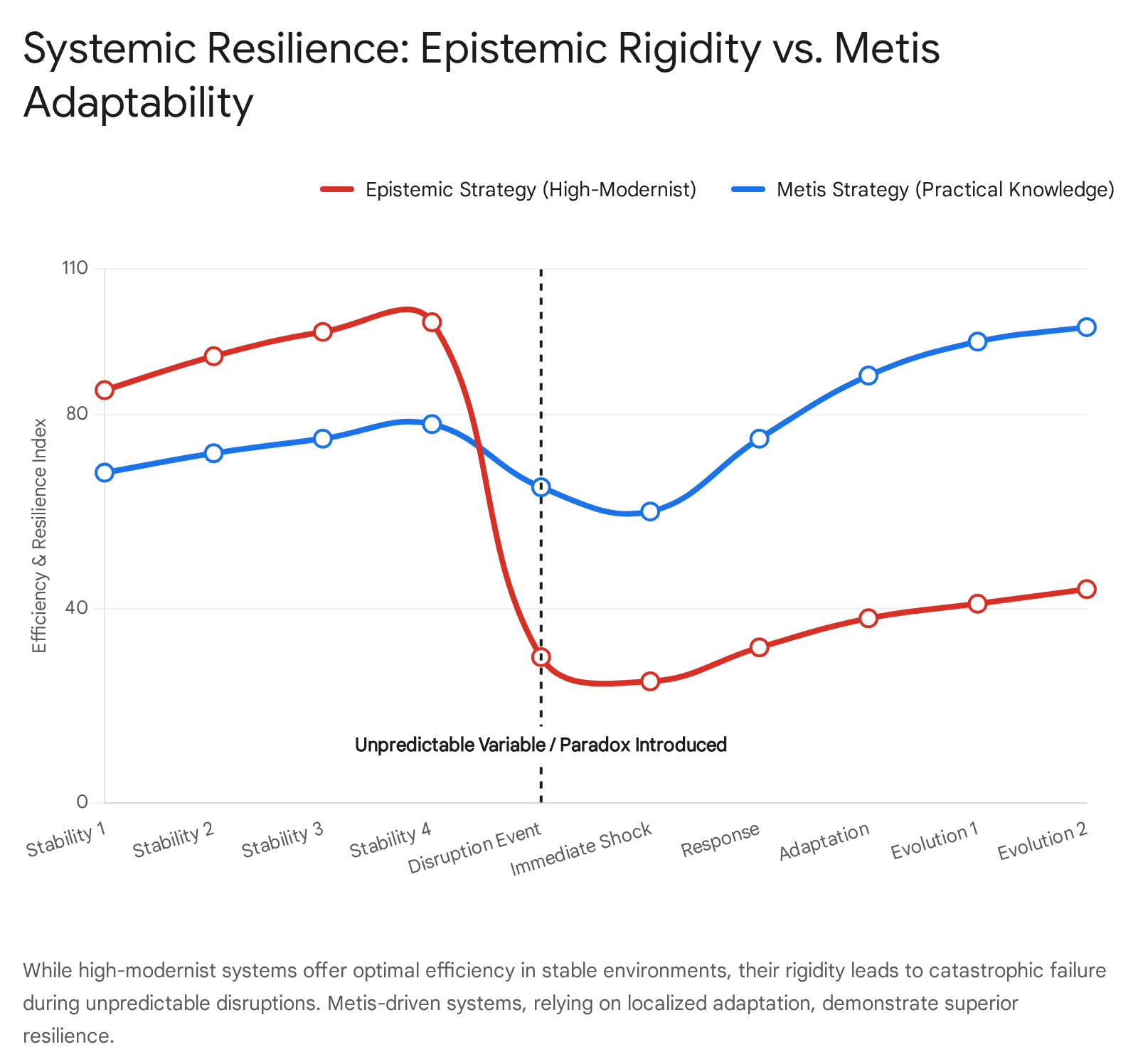
The corporate equivalent is the pervasive culture of Taylorism and High-Modernist Management. Just as state planners seek to simplify society, corporate leadership frequently attempts to force administrative legibility onto the organization. They prioritize what Scott categorizes as Epistemic Knowledge, formalized, standardized, centralized, and highly quantitative data derived from institutional education and scientific methods. In doing so, they actively marginalize, ignore, and sometimes penalize Metis, the practical, localized, adaptable wisdom possessed by the employees who are actually operating on the ground.
The vital strategic lesson of Russell's paradox, Gödel's incompleteness, and Scott's high modernism is that the map is not the territory. When a high-modernist strategic spreadsheet encounters a chaotic, un-computable variable, a global pandemic, a sudden shift in macroeconomic interest rates, or a localized cultural crisis within an engineering team, the model crashes just as surely as the Barber Paradox loops infinitely.
By insisting that only what can be measured is real, data-obsessed leadership designs strategic "monocultures." Just as an agricultural monoculture is highly legible to a central planner but fatally susceptible to a single disease pathogen, a corporate strategy stripped of Metis and diverse human insight is brutally fragile. The most vital forces dictating the long-term survival of a business, brand trust, employee morale, cultural alignment, aesthetic design, and timing, are entirely un-computable. They are the corporate equivalents of Wittgenstein's ethics and aesthetics: they cannot be captured in a logical proposition; they can only be demonstrated in practice. If an organization excludes these factors from its strategy simply because they cannot be measured in a centralized dashboard, it will inevitably fail.
Conclusion: The Pivot to Humanity and the Limits of Rationality
If the narrative of Bertrand Russell ended with the publication of Gödel’s theorems or the bitter alienation of Ludwig Wittgenstein, it would be a purely depressing tale of hubris. However, Russell's true genius lay in his capacity to pivot. Upon recognizing the insurmountable limits of absolute, a priori certainty, he did not descend into nihilism or philosophical despair. Instead, he turned his formidable intellect outward, engaging directly with the messy, illogical, and deeply human realities of politics, society, and ethics.
The latter half of Russell’s nearly century-long life stands in stark contrast to the isolated, grueling years spent writing Principia Mathematica. He transformed from an insulated aristocrat obsessed with symbolic logic into a fierce public intellectual and a tireless advocate for peace, education, and human rights. He was dismissed from Trinity College for his staunch pacifist stance during World War I, and was subsequently imprisoned for his anti-war protests. Undeterred by the loss of his academic standing, he wrote prolifically for popular audiences on social reconstruction, marriage, and the pursuit of happiness. His pivot to humanity was recognized globally; in 1950, he was awarded the Nobel Prize in Literature, utilizing his acceptance speech to hammer home themes of social activism rather than logical theory.
Even well into his eighties and nineties, Russell remained a vibrant force against dogmatism and authoritarian control. In 1955, he released the Russell-Einstein Manifesto, highlighting the existential dangers of nuclear weapons. He served as the founding president of the Campaign for Nuclear Disarmament (CND) in 1958, and was imprisoned yet again at the age of 89 in connection with fierce anti-nuclear protests. He realized that while logic is an incredibly powerful diagnostic tool, it is a catastrophic and sterile master when applied holistically to the governance of human life.
In the prologue to his autobiography, looking back across a life defined by the rigorous pursuit of ultimate truth, Russell articulated the foundational pillars of his existence. He wrote: "Three passions, simple but overwhelmingly strong, have governed my life: the longing for love, the search for knowledge, and unbearable pity for the suffering of mankind".
For the data-obsessed executive, the strategic planner, and the architect of corporate policy, this statement is deeply instructive. The man who arguably pushed the human mind closer to pure mathematical certainty than anyone in the twentieth century deliberately excluded "logic," "certainty," and "efficiency" from his ultimate guiding principles. He recognized that at the bedrock of reality, there are profound forces that cannot be mapped, quantified, or optimized by an algorithm.
Data models, financial spreadsheets, and algorithmic legibility are vital tools for operating an enterprise at scale; the state, as James C. Scott notes, requires some level of administrative legibility to function, just as a corporation requires financial metrics to survive. However, when these quantitative tools are elevated from instruments of measurement to ideologies of absolute truth, when the map aggressively and blindly supersedes the territory, the organization walks directly into the Trap of Hyper-Rationality.
True strategic leadership demands the courage to operate in the dark, acknowledging that absolute certainty is mathematically and philosophically impossible. It requires integrating the top-down Epistemic frameworks with the bottom-up, messy Metis of human intuition, culture, and adaptability. Leaders must build their models and run their logic, but they must ultimately remember that the foundation of any human enterprise is wild, paradoxical, and fundamentally un-computable. Attempting to force reality to prove otherwise will only break the mind of the architect.
No spam, no sharing to third party. Only you and me.
Member discussion