
Bergson’s "Duration" vs. The Gantt Chart: Why Timelines Fail
Note:
Every project manager has experienced the mystery: The Gantt chart was perfect. The hours were estimated correctly. The resources were allocated. Yet, the project is late.
Why?
Henri Bergson would argue that we are using the wrong instrument. We are trying to measure Life (Creative Work) with a ruler designed for Space (Dead Matter).
To fix our broken relationship with deadlines, we must understand the difference between Time and Duration.
In 1889, Henri Bergson published Time and Free Will, dropping a philosophical bomb on the scientific world.
He argued that for centuries, humanity has been confused about what "Time" actually is.
We think of Time as a line. We draw it on a whiteboard: t1, t2, t3. We chop it up into hours, minutes, and "sprints." We treat it like salami that can be sliced, stored, and traded."
Bergson called this Spatialized Time (Le Temps). It is useful for trains and factories.
But it is not how human beings experience reality.
We live in Duration (La Durée).
And the reason your software project is late is that you are managing Duration as if it were Spatial Time.
The Melody Metaphor
To understand the difference, imagine a melody.
- Spatial Time: Imagine the notes of a song drawn on a piece of paper. You can see them all at once. You can cut the paper in half. You can count the notes. This is a Gantt Chart.
- Duration: Now, listen to the song. You cannot separate the notes. The note you are hearing now contains the echo of the previous note and the anticipation of the next one. They melt into each other. If you stop the song for "just a second," you haven't just paused a point on a line; you have broken the flow. You have to start over to recover the feeling.
Knowledge work is a melody, not a stack of bricks.
The Three Lies of the Gantt Chart
Lie #1: The "Man-Hour" is a Unit of Production
The Gantt Chart assumes that 1 Hour = 1 Hour.
If a task takes 4 hours, it doesn't matter if I do it from 8 AM–12 PM, or in four 1-hour chunks scattered throughout the day.
In Duration, the quality of the hour changes depending on where it sits in the flow.
- The First Hour: Is warm-up. (Low value).
- The Fourth Hour: Is "Deep Flow." (High value). If you interrupt a developer or a writer in Hour 3 for a "15-minute stand-up," you haven't just cost them 15 minutes. You have reset their Duration back to zero. You killed the melody. Mathematical Cost: 15 minutes. Bergsonian Cost: 2 hours of lost momentum.
Lie #2: The Future is Already There
A Gantt Chart assumes the future is a road waiting for us to walk down. We just need to map the steps.
This works for Execution (Building a house that has blueprints).
It fails for Innovation (Writing code that solves a new problem).
Bergson argues that in Duration, the future is being created moment by moment. It is "radical novelty." You literally cannot know how long a creative solution will take, because the solution does not exist until it is finished.
Asking "When will the innovation be done?" is a category error. It’s like asking, "How long is the color blue?"
Lie #3: Success is Speed
We obsess over "Velocity" (Agile). We want to move fast.
But Bergson reminds us: "Time is invention or it is nothing at all."
Real value comes from ripening.
Just as you cannot "speed up" a pregnancy by putting nine women on the job for one month, you often cannot speed up a strategy by adding more people. The idea needs Duration to mature in the mind of the leader.
Haste destroys Duration. It forces the mind to rely on old habits (Mechanism) rather than inventing new solutions (Intuition).
The Wise Officer's Strategy: Managing Flow, Not Clocks
How do we survive in a corporate world that runs on clocks? We become Bilingual. We speak "Clock" to the stakeholders, but we practice "Duration" with the team.
1. Batch the "Clock Time"
Administrative tasks (emails, status reports, meetings) are Spatial. They are dead matter.
Strategy: Batch them ruthlessly. Put all meetings on one or two days.
This creates vast, protected open spaces for Duration on the other days.
Rule: Do not schedule an isolated meeting at 3:00 PM. It kills the afternoon Durée.
2. The "No-Hello" Policy (Protecting the Melody)
Instant messaging (Slack/Teams) is the enemy of Duration. A ping is a knife cut in the timeline.
Strategy: Encourage asynchronous culture.
Don't say "Hi" and wait. Say everything in one block.
Better yet, allow "Deep Work" hours where the green dot goes grey.
You are not hiding; you are composing.
3. Estimate in "Complexity," Not "Time"
Since you cannot predict the time of invention, stop lying about it.
Use "T-Shirt Sizing" (S, M, L, XL) or "Story Points."
This acknowledges that we are measuring the heaviness of the problem, not the length of the solution.
When a stakeholder asks for a date, give a range based on probability, not a promise based on a calendar.
Conclusion: Respect the Ghost
There is a fundamental error in how we run modern companies. We try to manage Flow (creativity, momentum, invention) using tools designed for Space (inventory, logistics...).
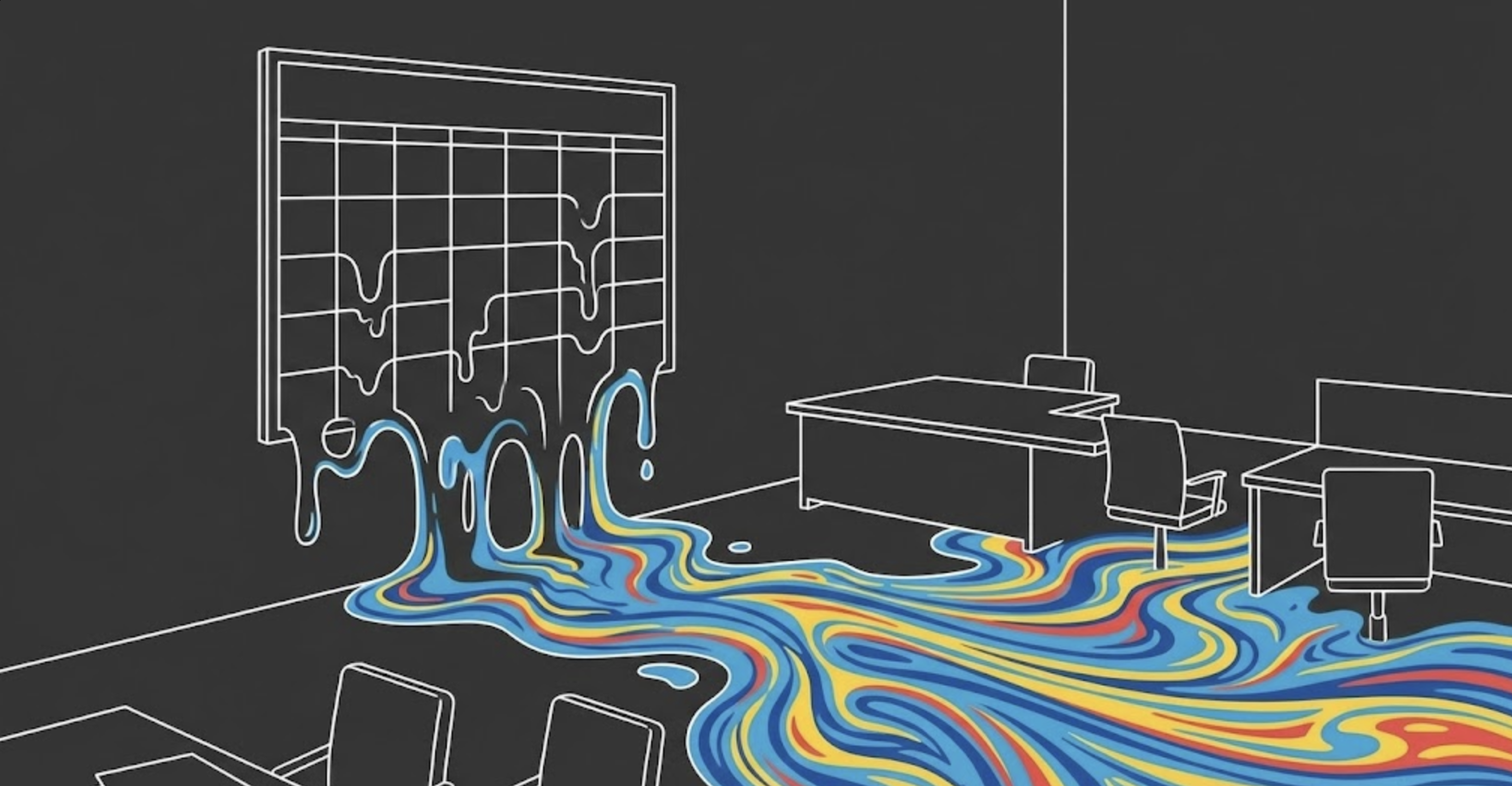
A Gantt chart is excellent for stacking bricks; bricks do not change their nature when you move them. But knowledge work is a river, not a pile of bricks. When you force a stream into a grid, it stagnates. The Chief Wise Officer understands that true productivity is not about cutting time into smaller static units. It is about protecting the Duration—the continuous, unbroken current where the actual work of creation happens.
As Bergson wrote:
"We must wait for the sugar to melt."
You cannot force the melting with a deadline. You can only create the conditions (heat/fluidity) for the tea to become sweet.
No spam, no sharing to third party. Only you and me.

Member discussion