
The World as Will and Solitude: Life, Philosophy, and Legacy of Arthur Schopenhauer
I. Introduction: The Shadow of German Idealism
The philosophical landscape of nineteenth-century Germany was a terrain dominated by the towering, intricate edifices of German Idealism. It was an era defined by the pursuit of the Absolute, a time when thinkers like Johann Gottlieb Fichte, Friedrich Wilhelm Joseph Schelling, and, preeminently, Georg Wilhelm Friedrich Hegel sought to heal the dualisms left behind by Immanuel Kant. These architects of thought aimed to unify the knowing subject and the known object into a rational, evolving whole, positing history as the progressive unfolding of Spirit. Their systems were optimistic, historicist, and fundamentally rationalist. Into this milieu, one of intellectual confidence and systemic grandeur, stepped Arthur Schopenhauer, a thinker who would ultimately shatter the epistemological and metaphysical confidence of the age.
Schopenhauer presented a worldview that was diametrically opposed to the spirit of his time. His philosophy was not historically progressive but cyclically tragic; it was not governed by a benevolent reason, but driven by a blind, voracious, and irrational force he termed "Will." While his contemporaries looked to history and the state for meaning, Schopenhauer looked inward to the body and outward to the suffering of sentient beings, concluding that existence itself was a mistake. This is an examination of Schopenhauer’s life and work.
We explore his erratic relationship with Johann Wolfgang von Goethe, his bitter, pathological rivalry with Hegel, and the solitary, regimented routine of his later years in Frankfurt that cemented his image as the "Sage." Furthermore, we trace the seismic impact of his thought on the giants of modernism: Richard Wagner, Friedrich Nietzsche, Sigmund Freud, and Leo Tolstoy. Finally, we provide a complete bibliography of his works, ensuring a totalizing view of the philosopher who famously declared the world to be "my representation."
1.1 The Kantian Inheritance and the Great Deviation
To understand the magnitude of Schopenhauer's contribution, one must first situate him in the wake of Immanuel Kant. Schopenhauer considered himself the only true heir to Kant, famously dismissing the Idealists as "sophists" who had betrayed the critical project for the sake of theological comfort and academic careerism. He accepted Kant’s fundamental distinction between the phenomenon (the world as it appears to us, structured by our cognitive faculties) and the noumenon (the thing-in-itself, the reality that exists independently of our perception). However, whereas Kant argued that the thing-in-itself was strictly unknowable, a limit to human reason, Schopenhauer made the audacious, revolutionary claim that we experience the thing-in-itself directly. This experience is not found in the stars or abstract concepts, but in our own bodies. This inner essence, he argued, is Will. This deviation is the fulcrum upon which his entire philosophy turns, transforming Kant's epistemological modesty into a metaphysical pessimism that stripped the universe of its rationality.
II. Historical Facts: The Making of a Misanthrope
The trajectory of Schopenhauer's philosophy cannot be disentangled from the trajectory of his life. His misanthropy, his misogyny, his pessimism, and his glorification of the arts were all deeply rooted in his personal history, a history marked by patrician privilege, familial suicide, and a catastrophic relationship with his mother.
2.1 The Merchant’s Son: Danzig and Hamburg (1788–1805)
Arthur Schopenhauer was born on February 22, 1788, in the Free City of Danzig (now Gdańsk, Poland). He was the son of Heinrich Floris Schopenhauer, a wealthy, patrician merchant of the Hanseatic League. Heinrich Floris was a man of staunch republican principles, immense wealth, and a volatile temperament, known for his "deafness" to the trivialities of social life and a fierce independence. His mother, Johanna Trosiener, was twenty years Heinrich's junior. Unlike her husband, she was vivacious, socially ambitious, and destined to become one of the most celebrated novelists of her day.
The early years of Arthur’s life were dictated by his father’s overpowering desire to mold him into a cosmopolitan merchant, a "citizen of the world" who would carry on the family business. In 1793, when Danzig was annexed by Prussia, an event Heinrich Floris viewed as a catastrophe for liberty, the family moved to the free city of Hamburg. Here, the conflict between Arthur's scholarly inclinations and his father's commercial ambitions began to fester. Heinrich Floris offered his son a proposition that would shape his worldview: Arthur could either stay in school and prepare for a university education, a path the boy desperately desired, or accompany his parents on a grand tour of Europe, after which he would apprentice in trade. The allure of travel was too great for the young Arthur. He chose the tour, a decision he would later regret as it delayed his formal philosophical training. This journey (1803–1804), however, was crucial for his philosophical development; it exposed him to the "profound suffering of the poor" across Europe, from the slums of London to the galley slaves of Toulon, sowing the seeds of his pessimism.
The defining trauma of Schopenhauer’s youth occurred in April 1805. His father, Heinrich Floris, was found dead in a canal in Hamburg. The consensus, then and now, is that he committed suicide, likely driven by bouts of depression and anxiety over his business affairs. This event devastated Arthur. He revered his father, seeing him as a victim of the world's inherent misery. The suicide cast a long shadow over his philosophy, particularly regarding the nature of suffering and the "will-to-live." It also left Arthur with a significant inheritance, granting him the financial independence that would later allow him to pursue philosophy without the need for academic employment, a freedom he would wield like a weapon against the "university professors" he despised.
2.2 The Weimar Years: Johanna’s Salon and the Break
Following Heinrich’s death, the family dynamic fractured irreparably. Johanna Schopenhauer, now a wealthy widow, moved to Weimar, the cultural capital of Germany, to establish a literary salon. She blossomed in this environment, befriending Goethe and becoming a successful author. Arthur, initially bound by his promise to his late father, continued his merchant apprenticeship in Hamburg, a vocation he loathed. By 1807, the misery was too great; with his mother’s reluctant permission, he left commerce to pursue the Gymnasium in Gotha and then moved to Weimar.
The relationship between Arthur and Johanna was catastrophic. Johanna was a socialite who enjoyed the "trivial gatherings" Arthur despised. She found his gloominess, his arrogance, and his dogmatism "unbearable and burdensome." Their correspondence reveals the depth of their alienation. In a devastating letter from November 6, 1807, Johanna wrote to her son:
"You are unbearable and burdensome, and very hard to live with; all your good qualities are overshadowed by your conceit, and made useless to the world simply because you cannot restrain your propensity to pick holes in other people".
Arthur did not live with his mother in Weimar; they maintained separate residences to avoid conflict. He viewed her newfound social life as a disrespect to his father’s memory, interpreting her "new life" as a betrayal. The final rupture came in 1814. Arthur, having completed his doctoral dissertation, expected maternal praise. Instead, Johanna mocked it. When he declared that his book would be read when her romance novels were forgotten, she retorted that his book would be available forever because the entire print run would still be in the warehouse. They parted ways, and Arthur never saw her again for the remaining 24 years of her life. This estrangement deeply colored his later writings on women, fueling a misogyny that he attempted to systematize in his philosophy.
2.3 Education and Influences
Schopenhauer’s university years were marked by a voracious consumption of the classics and a disdain for contemporary academic philosophy.
- Göttingen (1809–1811): He enrolled initially in medicine but shifted to philosophy under the guidance of Gottlob Ernst Schulze. Schulze advised him to restrict his reading to Plato and Kant before touching Aristotle or Spinoza. This advice was foundational, ensuring Schopenhauer's thought remained rooted in transcendental idealism rather than the nascent German Idealism of Fichte or Schelling.
- Berlin (1811–1813): He transferred to the University of Berlin, hoping to learn from Johann Gottlieb Fichte, the most famous philosopher of the day. However, he was quickly disillusioned, finding Fichte’s obscure idealism to be "windbaggery." He also attended lectures by Friedrich Schleiermacher, whom he equally despised. It was here that his opposition to "university philosophy" crystallized; he came to see academic philosophy as a pseudo-theological enterprise designed to support the state and church rather than pursue truth.
- Rudolstadt and the Doctorate (1813): Fleeing the turmoil of the Napoleonic Wars (specifically the Grande Armée’s arrival in Berlin), Schopenhauer retreated to the quiet town of Rudolstadt. In this seclusion, he wrote his doctoral dissertation, On the Fourfold Root of the Principle of Sufficient Reason, which earned him his degree from the University of Jena in absentia.
III. The Philosophical Foundation: The Fourfold Root
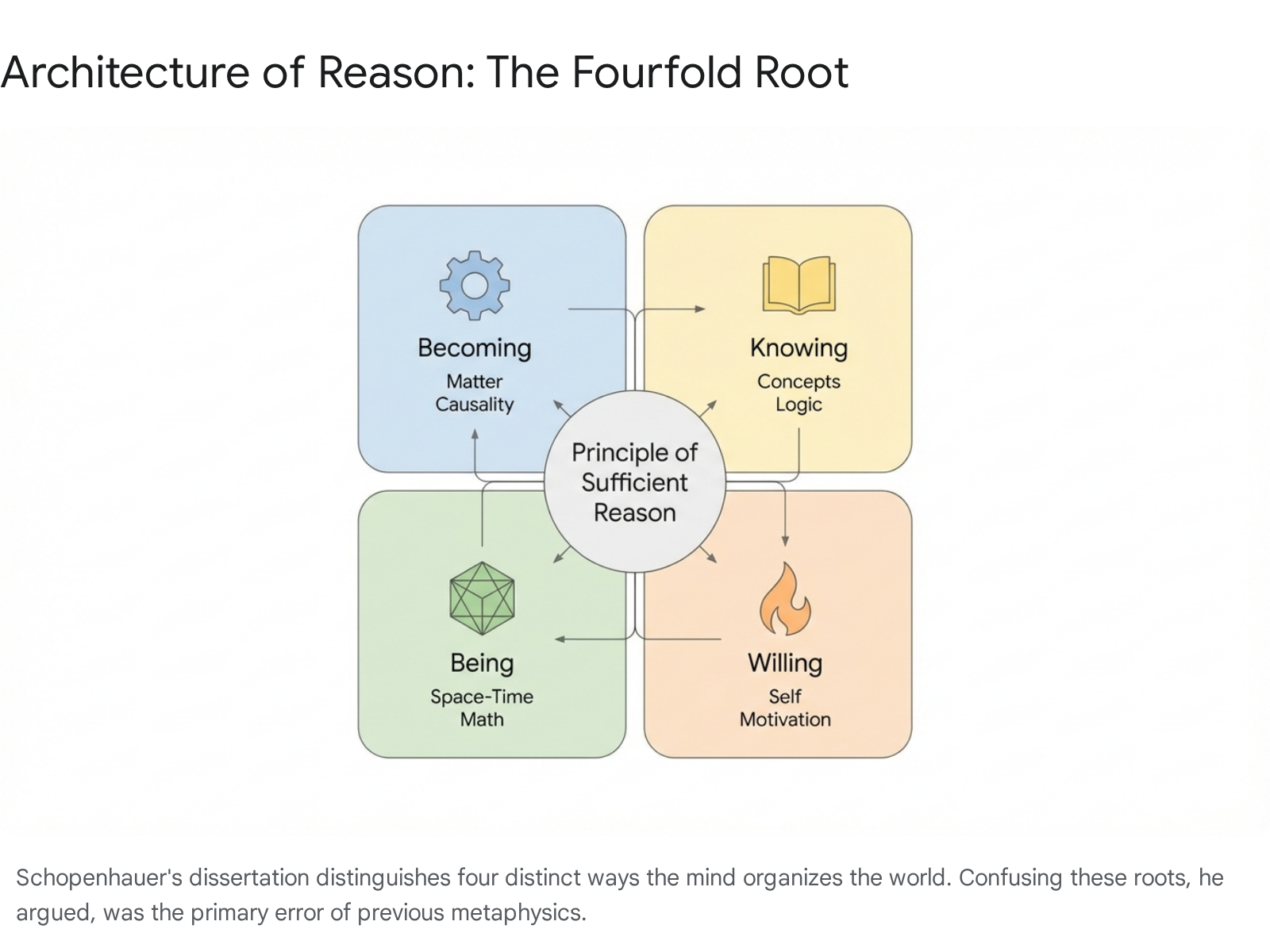
Schopenhauer consistently maintained that On the Fourfold Root of the Principle of Sufficient Reason (Ueber die vierfache Wurzel des Satzes vom zureichenden Grunde, 1813, revised 1847) was the necessary introduction to his entire system. He argued that previous philosophers had confused the different ways in which we ask "why?" and thus conflated different kinds of necessity. Without understanding this distinction, the rest of his metaphysics remains opaque.
The Principle of Sufficient Reason (PSR) states that "nothing is without a reason for being rather than not being." Schopenhauer identifies four distinct "roots" of this principle, corresponding to four distinct classes of objects for the subject. This classification is not just academic; it is the map of the human mind's interaction with the world.
3.1 The First Root: Becoming (Physiological/Physical)
- Object Class: Intuitive, empirical representations (physical objects).
- Principle: The Law of Causality (Principium rationis sufficientis fiendi).
- Explanation: Every material state presupposes a prior state from which it follows necessarily. This governs the physical world of changes. It explains why a physical event occurs. This is "Physical Necessity." Schopenhauer emphasizes that causality applies only to changes in matter, not to the existence of matter itself. This distinguishes his physics from a creationist metaphysics.
3.2 The Second Root: Knowing (Logical)
- Object Class: Abstract concepts (judgments).
- Principle: The Law of Logic (Principium rationis sufficientis cognoscendi).
- Explanation: A judgment must have a sufficient ground to be true. This ground can be logical (deductive), empirical (inductive), transcendental (based on the forms of possibility), or metalogical (based on the rules of thought). It explains why a conclusion is true given the premises. This is "Logical Necessity." Schopenhauer warns against confusing a physical cause with a logical ground, a common error in rationalist philosophy.
3.3 The Third Root: Being (Mathematical)
- Object Class: Forms of intuition (Space and Time).
- Principle: The Law of Being (Principium rationis sufficientis essendi).
- Explanation: The parts of space and time determine one another. In geometry, the position of lines and points determines others; in arithmetic, the succession of numbers is determined. It explains why mathematical truths hold (e.g., why 3+5=8 or why the angles of a triangle equal two right angles). This is "Mathematical Necessity." This root grounds mathematics not in logic (as Leibniz thought) but in direct intuition.
3.4 The Fourth Root: Willing (Psychological)
- Object Class: The Subject of Willing (Self-consciousness).
- Principle: The Law of Motivation (Principium rationis sufficientis agendi).
- Explanation: We know ourselves as willing agents. Every action we take is the result of a motive acting upon our character. A motive is simply a cause seen from the inside. It explains why we act. This is "Moral Necessity." This final root is the bridge to his later metaphysics, as it identifies the "I" not just as a knowing subject but as a willing subject.3
IV. The Metaphysics: The World as Will and Representation
Schopenhauer’s masterpiece, Die Welt als Wille und Vorstellung (The World as Will and Representation), was published in late 1818 (with an 1819 imprint). It unfolds in four books, mirroring the structure of a symphony, moving from epistemology to metaphysics, then aesthetics, and finally ethics. This work is the systematic exposition of the "single thought" Schopenhauer believed he had discovered.
4.1 Book I: The World as Representation
Schopenhauer begins with the axiom: "The world is my representation." This is the Kantian side of his thought. The world we perceive, trees, tables, stars, exists only as an object for a subject. It is structured by the forms of space, time, and causality (the Fourfold Root). Without a perceiving subject, there is no objective world. This realm is governed by strict determinism; everything that happens in the world of representation has a cause. This is the world of science, of common sense, and of the "Veil of Maya" in Indian philosophy, a world of illusion insofar as it hides the true nature of reality.
4.2 Book II: The World as Will
If the world were merely representation, it would be a "dream" or a "phantasmagoria." But Schopenhauer argues we have a unique access to the thing-in-itself. We are not just knowing subjects; we are also embodied.
- The Body as Key: We know our body in two ways: as an object among objects (representation) and as Will (immediate feeling of desire, movement, pain).
- The Extension: Schopenhauer extends this insight to the entire universe. If our inner essence is Will, then by analogy, the inner essence of all things, from the gravity pulling a stone to the instinct driving a tiger, is also Will.
- Nature of the Will: This Will is blind, irrational, striving, and singular. It is outside space and time (which are merely the principium individuationis, the principle of individuation). Therefore, the Will is one; the separation between individuals is an illusion. This Will is a ceaseless striving that can never be satisfied, a hunger that consumes itself.
4.3 Book III: Aesthetics and the Platonic Ideas
While the Will is endless striving and suffering, Schopenhauer offers a temporary respite: Art.
- The Genius: The artist (genius) has the capacity to transcend their own individual will and perceive the Platonic Ideas, the eternal, essential forms of things, independent of the principle of sufficient reason. In this state of aesthetic contemplation, the subject becomes a "pure, will-less subject of knowledge," freed from the slavery of desire.
- The Hierarchy of Art: Schopenhauer ranks the arts based on the "grade" of the Will's objectification they represent. Architecture illuminates the will in gravity (the lowest grade); landscape painting reveals the vegetative soul; sculpture and historical painting reveal the human form and character. Poetry, particularly tragedy, is higher still, revealing the terrible conflict of the Will with itself.
- The Supremacy of Music: Music occupies a supreme, almost mystical position. Unlike other arts, which copy the Ideas (which are objectifications of the Will), music is a copy of the Will itself. This explains music's profound, direct emotional impact. It speaks the "universal language" of the Will, bypassing the intellect to speak directly to the emotions. It expresses the metaphysical essence of the world, "the thing-in-itself," without the mediation of the world of representation.
4.4 Book IV: Ethics, Asceticism, and Denial
Since the Will is a blind striving that can never be satisfied, life is essentially suffering. "It swings like a pendulum backwards and forwards between pain and boredom."
- Egoism: In the world of representation, individuals see themselves as separate. This leads to egoism and conflict (bellum omnium contra omnes). The individual will seeks to devour others to sustain itself.
- Compassion (Mitleid): Moral insight occurs when one pierces the veil of Maya and realizes that the sufferer and the tormentor are one and the same (tat tvam asi - "Thou art that"). This metaphysical identity is the basis of compassion, the only genuine moral incentive. When I feel another's pain as my own, I am recognizing the unity of the Will.
- Denial of the Will: The ultimate salvation is not suicide (which Schopenhauer rejects), but the "denial of the will-to-live" (asceticism). By ceasing to desire, the saint quiets the Will, achieving a state of Nirvana or nothingness relative to the world of representation. This is a state of profound peace, the "sabbath of the penal servitude of willing".
4.5 Suicide vs. Asceticism: A Crucial Distinction
Schopenhauer is often misunderstood as an advocate of suicide. In his essay On Suicide, found in Parerga and Paralipomena, he argues that suicide is not a moral crime (contrary to Christian doctrine) but it is a "clumsy experiment." The suicide does not deny the Will; they deny life because they cannot have it on their own terms. They effectively will a better life, not the cessation of willing. The suicide destroys the phenomenon (the body) but leaves the thing-in-itself (the Will) untouched. True salvation comes only from the ascetic denial of the will-to-live, a state of desirelessness, not destruction. The ascetic denies the will to enjoy the pleasures of life; the suicide denies the suffering of life but still affirms the will to pleasure.
V. The Hedgehog and the Poet: Relationships and Conflicts
5.1 The Hedgehog’s Dilemma
Schopenhauer’s view of human social interaction is famously encapsulated in the "Hedgehog’s Dilemma" (or Porcupine’s Dilemma), found in Parerga and Paralipomena (1851). This parable is a masterful condensation of his social pessimism.
- The Parable: "A number of porcupines huddled together for warmth on a cold day in winter, but, as they began to prick one another with their quills, they were obliged to disperse. However, the cold drove them together again, when just the same thing happened. At last, after many turns of huddling and dispersing, they discovered that they would be best off by remaining at a little distance from one another."
- The Meaning: Humans are driven together by a "need for society" (warmth/boredom), but their "prickly and disagreeable qualities" (egoism/bad manners) repel them. The solution is a "moderate distance", politeness.
- The Solitary: Schopenhauer concludes that "a man who has some heat in himself prefers to remain outside, where he will neither prick other people nor get pricked himself." This justifies his own chosen isolation, framing his solitude not as a failure of social skill, but as a surplus of internal warmth.
5.2 The Goethe Conflict: Light, Darkness, and Ego
In 1813/14, during his time in Weimar, Schopenhauer collaborated with Goethe on the poet's Theory of Colours (Zur Farbenlehre). Goethe was vehemently anti-Newtonian, believing that white light was simple (not a composite of colors) and that color arose from the interaction of light and darkness (the Urphänomen).
Schopenhauer wrote On Vision and Colors (1816) to support Goethe but diverged significantly in his explanation.
- The Divergence: Goethe treated color as an objective phenomenon of nature. Schopenhauer, a Kantian, treated it as a subjective physiological activity of the retina. Schopenhauer argued that the retina has a "full activity" (white) and can be split into fractions (colors). For example, Red might be a specific fraction of retinal activity, and Green the remaining complement.
- The Fallout: Schopenhauer sent his manuscript to Goethe, expecting the poet to sponsor its publication. Goethe, sensing that Schopenhauer was rewriting his theory into a subjective idealism, grew distant. He did not edit the work and eventually severed the collaboration. Schopenhauer was deeply hurt but continued to praise Goethe’s work as a necessary "data" set for his own theory. He famously wrote to Goethe, comparing himself to Oedipus seeking the truth even if it meant horror, while Goethe (and the rest of humanity) were like Jocasta, begging not to know. This "courage to be a philosopher" was central to Schopenhauer's self-image.
- The Epigrams: Goethe mocked Schopenhauer’s gloom in his Venetian Epigrams, specifically Epigram 82 ("Trübes Wetter" - Gloomy Weather), implying that for some (Schopenhauer), the sun is always clouded by their own dark disposition.
5.3 The Rivalry with Hegel
Schopenhauer’s hatred for Hegel was pathological. In 1820, Schopenhauer obtained a lectureship at the University of Berlin. With supreme confidence, he scheduled his lectures at the exact same time as Hegel’s. The result was a humiliation: Hegel’s hall was packed with hundreds of students; Schopenhauer’s had fewer than five. He cancelled the lectures and never taught again.
He described Hegel as a "clumsy charlatan," a "scribbler of nonsense," and accused him of ruining a generation of German intellect with "verbiage" that destroyed critical thinking. He viewed Hegel’s "optimism" and "historicism" as fundamentally false, a "justification of the status quo" that served the Prussian state rather than the truth.
VI. The Sage of Frankfurt: A Life in Routine
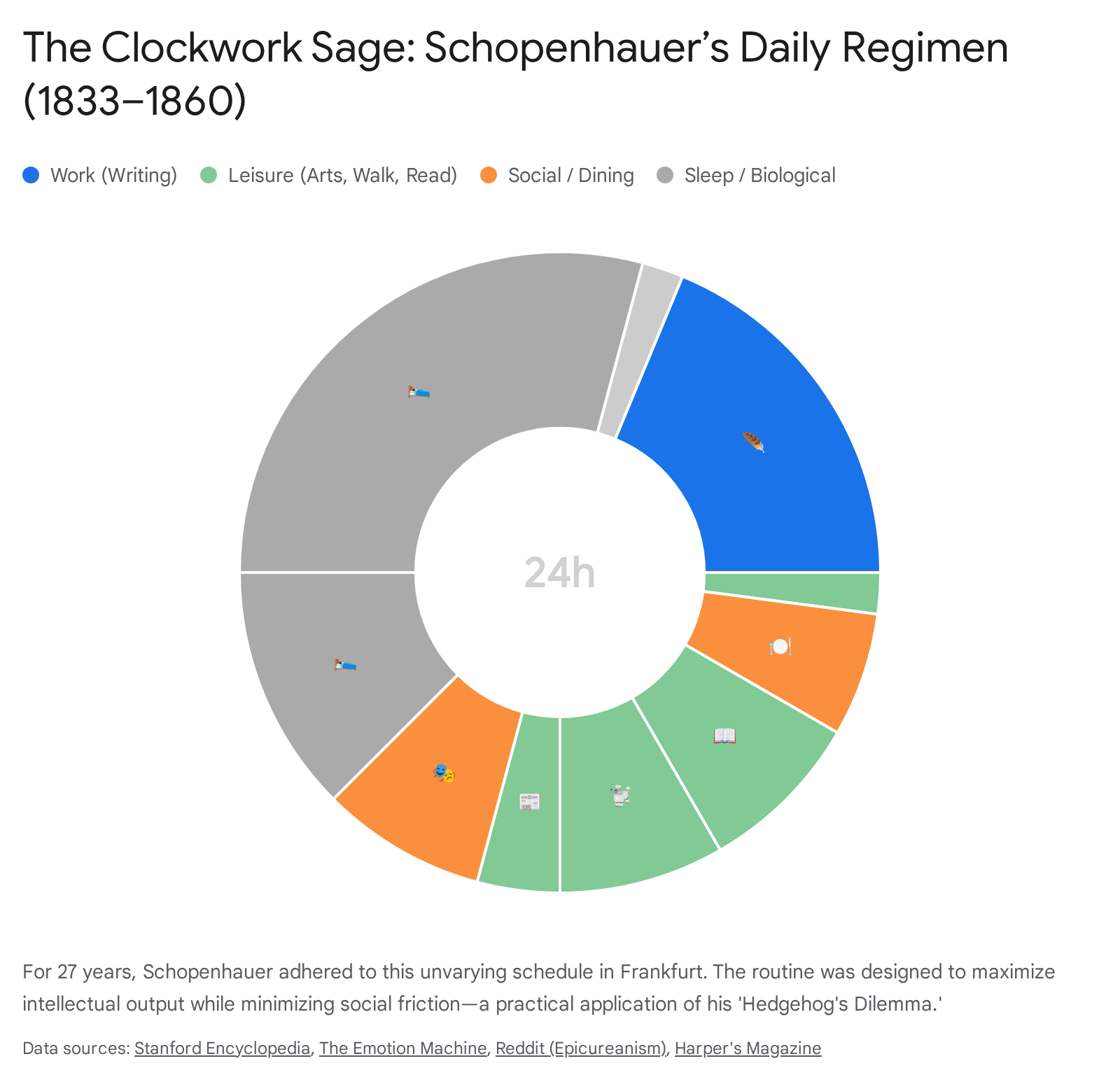
After his failure in Berlin and years of travel (Italy, Dresden), Schopenhauer settled in Frankfurt am Main in 1833, where he remained until his death in 1860. It was here that he cultivated the persona of the solitary sage, living a life of clockwork regularity.
6.1 The Daily Regimen
Schopenhauer lived by a rigid, Kantian-like routine for 27 years, which he believed was essential for his work and health. This routine was not only a habit but a philosophical praxis, a fortress of solitude against the chaos of the Will.
- Morning (7:00 AM - 12:00 PM): He woke, took a cold sponge bath, and drank strong coffee. He then wrote and studied for exactly four hours. He strictly forbade interruptions during this time.
- Flute Practice (12:00 PM - 12:30 PM): To relax his mind, he played the flute (Rossini was a favorite). This aligns with his philosophy of music as a temporary respite from the Will.
- Lunch at the Englischer Hof (1:00 PM): He dined daily at this fashionable inn. He was a hearty eater, often consuming a "double portion," creating local anecdotes. When asked why he ate so much, he allegedly replied, "I eat a double portion because I think a double portion." He would engage in conversation, often lecturing fellow diners with his caustic wit.
- The Walk (4:00 PM - 6:00 PM): Regardless of the weather, he walked rapidly for two hours, usually accompanied by his white poodle (named Atma, Sanskrit for "Soul," or Butz). He believed rapid movement was necessary for the circulation of ideas.
- Evening: He visited the library reading room to read The Times (London), keeping abreast of world events to confirm his pessimism. He attended the theater or concerts (Beethoven, Mozart, Rossini) and read the Upanishads before sleep.
6.2 "On Women" and Personal Relationships
Schopenhauer remained a bachelor his entire life. His views on women were notoriously misogynistic, crystallized in his essay Über die Weiber (1851). He described women as the "sexus sequior" (the second sex), "childish, frivolous, and short-sighted," and naturally meant to obey. He argued that women lacked the capacity for purely objective artistic contemplation, claiming they were trapped in the subjective and the concrete.
However, his biography reveals a more complex reality. He had several affairs, including a significant on-and-off relationship with the opera singer Caroline Medon (Caroline Richter). He met her when he was 33 and she was 19. He considered marrying her but broke it off, partly due to her illegitimate child and his own desire for absolute independence. When he left Berlin in 1831 to escape cholera (the same epidemic that killed Hegel), he offered to take her with him only if she left her son behind. She refused. In his will, however, he left her a significant sum, indicating a lingering affection. Later in life, he was charmed by the sculptress Elisabet Ney, telling a friend, "I have not yet spoken my last word about women," suggesting a late-life softening of his rigid views.
VII. The Late Triumph: Parerga and Paralipomena
Schopenhauer remained obscure for most of his life. The World as Will and Representation sold poorly. However, in 1851, he published Parerga and Paralipomena (Greek for "Appendices and Omissions"). This collection of essays and aphorisms was written in a more accessible, literary style. It covered topics like ghosts ("Essay on Spirit Seeing"), university philosophy, style, and, most famously, "Aphorisms on the Wisdom of Life".
This work catapulted him to fame. An 1853 review by John Oxenford in the Westminster Review titled "Iconoclasm in German Philosophy" introduced him to the English-speaking world, and soon Europe hailed him as the philosopher of the age. He spent his final years enjoying this belated adulation, reading favorable reviews in his time at the Englischer Hof. He noted with irony that the "Nile of fame" had finally reached him, just as he was preparing to leave the stage.
VIII. Legacy and Influence
Schopenhauer’s influence on the late 19th and early 20th centuries was immense, arguably greater than any other philosopher of his time. He was the "educator" of modernity's greatest rebels. The network of his influence stretches across music, literature, psychology, and philosophy, creating a "Schopenhauerian Web" that defined the modern era.
8.1 Richard Wagner
Wagner discovered Schopenhauer in 1854 and called it a "gift from heaven." It transformed his understanding of his own work and led to a radical shift in his artistic direction.
- Tristan und Isolde: This opera is the musical embodiment of Schopenhauerian erotic longing. The lovers' desire cannot be satisfied in the phenomenal world; it can only find fulfillment in the "night" of death, the cessation of the individual will.
- The Ring Cycle: Wagner changed the ending of the Ring. Originally, it ended with a Feuerbachian optimization of love and a new order. The revised ending reflects Schopenhauerian resignation, the destruction of Valhalla and the gods as a necessary negation of the Will to Power, a recognition that the desire for power is the root of suffering.
8.2 Friedrich Nietzsche
Nietzsche called Schopenhauer his "great teacher." His essay Schopenhauer as Educator (1874) praises Schopenhauer’s honesty, his atheism, and his courage to face the terror of existence without religious crutches. The Birth of Tragedy is deeply Schopenhauerian, using the Dionysian (Will) and Apollonian (Representation) duality to explain Greek art.
However, Nietzsche eventually broke with Schopenhauer’s pessimism. He rejected the "denial of the will" and instead affirmed the "Will to Power" and the "Eternal Recurrence." He saw Schopenhauer’s asceticism as a symptom of decadence, a "European Buddhism" that negated life. Yet, he always acknowledged that Schopenhauer was the one who asked the right question: "Does existence have a meaning?" and provided the honest, if negative, answer that Nietzsche sought to overcome.
8.3 Sigmund Freud
Freud acknowledged that Schopenhauer anticipated the core concepts of psychoanalysis, though he claimed to have read him late in life to preserve his own originality.
- The Will = The Id: The irrational, striving Will, which operates below the surface of consciousness, is the direct precursor to Freud's Id.
- Repression: Schopenhauer described the intellect’s refusal to accept unpleasant realities from the Will, a mechanism Freud would formalize as repression.
- The Death Drive: Schopenhauer’s focus on the return to inorganic peace, the desire of the Will to cease its striving, parallels Freud’s Thanatos or death drive.
8.4 Leo Tolstoy and the East
Tolstoy called Schopenhauer "the greatest genius among men." The novel Anna Karenina and his later Christian anarchism were deeply influenced by Schopenhauer’s ethics of compassion and asceticism. Tolstoy found in Schopenhauer a confirmation of his own doubts about the progress of civilization and the meaning of history.
Schopenhauer was also the primary conduit for Eastern Philosophy in the West. He kept a Latin translation of the Upanishads (the Oupnek'hat) by his bedside, famously declaring: "It has been the solace of my life, it will be the solace of my death." He saw in Indian philosophy a confirmation of his own pessimistic idealism and was the first major Western philosopher to place Buddhism on par with Christianity.
IX. Complete Bibliography of Arthur Schopenhauer
The following is a comprehensive list of Schopenhauer’s published works, including original German titles and publication years. This list serves as a roadmap to his intellectual output.
X. Conclusion: The Legacy of the Outsider
Arthur Schopenhauer died on September 21, 1860, sitting in his armchair at home in Frankfurt, his poodle by his side. His physician found him; he had died of heart failure, peaceful and painless. The inscription on his grave is simply "Arthur Schopenhauer," with no dates or epitaph, he believed his works would speak for themselves.
Schopenhauer was the great outsider of Western philosophy. He wrote in clear, literary German when obscure jargon was the norm. He was an atheist in a religious age, a pessimist in an era of progress, and a champion of the East when the West was at the height of its colonial arrogance. His philosophy offers no happy ending, no historical redemption, and no promise of a personal God. Yet, in his unflinching honesty about the suffering of existence and his celebration of art and compassion as our only refuge, he provided a "solace" that has resonated with artists, writers, and thinkers for nearly two centuries. He remains the indispensable philosopher of the darker side of the human condition, the "Emperor of the Air" who mapped the geography of our suffering and offered us the quiet dignity of denial.
No spam, no sharing to third party. Only you and me.



Member discussion