
Antifragility: Beyond Resilience
"How do we reduce risk?"
We invest in "Robustness" and "Resilience." We use more intelligent firewalls, redundant servers, and build detailed 3-year plans. We try to build a fortress that nothing can hurt.
This is a mistake.
In a volatile market, a fortress is a trap. If you build something that is rigid, eventually a wave will come that is higher than your wall, and you will be destroyed.
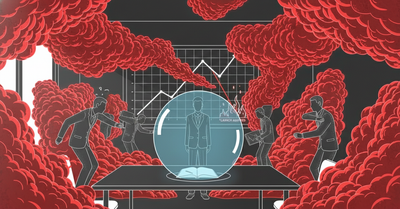
The goal of a modern strategy is not to resist the shock. It is to get stronger because of the shock.
Nassim Nicholas Taleb, in his seminal book Antifragile, coined the term for this property.
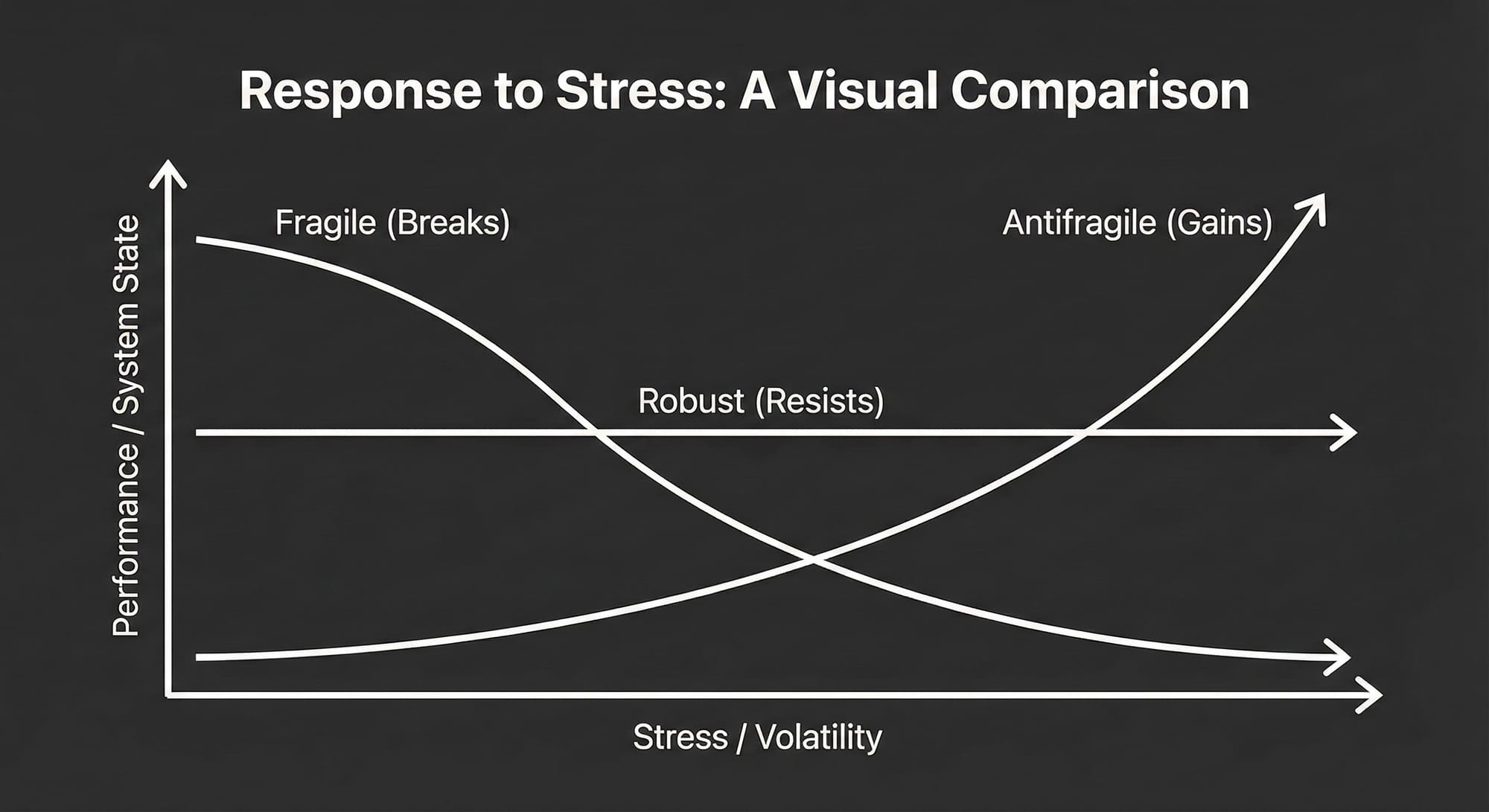
- Fragile things break under stress (e.g., a wine glass).
- Robust things resist stress (e.g., a rock).
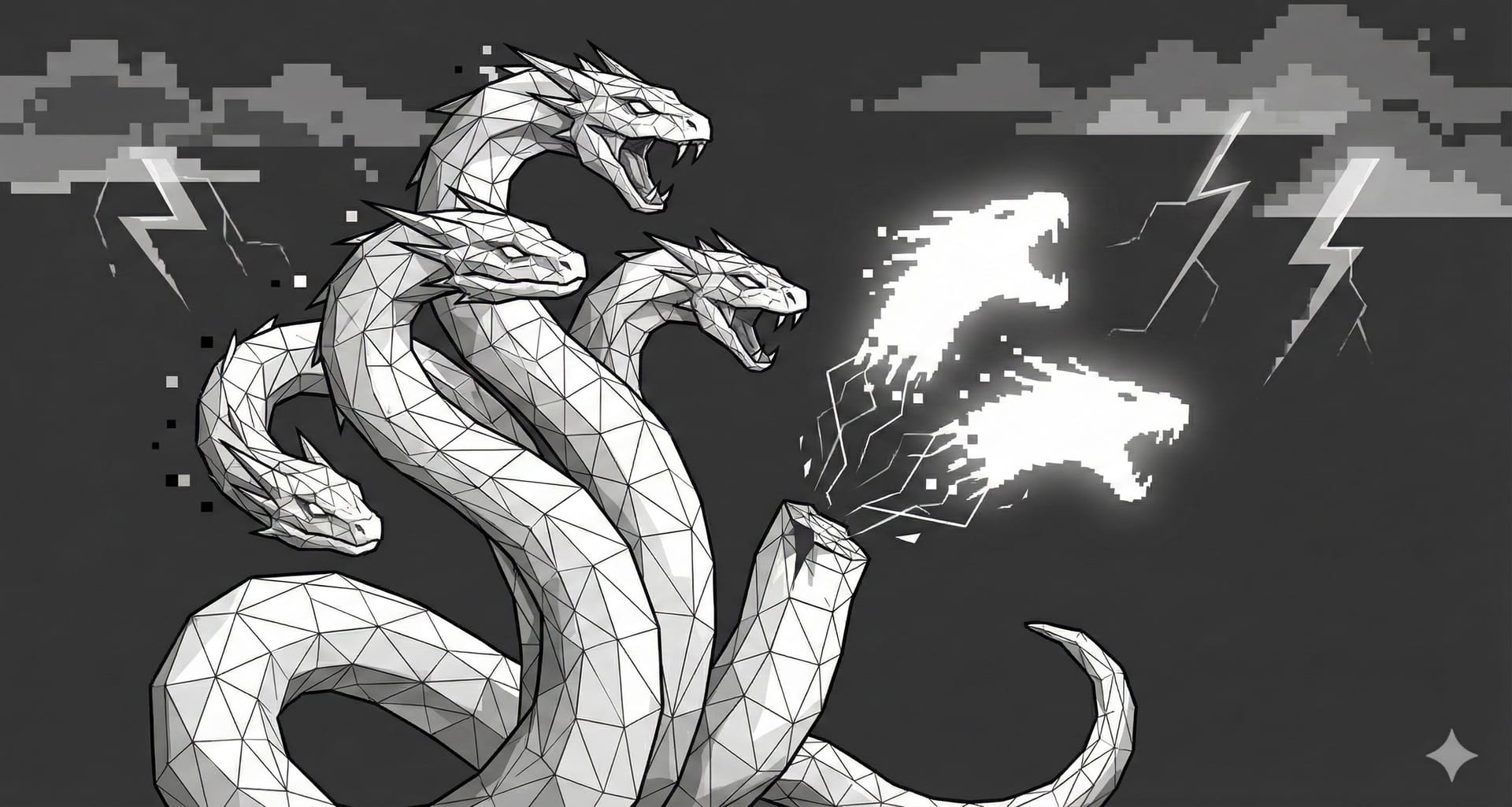
- Antifragile things benefit from stress (e.g., the human immune system, or the Hydra).
If you are just "Resilient," you survive the crisis and return to zero.
If you are "Antifragile," you survive the crisis and own the market.
1. The Triad: Determining Your Strategic Health
Taleb categorizes every system into one of three buckets. Where does your organization sit?
1. The Fragile (The Wine Glass)
These systems love tranquility. They are optimized for efficiency and stability.
- Example: Just-In-Time Supply Chains.
- The Risk: They are highly efficient when everything goes right, but one small error (a ship stuck in the Suez Canal) causes total collapse.
2. The Robust (The Rock)
These systems don't care about tranquility or chaos. They just exist.
- Example: A mainframe server from 1990.
- The Risk: They don't break, but they don't improve. They eventually become obsolete.
3. The Antifragile (The Hydra)
These systems require chaos to survive. If you deprive them of stress, they atrophy.
- Example: The Airline Industry. (When one plane crashes, the investigation reveals a flaw, and every other plane becomes safer. The system learns from the failure of the individual).
The Executive Lesson:
Stop trying to remove all volatility from your company. If you suppress small forest fires (small failures), you are accumulating fuel for a massive inferno later.
2. Engineering Antifragility: The "Chaos Monkey"
How do you build a digital system that likes pain?
You inject the pain yourself.
The most famous example is Netflix.
In 2011, while moving to the cloud, they realized that servers would fail randomly. Instead of trying to prevent failure, they automated it.
They built "Chaos Monkey"—a script that randomly shuts down production servers during business hours.
This sounds insane. Why would a CTO attack their own company?
Because it forced the engineers to design self-healing systems.
- Because the servers were dying every day, the code had to be Antifragile.
- When AWS actually had a massive regional outage, Netflix didn't even blink, while their competitors went dark.
The Strategy:
You don't need to shut down production. But you must introduce Artificial Stressors.
- randomly rotate staff between teams.
- simulate a data breach.
- force a failover to the backup data center when everything is fine.
If you don't break your system on Tuesday morning, reality will break it on Friday night.
3. Strategic Optionality: Small Bets vs. The "Big Bet"
Fragile companies make "Big Bets" based on predictions.
- "We forecast that VR is the future, so we will invest $10B in the Metaverse."
If the prediction is right, they win. If it is wrong (and predictions are usually wrong), they die. This is Fragility.
Antifragile companies use a Barbell Strategy.
- 90% Safe: Boring, cash-flow positive core business (The Rock).
- 10% High Risk: Tiny, aggressive experiments (The Hydra).
If 9 out of 10 experiments fail, you lose a little money (capped downside).
If 1 out of 10 succeeds (like Amazon Web Services did for Amazon), you gain infinite upside.
The Lesson:
Do not bet the company on a 5-year roadmap.
A roadmap implies you know the future. You don't.
Instead, maintain a portfolio of "Options"—small teams exploring different futures.
4. The "Skin in the Game" Filter
A system cannot be Antifragile if the decision-makers are insulated from the consequences.
- In the 2008 Financial Crisis, bankers took risks. If they won, they got bonuses. If they lost, the taxpayer bailed them out.
- The system was Fragile because the feedback loop was broken.
In your company, ensure that the people designing the system are the ones who get woken up when it breaks.
- Bad Pattern: A "DevOps Team" handles the pager, while "Developers" write the code. (Developers have no incentive to write stable code).
- Antifragile Pattern: "You Build It, You Run It." If you ship a bug, your phone rings at 3 AM.
Pain is the only teacher. If you remove the pain of failure, you remove the learning.
Summary
Resilience is a passive virtue. It is the ability to endure suffering.
Antifragility is an active virtue. It is the ability to use suffering as fuel.
The world is becoming more volatile, not less. AI, geopolitical instability, and market shifts are increasing the randomness of the environment.
- The Fragile Leader tries to predict the future and build a wall.
- The Antifragile Leader accepts they cannot predict, so they build a Hydra—a team that gets smarter every time it loses a head.
Stop optimizing for "Smooth Sailing." Build a ship that loves the storm.
No spam, no sharing to third party. Only you and me.

Member discussion