
Amor Fati: Loving the Market Downturn

There is a phrase you hear in every board meeting during a recession: "We just need to weather the storm."
This is the language of Endurance. It implies that the downturn is an error in the system—a temporary deviation from the "normal" up-and-to-the-right chart—and that our goal is simply to survive until the "good times" return.
This mindset is dangerous. It breeds passivity. It creates leaders who hide in bunkers, cutting costs and waiting for a rescue boat that may never come.
The alternative is Amor Fati (Latin for "Love of Fate").
Coined by Friedrich Nietzsche, Amor Fati is not just accepting the crisis; it is enthusiastically embracing it. It is the refusal to wish for things to be different. It is the realization that the crash, the budget cut, and the constraint are not obstacles to the path; they are the path.
Here is why the best leaders don't just endure the downturn—they require it.
1. Beyond Stoicism: Acceptance vs. Affection
We often confuse Amor Fati with Stoicism ("Keep calm and carry on"). But there is a crucial nuance.
- The Stoic says: "I accept that the market has crashed. I will not let it disturb my mind." (Tolerance).
- Nietzsche says: "I am glad the market crashed. It was necessary." (Affection).
In Ecce Homo, Nietzsche writes:
"My formula for greatness in a human being is Amor Fati: that one wants nothing to be different, not forward, not backward, not in all eternity. Not merely bear what is necessary... but love it."
The Executive Application:
If you lose your biggest client, the Stoic leader suppresses their anger and moves on. The Amor Fati leader looks at the loss and asks: "How is this the best thing that happened to us?"
- Maybe that client was forcing us to build custom features that ruined our roadmap.
- Now they are gone, we are free to pivot to the product we should have built.
2. Antifragility: The Forest Fire
Nassim Taleb, a modern philosopher of risk, gave us the financial equivalent of Amor Fati: Antifragility.
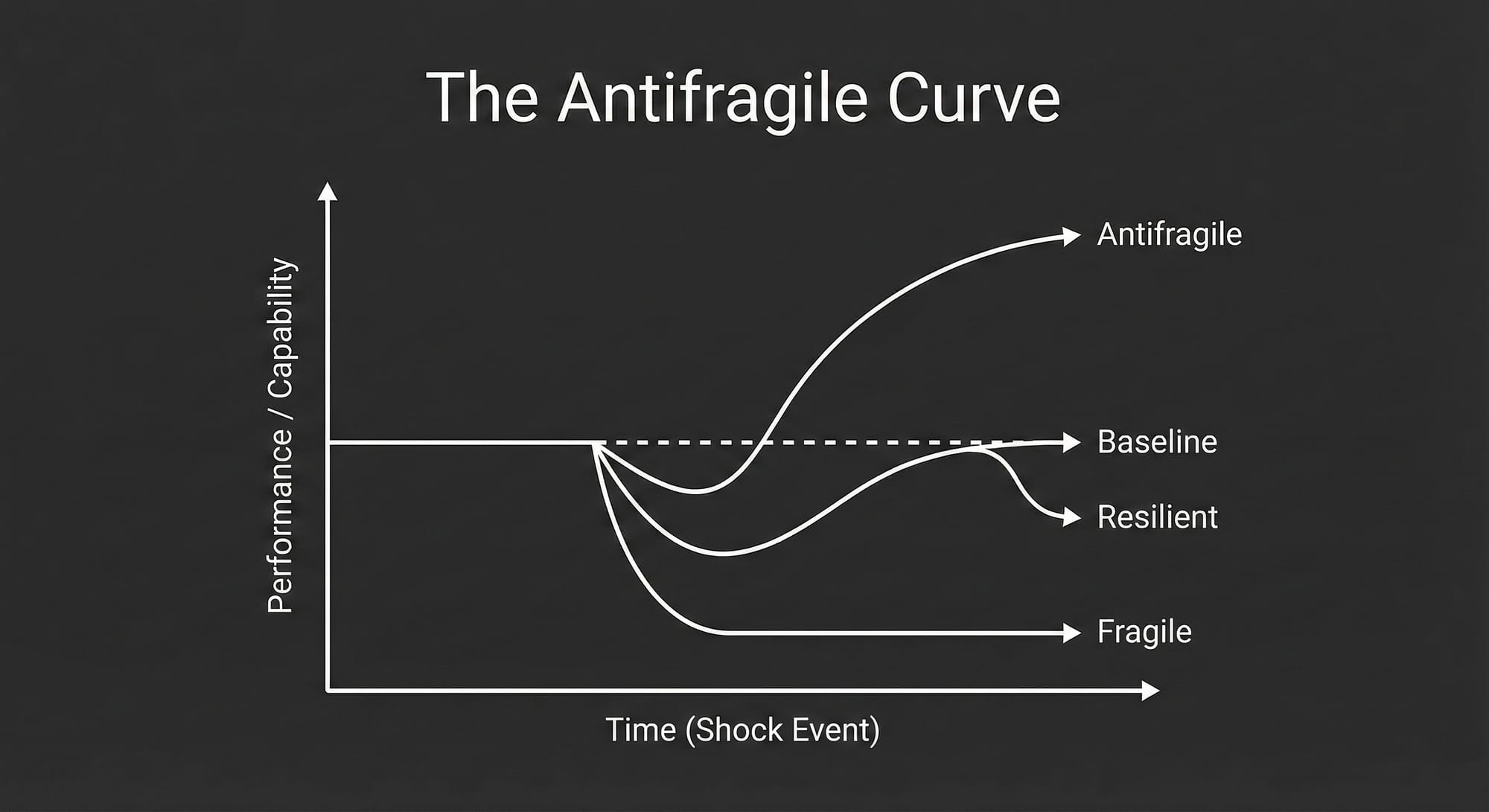
- Fragile things break under stress (A teacup).
- Resilient things resist stress (A rock).
- Antifragile things gain from stress (A muscle).
Economic downturns are forest fires. They are destructive, yes. But they burn away the dead wood—the "Zombie Companies" living on cheap VC money, the bloated middle management, the features nobody uses.
The "Cleansing" Opportunity:
In a bull market, it is politically impossible to kill a legacy product or restructure a team. Everyone is "busy" and revenue is growing.
In a downturn, the fire gives you cover. You can finally make the hard decisions that you knew were right 18 months ago.
The downturn provides the mandate for efficiency that the bull market denied you.
3. The Pivot Point: Constraints as Fuel
When money is free (Zero Interest Rate Policy), engineering teams get lazy. They solve problems by throwing hardware and headcount at them.
When the budget is cut by 40%, they are forced to think.
The History of Constraints:
- Uber and Airbnb were born in the 2008 financial crisis.
- Google survived the Dotcom bubble burst by forced focus on monetization (AdWords).
Constraints force innovation. If you have infinite runway, you spend years building a "Perfect Platform." If you have 6 months of runway, you build the feature that actually sells.
Amor Fati means loving the budget cut because it forces you to find the "Product-Market Fit" you were ignoring.
4. Leading Through the "Eternal Recurrence"
Nietzsche proposed a thought experiment called the Eternal Recurrence:
"What if a demon were to creep after you... and say to you: 'This life as you now live it and have lived it, you will have to live once more and innumerable times more'?"
Would you curse the demon? Or would you welcome the moment?
The Leadership Test:
When you announce layoffs or a pivot, your team looks at your face.
If you look like a victim—apologetic, defeated, waiting for the storm to pass—they will despair.
If you look like you choose this reality—that this challenge is exactly the arena you wanted to play in—they will rally.
Do not apologize for the market conditions. Do not say "We just need to survive until Q4."
Say: "The easy money is gone. The tourists are leaving the industry. Now we can finally do the real work."
Summary
The market does not care about your roadmap. The market is a force of nature.
To wish for a different market is to argue with reality, and as Byron Katie says: "When you argue with reality, you lose, but only 100% of the time."
Stop waiting for the up-turn.
Love the down-turn.
It is the fire that burns away the non-essential. It is the only way to find out what your company is actually made of.
No spam, no sharing to third party. Only you and me.



Member discussion