
Amor Dei: Why You Should Love the Algorithm (And the Crash)
Note: In business, we waste immense energy fighting reality. We rage against the market, the algorithm, or the "unfair" economy. Baruch Spinoza, the rigorous rationalist of the 17th century, argues that this anger is not just useless—it is a sign of ignorance. His solution, found in the final pages of his Ethics, is "Amor Dei Intellectualis" (The Intellectual Love of God). It is not a religious sentiment, but a ruthless cognitive strategy for converting chaos into clarity.
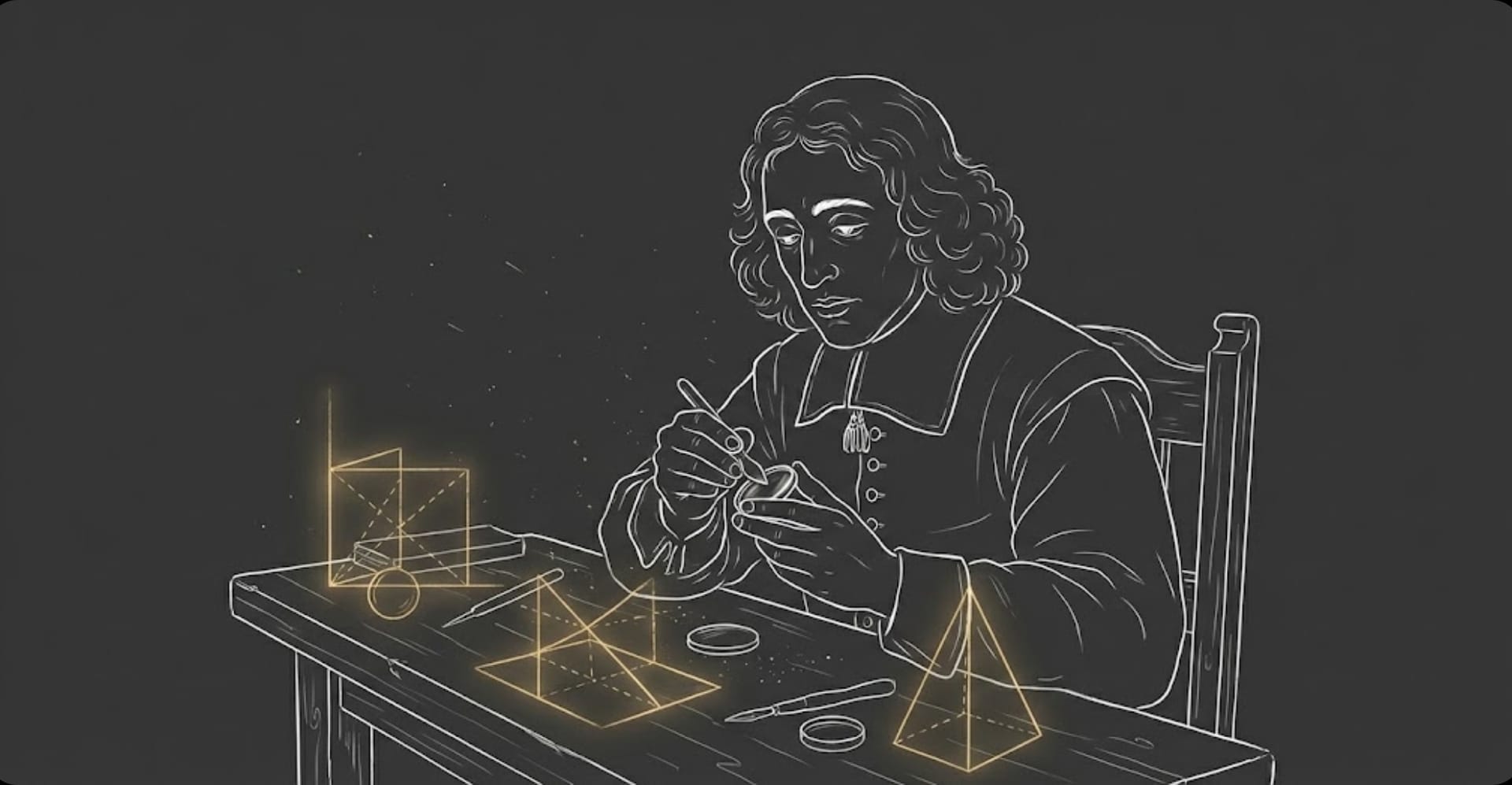
Imagine a man sitting in a small, dust-filled room in The Hague in the 1670s. He is coughing; the silica dust from grinding lenses for microscopes and telescopes is slowly destroying his lungs. He has been excommunicated (herem) by his community. He has refused prestigious university chairs to maintain his independence. He is not "happy" in the modern sense. He is not chasing dopamine. He is in a state of Beatitudo (Blessedness), a deep, unshakeable serenity that comes from understanding exactly how the universe works.
This was Baruch Spinoza. While Nietzsche climbed mountains to scream his "Yes," Spinoza sat in quietude, polishing glass, helping humanity see the stars and the microbes, while he mapped the geometry of human emotion.
The Philosophy: The Third Kind of Knowledge
In his masterpiece The Ethics (Ethica, Ordine Geometrico Demonstrata), Spinoza argues that there are three ways to perceive the world. Most business leaders are stuck in the first two.
- Imagination (Experientia Vaga): You see things based on how they affect you. (e.g., "The stock market crash is a disaster because I lost money.") This leads to fear and anger.
- Reason (Ratio): You see things based on general laws. (e.g., "Markets cycle down due to liquidity contractions.") This leads to calm understanding.
- Intuition (Scientia Intuitiva): You see the specific event as a necessary part of the infinite whole. You see that this crash had to happen, exactly this way, due to the eternal chain of cause and effect.
It is from this third level that we reach Amor Dei Intellectualis (The Intellectual Love of God). Reference: Ethics, Part V, Proposition 32 & 33.
The Equation: Deus sive Natura
Spinoza’s God is not a judge in the clouds. Deus sive Natura ("God or Nature"). God is the system. God is the laws of physics, the logic of mathematics, and the causal chain of the economy. Therefore, everything that happens is "necessary." There are no mistakes in the universe.
- To get angry at a competitor is to get angry at a rock for falling.
- To hate a market trend is to hate gravity.
The Corporate Application: From Tantrum to Strategy
1. Escaping "The Sad Passions"
Spinoza defines "Sadness" (Tristitia) as "a passage from a greater to a lesser perfection." When you rage against a re-org or a budget cut, you are experiencing a "Sad Passion." You are passive. You are letting an external cause reduce your power to act. The Spinozist Leader refuses to be passive. Instead of asking "Why is this happening to me?" (Imagination), they ask "What is the causal chain that made this inevitable?" (Reason). The moment you clearly understand the cause of an emotion, it ceases to be a passion. The anger evaporates, replaced by the clarity of the mechanism.
2. Radical Acceptance (Not Resignation)
There is a difference between "Giving Up" and "Amor Dei."
- Resignation: "The project failed, I guess I suck." (Depressing).
- Amor Dei: "The project failed because the timeline was physically impossible given the resources (Variable A) and the technical debt (Variable B). The outcome was mathematically certain on Day 1."
This perspective is liberating. It removes the "Moral Weight" from failure. If the lens you ground has a flaw, you don't call it "evil." You realize your hand slipped or the glass was impure. You correct the variable. You do not weep over the glass.
3. Sub Specie Aeternitatis (The View from Eternity)
Spinoza advises us to view our lives Sub Specie Aeternitatis, "Under the aspect of eternity." In the heat of Q4, missing a target feels like the end of the world. Spinoza asks you to zoom out. Look at your company through the lens of a telescope (history) or a microscope (systems).
- In the scale of the economy, this fluctuation is noise.
- In the scale of your career, this failure is a data point.
The Chief Wise Officer's View
Spinoza’s Beatitudo is the ultimate executive skill. It is the ability to walk into a boardroom where everyone is panicking, and remain perfectly still. Not because you don't care, but because you see the Geometry of the situation. You see that the panic is a result of Variable X. You see that the solution is Variable Y. You love the problem, not because it is "good," but because it is true.
As Spinoza wrote in the preface to Part III of The Ethics:
"I shall consider human actions and desires in exactly the same manner, as though I were concerned with lines, planes, and solids."
No spam, no sharing to third party. Only you and me.


Member discussion