Ada Lovelace: Poetical Science (The Art of the Polymath)
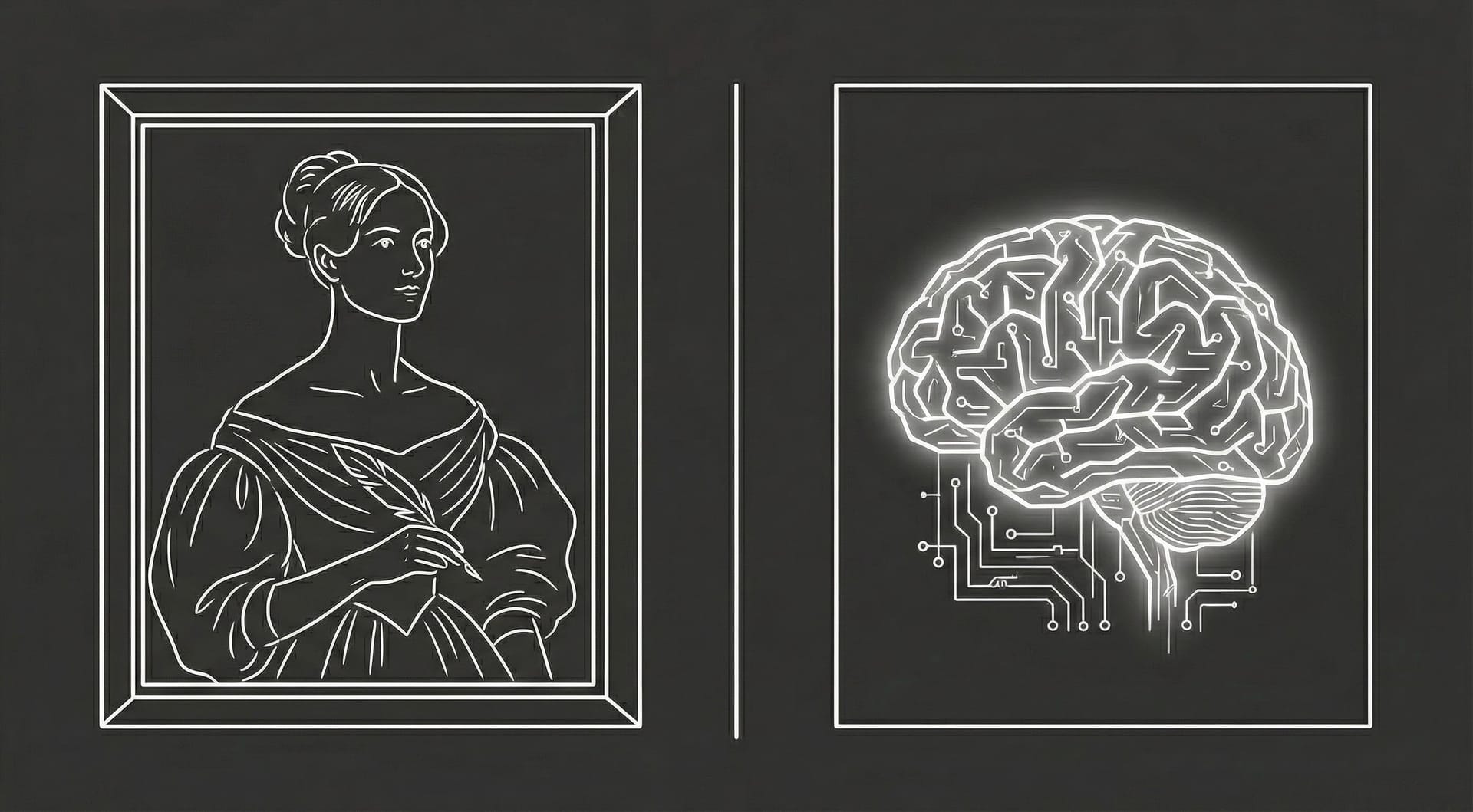
In the modern tech industry, we have created a false dichotomy. We split the world into two tribes:
- The "Creatives" (Designers, Marketers, Visionaries) who deal with emotion and aesthetics.
- The "Techs" (Engineers, Data Scientists) who deal with logic and syntax.
We put them in different departments. We manage them differently. We assume they speak different languages.
But the very first person to ever write a computer program did not see this division. In fact, she believed that you could not be a great scientist without also being a poet.
Ada Lovelace (1815–1852) is often celebrated as the "First Programmer." But her contribution wasn't just writing code; it was defining the Soul of Software. She foresaw the digital revolution 100 years before the first transistor was built, precisely because she refused to choose between Art and Science.
She called her method "Poetical Science."
For the Chief Wise Officer, this is the ultimate leadership model: the ability to bridge the gap between the rigorous and the beautiful.
1. The Clash of Blood: Byron vs. The Princess of Parallelograms
Ada was born into a war between two extreme personalities.
- Her Father: Lord Byron, the famous Romantic poet. He was chaotic, emotional, brilliant, and dangerous.
- Her Mother: Lady Byron, a strict mathematician. She was terrified that Ada would inherit her father’s "poetic madness," so she raised Ada on a strict diet of logic, calculus, and science to suppress her imagination.
It didn't work. You cannot suppress nature; you can only synthesize it.
Ada didn't reject her father's poetry; she applied it to mathematics. She realized that Math is the language of nature's imagination.
While her mother saw math as a tool for discipline, Ada saw it as a tool for exploration. She wrote:
"Imagination is the Discovering Faculty, pre-eminently... it penetrates into the unseen worlds around us, the worlds of Science."
The Executive Lesson:
Do not hire "Just Engineers" or "Just Creatives." The greatest innovations come from the tension between the two.
- Steve Jobs lived at this intersection (Calligraphy + Circuitry).
- Leonardo da Vinci lived at this intersection (Anatomy + Art).If your engineering team has no "poetic" sense, they will build brutal, unusable software. If your design team has no "scientific" sense, they will build beautiful hallucinations.
2. The Analytical Engine: Seeing What Babbage Missed
In 1833, Ada met Charles Babbage. He was designing the "Analytical Engine"—a massive, theoretical mechanical calculator.
Babbage saw his machine as a super-calculator. He thought it would be used to print logarithmic tables for navigation. He was focused on Number Crunching.
Ada saw something else. She saw Symbolic Logic.
In her famous "Notes" on the engine (which were three times longer than Babbage’s original paper), she made a conceptual leap that is the foundation of the modern world:
"[The Engine] might act upon other things besides number, were objects found whose mutual fundamental relations could be expressed by those of the abstract science of operations..."
She realized that if a machine could manipulate numbers, it could manipulate anything that could be represented by numbers: Music, Letters, Images.
"The engine might compose elaborate and scientific pieces of music of any degree of complexity or extent."
Babbage built the hardware (the body). Ada provided the software (the soul).
She was able to see this future not because she was better at math than Babbage, but because her "Poetical Science" allowed her to imagine a context beyond the immediate utility.
3. The First Algorithm (And the First Bug)
Ada didn't just philosophize; she executed.
Note G of her translation contains the first algorithm intended to be processed by a machine: a method for calculating Bernoulli numbers.
It includes loops, conditional branching, and variables. It is code.
Tragically, the machine was never built in her lifetime. She died at 36 (the same age as her father), thinking she had failed to leave a legacy.
But her legacy is not the code itself; it is the Epistemology of Code. She taught us that software is a medium for human expression, not just calculation.
4. The Artifact: The Polymath Hiring Matrix
How do you find "Adas" in a market of specialists?
Most hiring processes filter for deep specialization (e.g., "Must have 10 years of Java"). This filters out the polymaths.
Use this matrix to interview for roles that require high-level architecture, product vision, or leadership.
🛠️ Tool: The Polymath Hiring Matrix
Goal: Assess if a candidate can bridge the gap between "System" (Logic) and "Sentiment" (User/Beauty).
| Dimension | The Question to Ask | What You Are Looking For (The Signal) |
| 1. Metaphorical Thinking | "Explain a complex technical concept (like Recursion or Blockchain) using a metaphor from nature or art." | Signal: Can they map abstract logic to the physical world? (e.g., "Blockchain is like a village ledger that everyone watches.") |
| 2. Second-Order Effects | "If we optimize this algorithm for maximum speed, what is the cultural or user impact that might break?" | Signal: Do they see beyond the immediate metric? (Poetical Science considers the whole system, not just the variable.) |
| 3. The "Beauty" Test | "Tell me about a piece of code or a system you've seen that you found beautiful. Why?" | Signal: Passion for structure. Great engineers hate "ugly" code. If they don't care about aesthetics, they will create tech debt. |
| 4. Historical Context | "What technology from the last 50 years do you think we will regret inventing? Why?" | Signal: Philosophical depth. Can they critique their own industry? |
Summary
We are entering the age of AI, where "generating code" is becoming a commodity. The value of a pure syntax-writer is dropping.
But the value of an Ada Lovelace—someone who can ask the right questions, who can see the musicality in the data, and who understands the human intent behind the machine—is skyrocketing.
Your organization needs specialists, yes. But at the top, you need generalists.
You need leaders who are not afraid to be poets in the server room.
"Those who have learned to walk on the threshold of the unknown worlds, by means of what are commonly termed par excellence the exact sciences, may then... look down on this world of ours." — Ada Lovelace
Further Reading
- "Ada's Algorithm" by James Essinger. (A focus on how her mind worked).
- "The Innovators" by Walter Isaacson. (Chapter 1 covers Ada as the mother of the digital age).
- "Sketch of the Analytical Engine" - Ada’s original notes (The birth certificate of software).
No spam, no sharing to third party. Only you and me.
Member discussion