
The 3-Horizon Tech Roadmap: Turning Feature Lists into Strategy

Most Series B startups do not have a Technology Strategy. They have a Backlog.
There is a profound difference.
- A Backlog is a list of things you want to do (Features).
- A Strategy is a plan for how your technology will create a competitive advantage over time.
When a professional CIO enters a growing organization, their first job isn't to hire more engineers or rewrite the code. Their first job is to kill the "Feature Treadmill" and replace it with a 3-Horizon Roadmap.
This is the exact methodology used to transform a reactive engineering team into a strategic asset.
1. The Diagnosis: Audit Before Action
Before drawing a map, you must know where you are.
A roadmap built without an audit is just a wish list.
The first 30 days are purely diagnostic. We audit three layers:
- The Code: Is it scalable? (See the "Tech Due Diligence" checklist).
- The Process: How long does it take to ship "Hello World" to production? (Cycle Time).
- The Money: Where is the cloud budget going? (Unit Economics).
Once the "Current State" is defined, we map the path to the "Future State" using the Three Horizons Model, adapted from McKinsey.
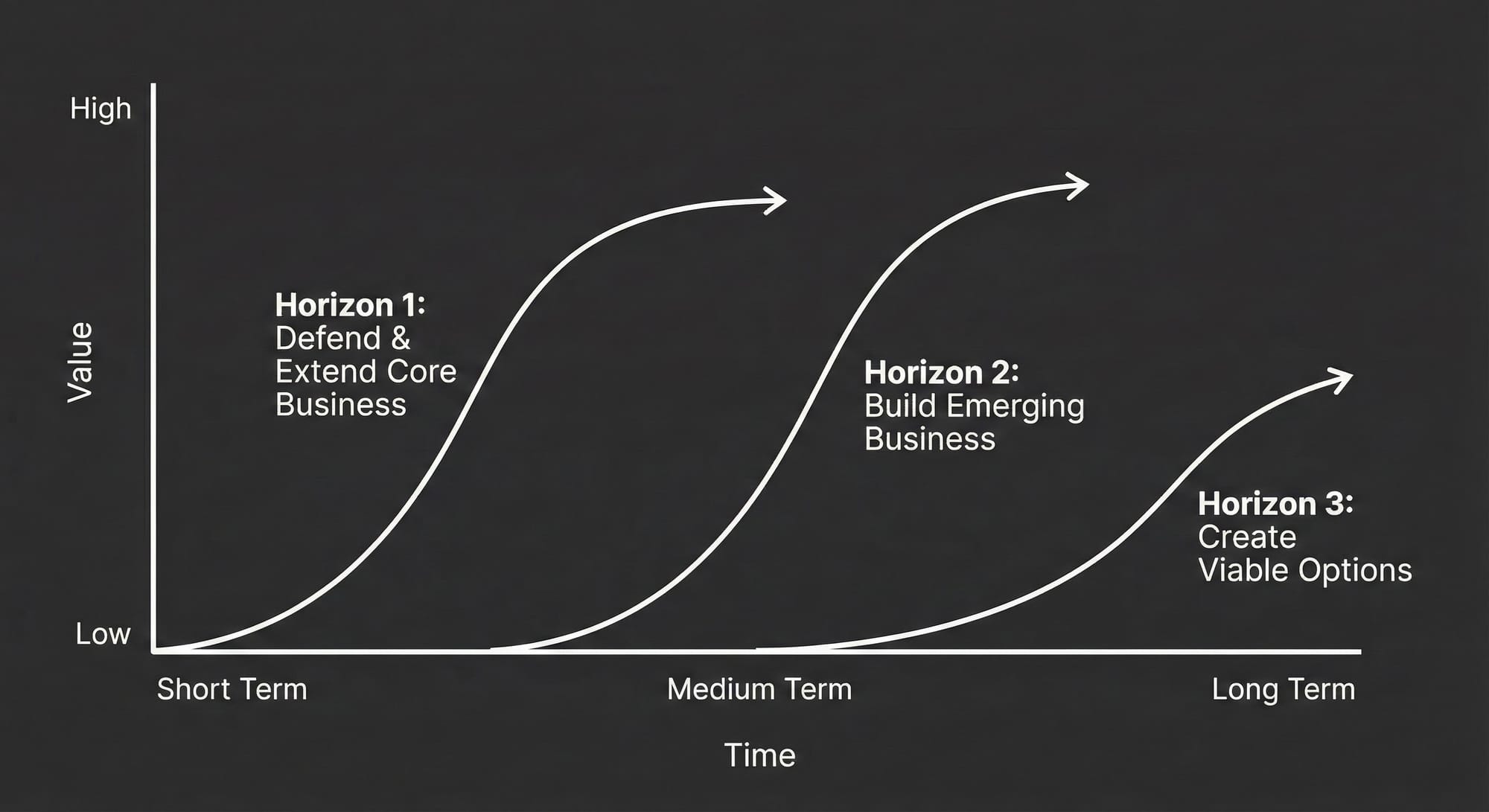
Horizon 1: Stabilization
Theme: "Stop the Bleeding."
In a chaotic scale-up, the house is usually on fire. The goal here is Operational Resilience, not innovation. If the platform is unstable, you cannot build new features anyway.
Typical Objectives:
- Kill the Debt: Identify the top 3 sources of customer support tickets and fix the root cause.
- Reduce Risk: Implement the "Golden Path" for deployments (see our previous article).
- Cost Control: Audit unused SaaS seats and optimize AWS reserved instances.
The Deliverable to the Board: "We are reducing the crash rate by 50% and cutting cloud spend by 20% to fund future growth."
Horizon 2: Scalability
Theme: "Build the Factory."
Once the fires are out, we shift focus to Velocity. We need to build the machinery that allows us to hire 20 engineers without slowing down.
Whether you have a Monolith, Microservices, or Serverless, the goal here is to remove Architectural Bottlenecks.
Typical Objectives:
- Fix the Boundaries: Identify the parts of the system that are tightly coupled and separate them. (e.g., If the "Billing" code crashes the "Login" page, separate them).
- Data Maturity: Move from "Production Database Replicas" to a structured Data Warehouse (Snowflake/BigQuery) so the CEO has a real-time dashboard without slowing down the app.
- Compliance: Achieve ISO 27001 readiness to unlock Enterprise sales.
The Deliverable to the Board: "We are reducing the 'Time to Market' for new features from 4 weeks to 1 week."
Horizon 3: Innovation
Theme: "Compound AI Systems."
This is where we build the Moat.
Important: We do not build models. We are not OpenAI. We build systems that use commodity models (GPT-n, Claude, Llama) but inject them with our proprietary data.
Typical Objectives:
- Contextual AI (RAG): Integrate a Vector Database to allow LLMs to "read" our specific customer data safely. The Moat is the Data, not the Model.
- New Markets: Re-architecting the system to support Multi-Region (e.g., launching in Europe with GDPR compliance).
- Platformization: Turning the internal API into a public product for partners.
The Deliverable to the Board: "We are building a proprietary data layer that makes our product smarter the more the customer uses it."
3. The "70-20-10" Resource Allocation Rule
A roadmap is useless without a budget.
The most common failure mode is seeing a "Horizon 3" goal (AI) but allocating 100% of the engineers to "Horizon 1" bugs.
To execute this roadmap, you must enforce strict resource allocation buckets:
- 70% of Capacity → Horizon 1: Keeping the lights on, fixing bugs, incremental features.
- 20% of Capacity → Horizon 2: Re-platforming, paying down debt, improving developer experience.
- 10% of Capacity → Horizon 3: Moonshots, R&D, Experiments.
The Executive Discipline:
When Sales asks for "Just one more feature," you must defend the 20% and 10% buckets. If you steal from Horizon 2 to feed Horizon 1, you are mortgaging the future.
Summary
A strategic roadmap is not a list of features. It is a Risk Management Document.
- Horizon 1 manages the risk of Churn (Stability).
- Horizon 2 manages the risk of Velocity (Scalability).
- Horizon 3 manages the risk of Obsolescence (Innovation).
The job of a technology leader is to ensure the company is investing in all three simultaneously.
No spam, no sharing to third party. Only you and me.



Member discussion